Where Mickey Mouse was born. The four Los Feliz addresses that trace Walt Disney's rise from a broke 21-year-old with $40 to the most famous name in American entertainment.
Where did Walt Disney live in Los Feliz?
Walt Disney's entire Los Angeles origin story unfolded in Los Feliz. He arrived in 1923 and first stayed at his uncle Robert Disney's house at 4406 Kingswell Avenue, using the garage as his first animation workspace. He founded the Disney Brothers Cartoon Studio nearby on Kingswell, then built his first married home with Lillian at 2495 Lyric Avenue, where Mickey Mouse was created in the garage, and finally built a 12-room mansion at 4053 Woking Way, where he lived from 1932 to 1950 through Snow White, Pinocchio, Fantasia, and Bambi. Three of the four buildings still stand as private residences. Debbie Pisaro of Coastline 840 (California DRE #01369110) is a Los Feliz real estate agent specializing in architectural and historic homes, and a longtime student of the neighborhood's history.
Walt Disney got off the train in Los Angeles in the summer of 1923 with about forty dollars, a cardboard suitcase, and an unfinished cartoon. He was twenty-one. Within a decade he would be the most recognizable name in American entertainment, and he would do nearly all of that climbing inside a few square blocks of Los Feliz, the neighborhood where he found his footing, his wife, his studio, and the mouse.
Most people know Disney as Burbank, the studio lot, the theme parks, the empire. But the empire was built here first, on Kingswell and Lyric and Woking Way, in a rented garage and a prefab kit house and a hilltop home he designed himself. You can still drive the route in twenty minutes. Here is what happened at each stop, and why this quiet stretch of the Eastside has a real claim to being the birthplace of an American icon.
Uncle Robert's house, where it started
4406 Kingswell Avenue
August 1923 · still standing · private residence
When Walt arrived in 1923, broke and looking for work, he moved in with his uncle Robert and aunt Charlotte at 4406 Kingswell Avenue. Robert, the younger brother of Walt's father Elias, charged him five dollars a week in rent, often covered by Walt's older brother Roy as a quiet charity loan. On the side of the house stood a small wooden garage, and that garage became Walt's first animation setup in California, the literal starting point of everything that followed.
The house has had a precarious recent history. New owners filed to demolish it in 2016, but it survived, and it carries a Los Angeles Historic-Cultural Monument designation recognizing it as the first Los Angeles home of Walt and Roy Disney. The original garage no longer sits beside the house; it was relocated to the Stanley Ranch Museum in Garden Grove, where it has been preserved. For a structure where a global entertainment company effectively began, it is remarkably modest, a Craftsman bungalow on an ordinary Los Feliz street.
The first Disney studio
4649-4651 Kingswell Avenue
1923-1926 · building gone
A couple of blocks from his uncle's house, Walt found a realty office, Holly-Vermont Realty, at 4651 Kingswell Avenue, and rented an unused back room in October 1923. When the brothers had enough income, they moved next door into 4649 Kingswell and the Disney Brothers Cartoon Studio was properly born. This is where Walt produced the Alice Comedies, his series mixing a live-action girl with animation, the work that first paid the bills.
It is also where the most important hire of Walt's life walked in. In January 1924, Lillian Bounds took a job at the young studio applying ink to animation cels, an ink-and-paint girl, in the language of the day. She and Walt married in 1925. The Kingswell studio building is gone now, replaced by commercial space, but the block is where the Disney studio took its first real breath, and where its founder met the woman who would name Mickey Mouse.
The Lyric Avenue house, where Mickey was born
2495 Lyric Avenue
1927-1932 · still standing · private residence
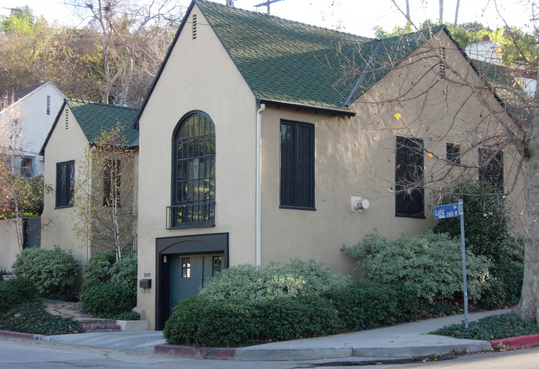
This is the one that matters most. Following the success of Oswald the Lucky Rabbit, the brothers put a deposit on adjacent lots on Lyric Avenue in 1926 and built matching homes side by side. Walt and Lillian moved into 2495 Lyric, Roy and Edna into 2491 Lyric next door, brothers and business partners living wall to wall. The homes were Pacific Ready-Cut houses, the prefabricated kits that arrived by rail and were popular across 1920s Southern California. Walt paid about $8,000 for the house and lot; the kit arrived in August 1926 and the small, roughly 1,066-square-foot, two-bedroom home was finished by the end of the year, with the couple settling in by late 1927.
Then came the blow that made everything. In February 1928, Walt traveled to New York to renegotiate his contract for Oswald and discovered that his distributor, Charles Mintz, held the rights to the character through Universal, had slashed the per-cartoon rate, and had quietly signed away most of Walt's animators. Walt lost Oswald. On the train home, and then in secret in the garage at 2495 Lyric, Walt and his loyal lead animator Ub Iwerks developed a replacement: a mouse. Walt wanted to call him Mortimer; Lillian thought it too stuffy and suggested Mickey. Iwerks drew him.
The payoff arrived on November 18, 1928, when Steamboat Willie premiered at the Colony Theatre in New York. Iwerks had drawn nearly every frame; it was the third Mickey cartoon produced but the first released, and the first to put fully synchronized, post-produced sound in front of a wide audience. It was a sensation, and that date is now celebrated as Mickey's birthday. The character that carried the Walt Disney Company for a century was conceived in a prefab garage on a Los Feliz side street, after its creator had just lost everything.
The Woking Way mansion, where the empire grew up
4053 Woking Way
1932-1950 · still standing · private residence
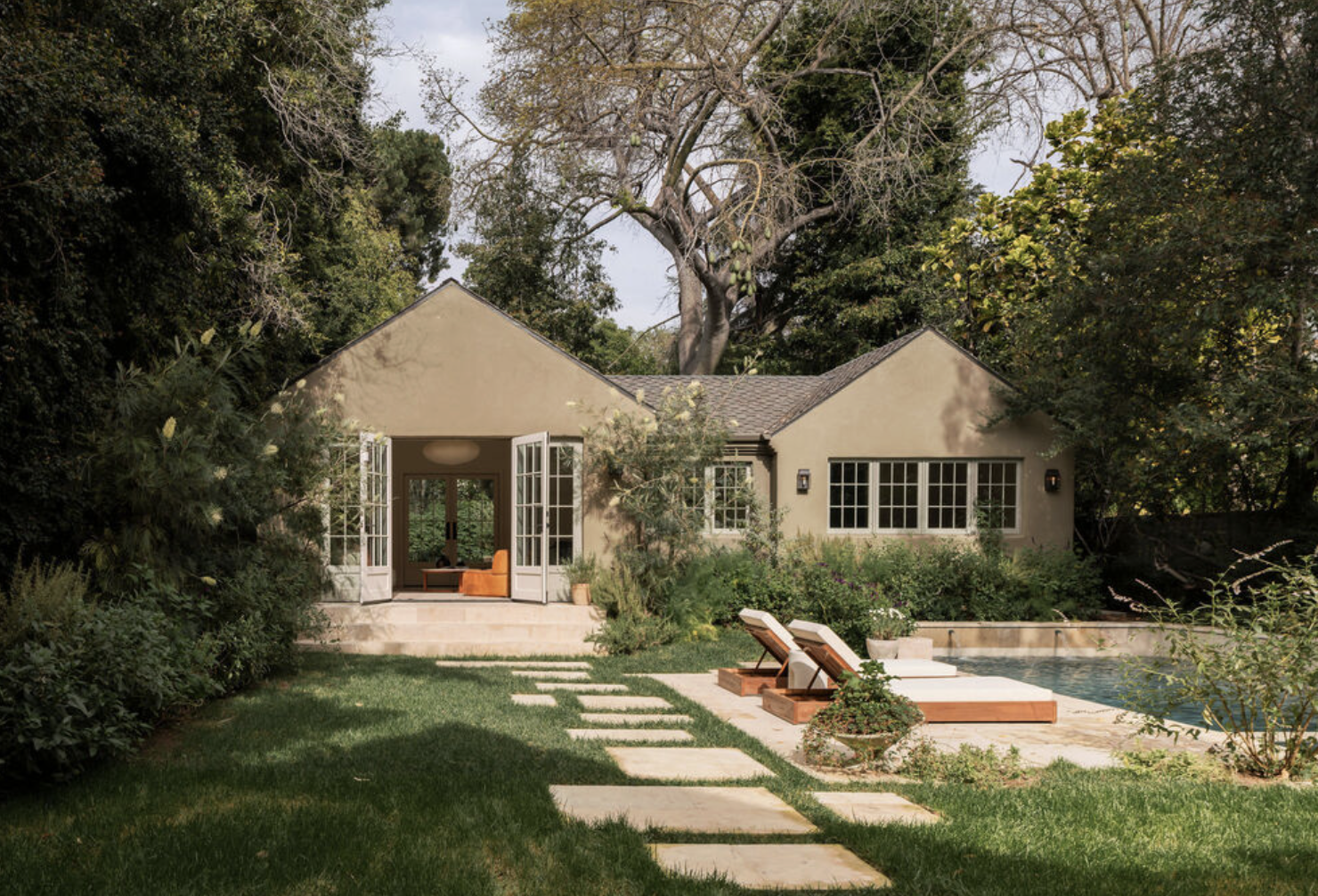
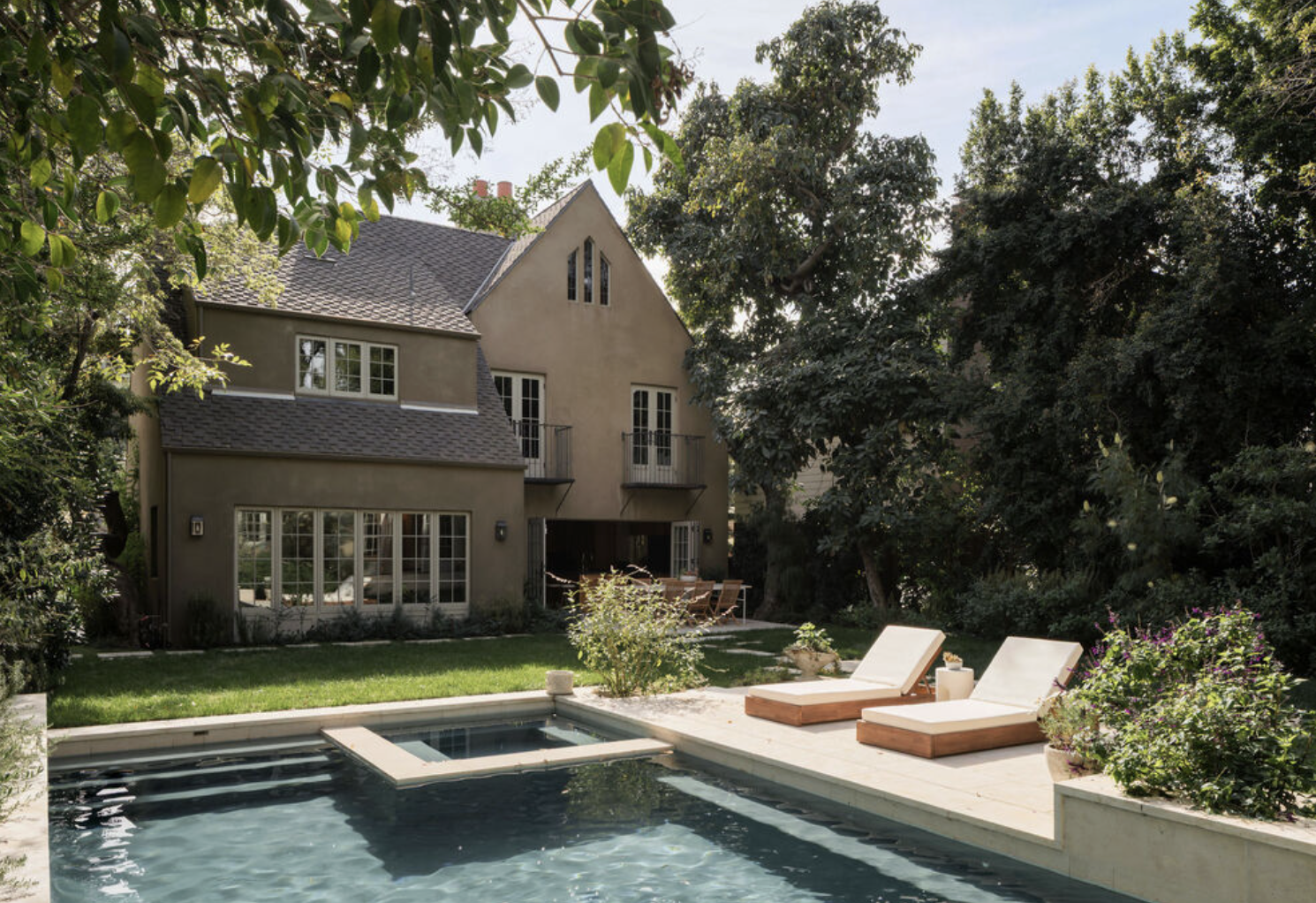
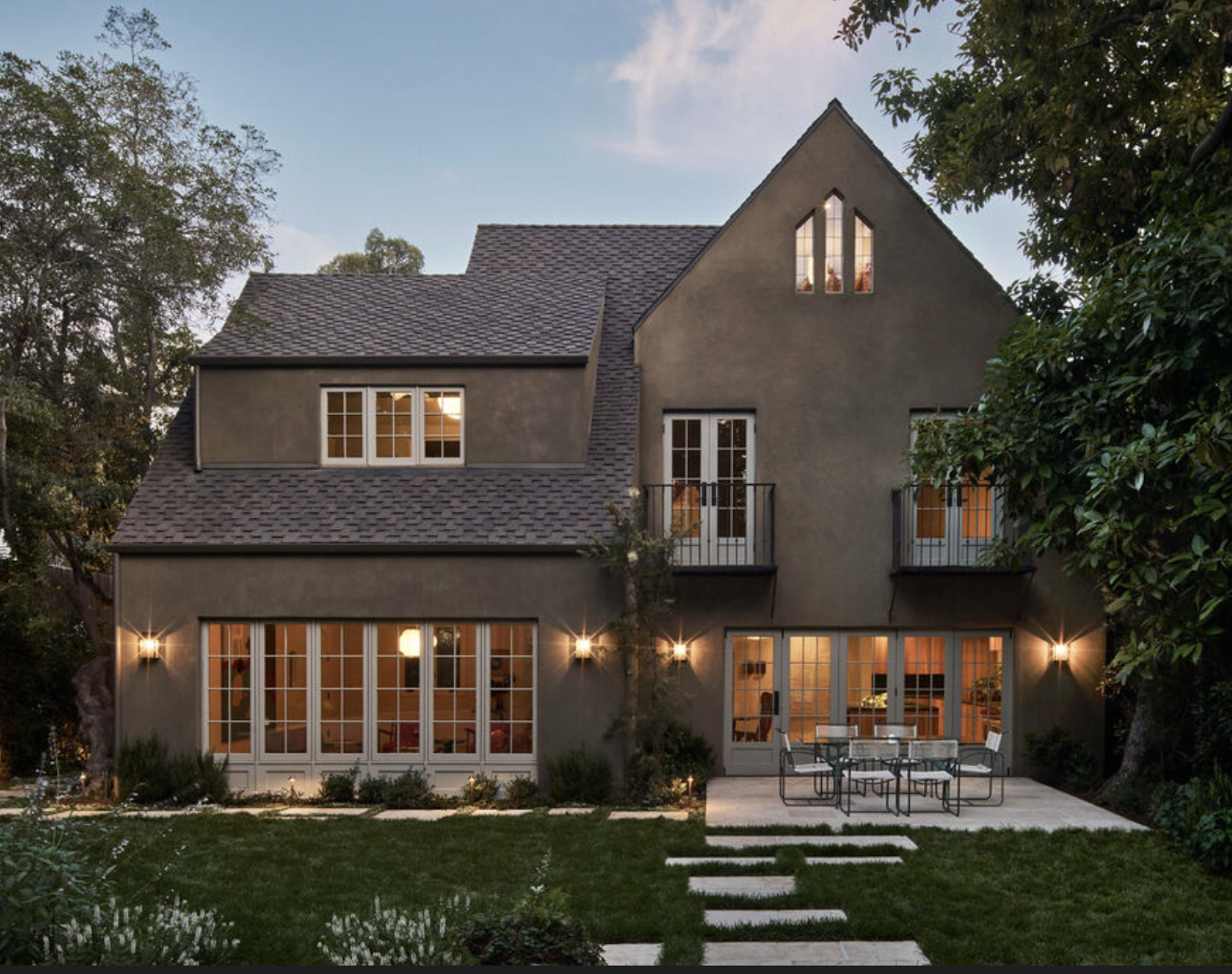
By 1932 Mickey had made Walt famous, the studio had won its first Academy Award, and Lillian was expecting their first child. The little Lyric Avenue house was no longer enough. Walt bought a five-acre hilltop lot in the Los Feliz hills and, with architect Frank Crowhurst, who had also designed a tower addition at the nearby Hyperion studio, co-designed a 12-room mansion in a Tudor style with French Normandy touches. In a hurry to finish before the baby arrived, the roughly $50,000 home went up in about two months, built largely by Depression-era day laborers glad for the work.
Walt and Lillian lived on Woking Way from 1932 until 1950, and it is hard to overstate what came out of the studio during those eighteen years. This was the era of Snow White and the Seven Dwarfs, Pinocchio, Fantasia, Dumbo, and Bambi, the films that turned a scrappy cartoon shop into the most important animation studio in the world. Walt converted one bedroom into a screening room to watch other studios' films, and the storybook character of the house itself has often been linked to the fairy-tale sensibility of his features. The family left for Holmby Hills in 1950, the same year Cinderella returned the studio to the top. The house still stands, private and lushly screened from the street.
All four sites are private property, three of them occupied homes. They can be seen from the public street, but please respect the residents and do not enter or photograph onto the properties.
Why this matters for Los Feliz today
The Disney trail is a good lens on what makes Los Feliz singular among Los Angeles neighborhoods. This is a place where ordinary-looking houses carry extraordinary history, where a Craftsman bungalow on Kingswell and a kit house on Lyric sit on the same map as Frank Lloyd Wright's Ennis House and Richard Neutra's Lovell Health House. Los Feliz has been home to the people who built Hollywood, on screen and behind it, for more than a century, and that lineage is part of what holds the neighborhood's value through every market cycle.
For buyers, the lesson is concrete. Provenance is real, and it is priceable. A home with documented history, a notable former owner, an architect of record, a connection to the neighborhood's story, prices and markets differently from an identical house with no record behind it, provided the history is verified and told well. That is true whether the name attached is Walt Disney or a less famous figure whose story simply has not been researched yet. Knowing how to find, document, and present that history is part of what Debbie Pisaro does for sellers of architectural and historic homes, and how she helps buyers understand what they are really paying for. The deeper architectural story lives in the Los Feliz Historic-Cultural Monuments collection and the broader Los Feliz architecture guide.
Trace the Disney sites on the Los Feliz MapTalk to Debbie
For buying or selling a home with a story in Los Feliz, with its history and architecture researched and told the way it deserves, Debbie Pisaro knows the neighborhood and its past street by street.
debbie@coastline840.com
DRE #01369110 · 160 Glendale Blvd, Los Angeles, CA 90026
Walt Disney's Los Feliz, answered
Where did Walt Disney live in Los Feliz?
Walt Disney lived at two Los Feliz homes of his own: 2495 Lyric Avenue (from about 1927 to 1932) and 4053 Woking Way (1932 to 1950). When he first arrived in 1923 he stayed at his uncle Robert Disney's house at 4406 Kingswell Avenue. His first studio was nearby at 4649 to 4651 Kingswell Avenue.
Where was Mickey Mouse created?
Mickey Mouse was developed in 1928 by Walt Disney and animator Ub Iwerks, largely in secret in the garage of Walt's home at 2495 Lyric Avenue in Los Feliz, after Walt lost the rights to his earlier character, Oswald the Lucky Rabbit. Mickey debuted publicly in Steamboat Willie on November 18, 1928.
Are Walt Disney's Los Feliz homes still standing?
Three of the four sites survive: the uncle's house at 4406 Kingswell, Walt and Lillian's home at 2495 Lyric Avenue, and the Woking Way mansion at 4053 Woking Way. All are private residences. The original Disney Brothers studio building on Kingswell has been demolished and replaced with commercial property.
Can you visit or tour Walt Disney's Los Feliz homes?
No. All of the surviving buildings are private property and most are occupied homes. They can be viewed from the public street, but they are not open for tours, and visitors should respect the current residents' privacy and not trespass.
Who designed Walt Disney's Woking Way mansion?
Walt Disney co-designed the 4053 Woking Way house with architect Frank Crowhurst, who had also designed a tower addition at Disney's Hyperion studio. Built in about two months in 1932, the roughly $50,000, 12-room home was done in a Tudor style with French Normandy elements on a five-acre hilltop lot.
Why did Walt Disney lose Oswald the Lucky Rabbit?
In February 1928, Walt went to New York to renegotiate his Oswald contract and learned that his distributor, Charles Mintz, controlled the character through Universal, which owned the rights, and had signed away most of Walt's animators. Walt walked away rather than accept the terms and created Mickey Mouse as a replacement, keeping only his loyal animator Ub Iwerks.
What films did Disney make while living on Woking Way?
Walt lived on Woking Way from 1932 to 1950, the studio's golden age. That period produced Snow White and the Seven Dwarfs, Pinocchio, Fantasia, Dumbo, Bambi, and Cinderella, the films that established Disney as the leading animation studio in the world.
Is the Walt Disney Kingswell house a Historic-Cultural Monument?
Yes. The house at 4406 Kingswell Avenue, where Walt and Roy first stayed with their uncle Robert in 1923, carries a Los Angeles Historic-Cultural Monument designation as the brothers' first Los Angeles home. It survived a 2016 demolition attempt and has since been restored.
Why is Los Feliz connected to Old Hollywood?
Los Feliz sat close to the early studios and drew filmmakers, actors, and executives from the silent era onward. Walt Disney, Cecil B. DeMille, and many others lived and worked in or near the neighborhood, leaving a dense layer of entertainment history that, along with its architecture, defines Los Feliz today.
Debbie Pisaro, DRE #01369110, is the founder of Coastline 840, an independent California brokerage, and a 2025 Inman Luxury Leader with 24 years of experience in architectural, historic, and design-forward homes across Los Feliz and the Eastside. She writes about California real estate at debbiepisaro.com, losfelizliving.com, and coastline840.com. Published March 22, 2026, updated July 3, 2026.