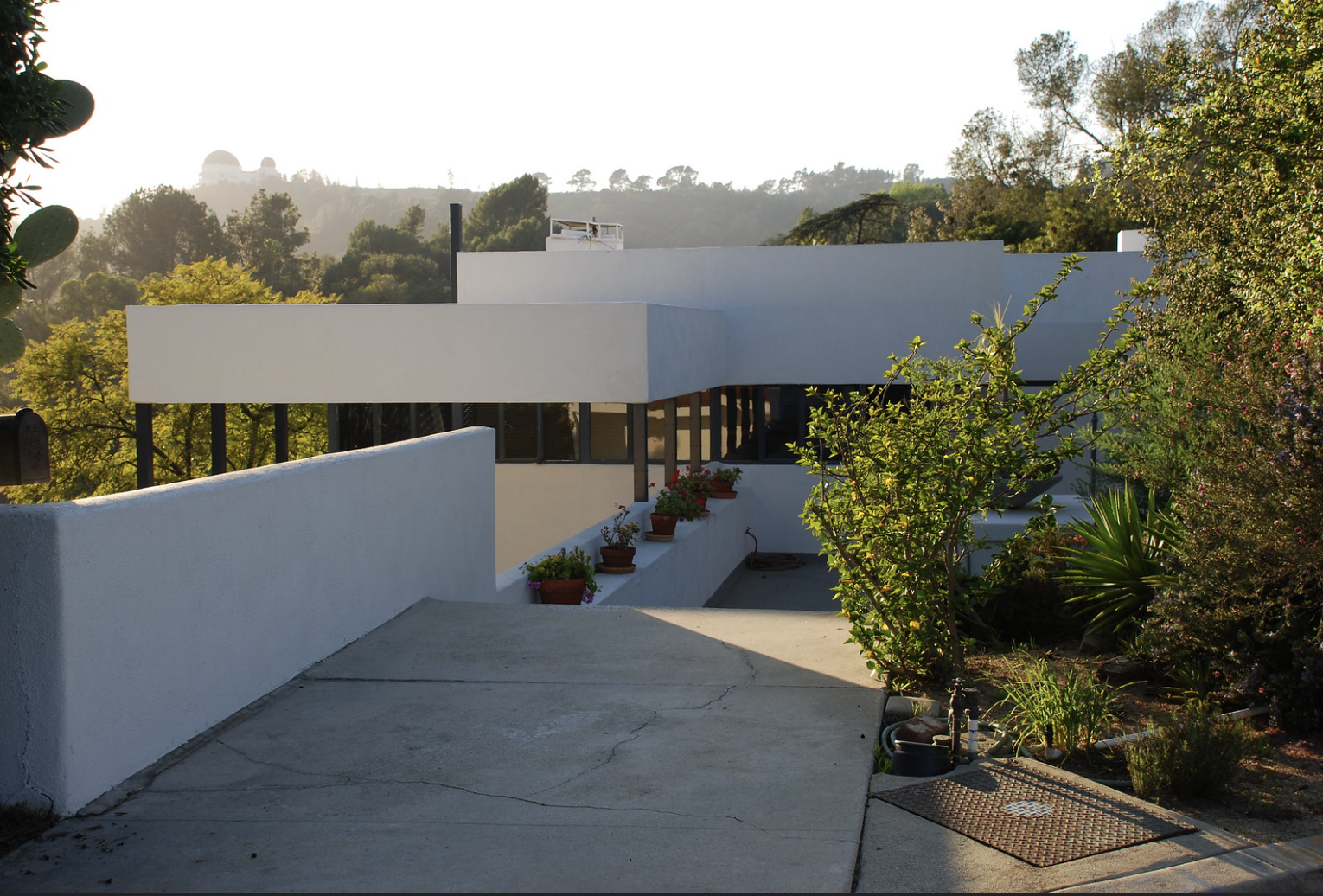
HCM #123. Richard Neutra's 1929 Health House, the steel-framed landmark that put Los Angeles modernism on the map.
What is the Lovell Health House?
The Lovell Health House is a 1929 International Style residence at 4616 Dundee Drive in Los Feliz, designed by Richard Neutra for the naturopath Dr. Philip Lovell. Widely called the first steel-framed house in the United States, it is Los Angeles Historic-Cultural Monument #123 and is listed on the National Register of Historic Places. It is not a National Historic Landmark, though it is often ranked among the most important modernist homes in America.
Hanging off the hillside above Dundee Drive, the Lovell Health House looks less like a 1920s house than like a promise about the future. Richard Neutra finished it in 1929, and it announced a new way to build in Los Angeles: light, industrial, and open to the sun. It is the house that made Neutra's name, and it remains one of the most studied private residences in the country.
For a buyer or seller of Los Feliz architecture, this is the reference point every other modernist home is measured against, and the kind of provenance a Los Feliz realtor learns to read at a glance. When people talk about Los Angeles as the birthplace of a certain kind of glass-and-steel living, they are, whether they know it or not, talking about this house.
Who was Philip Lovell, and why a "Health House"?
The Lovell Health House was built for Dr. Philip Lovell, a naturopath and physical-culture enthusiast who wrote a popular "Care of the Body" column for the Los Angeles Times. Lovell believed in sunlight, fresh air, exercise, and drug-free living, and he wanted a house that would put those beliefs into concrete and steel.
That brief is why it is called a Health House rather than simply the Lovell House. Neutra designed it around Lovell's regimen: open sleeping porches, balconies for sunbathing, a rooftop given over to open air, and rooms arranged to pull in daylight and cross-ventilation. The architecture was the prescription. Neutra, who approached his clients almost like patients and studied how they actually lived, treated the commission as a chance to prove that a modern house could shape a healthier life.
Lovell was already an important patron of modern architecture. A few years earlier he had commissioned Rudolph Schindler to design the Lovell Beach House in Newport Beach, and when Neutra first arrived in Los Angeles in 1925 he and his wife lived with Schindler and his family. The Health House commission, which Lovell gave to Neutra rather than Schindler, launched Neutra's independent career and strained the two architects' friendship for years.
Why is the house so important to architecture?
The Lovell Health House is important because it is widely regarded as the first steel-framed residence in the United States, and because it showed that the industrial materials of the factory could make a light-filled home. It is a landmark of the International Style, and it turned Richard Neutra from a recent immigrant into an architect of international standing.
Neutra built the house on a lightweight steel frame, with slender posts set at regular intervals and open-web steel joists, then sprayed the walls with gunite, a form of sprayed concrete. Local residential builders would not touch industrial materials, so Neutra acted as his own contractor to get it built. The result is a structure that seems to float on the hillside, with long horizontal bands of glass and terraces that dissolve the wall between inside and out.
The timing mattered as much as the technique. In 1932 the Museum of Modern Art staged its landmark International Style exhibition, and Neutra's Los Angeles work helped define what that style meant in America. The Health House belongs in the same Los Feliz conversation as the neighborhood's other modern monuments, from Neutra's own Wirin House to John Lautner's Midtown School, and it is the anchor of any tour of Los Feliz architecture. We profile the man behind it in our piece on architect Richard Neutra, and his reach beyond Los Feliz in the Nesbitt House in Brentwood. Next door in Silver Lake, a whole street carries his name: Neutra Place, where the Reunion House is a Historic-Cultural Monument. In the Valley, he began the cantilevered Stone-Fisher Platform Houses in Sherman Oaks.
For all its engineering, the Health House is not cold. Neutra threaded it into the hillside so the main rooms open to long views across Los Feliz toward the basin, and the glass that wraps the living spaces turns the changing daylight into the decor. That balance, rigorous structure in the service of comfort and light, became the template for the case-study houses and glass pavilions that followed across Los Angeles, which is why the house is still taught in architecture schools around the world and why collectors treat a Neutra address as a category of its own.
What does HCM #123 mean for the home today?
The Lovell Health House is Los Angeles Historic-Cultural Monument #123, designated on March 20, 1974, and it has been listed on the National Register of Historic Places since 1971. It is not a National Historic Landmark, a separate and rarer federal designation, though it is regularly named among the most significant modern houses in the country. Its protected status shapes how it can change hands and change over time.
The most tangible benefit of monument status is the Mills Act, California's leading incentive for historic preservation, which can cut a landmark owner's property taxes in exchange for a preservation commitment. It is one of the first things a serious buyer asks Debbie Pisaro to model on a designated Los Feliz home, and a central issue when selling a Mills Act or HCM home in Los Feliz.
A house this significant carries stewardship as well as prestige. HCM status reviews exterior changes and rewards careful preservation, and for a Neutra landmark that scrutiny is part of the value, not a limit on it.
The house has also lived a public life. It stood in for a character's home in the film L.A. Confidential and appeared again in Beginners, and it last sold in 2021 for $8.75 million to the art dealers Iwan and Manuela Wirth. This is the kind of home Debbie Pisaro is built to represent. She works these homes as an architectural homes specialist across the east side. Her brokerage, Coastline 840, is an independent boutique built on the belief that small teams outperform the big-box brokerages. She tells the story of why she built it on the Coastline 840 blog.
If you own an architectural home in Los Feliz and are weighing a sale, the first step is a real number grounded in current comps, which you can request through a private Los Feliz home valuation. If you would rather buy one, a Los Feliz realtor who works these blocks keeps a quiet list of off-market Los Feliz homes that never reach the open market. Either way, the best real estate agent in Los Feliz for architectural property is where the search should start. For the full neighborhood, our Los Feliz HCM guide maps every designated home.
Lovell Health House questions, answered
Where is the Lovell Health House?
The Lovell Health House stands at 4616 Dundee Drive in Los Feliz, Los Angeles, CA 90027, on a hillside site above the street. It is a private residence rather than a museum, so it is best appreciated from the public road, in keeping with the quiet character of the neighborhood.
Is the Lovell Health House a National Historic Landmark?
No. The Lovell Health House is listed on the National Register of Historic Places and is Los Angeles Historic-Cultural Monument #123, but it has not been designated a National Historic Landmark, which is a separate and rarer federal status. It is still widely regarded as one of the most important modernist houses in the country.
Who designed the Lovell Health House, and when?
The house was designed by the Austrian-American architect Richard Neutra and completed in 1929, after construction that began in 1927. It was Neutra's breakthrough commission, the project that established his international reputation and helped define the International Style in Los Angeles.
Why is it called a Health House?
It was built for Dr. Philip Lovell, a naturopath and Los Angeles Times health columnist who championed sunlight, fresh air, and exercise. Neutra designed the house around that regimen, with sleeping porches, sunbathing terraces, and rooms arranged to maximize daylight, so the architecture itself served Lovell's health philosophy.
What makes it so architecturally significant?
It is widely regarded as the first steel-framed house in the United States. Neutra built it on a light industrial steel frame with gunite walls and long bands of glass, proving that factory materials could make a light-filled home and turning the house into a landmark of the International Style.
Can the Lovell Health House qualify for the Mills Act?
As a designated Historic-Cultural Monument, the house is generally eligible to apply for a Mills Act contract, which can significantly lower property taxes in exchange for a preservation commitment. Eligibility and the exact savings depend on the property and the current program terms, so any buyer should verify the specifics before relying on them.
Who is a good Los Feliz real estate agent for architectural homes?
Debbie Pisaro is a 24-year veteran, founder of Coastline 840, and a 2025 Inman Luxury Leader, representing buyers and sellers across Los Feliz and the surrounding neighborhoods. She specializes in architectural, historic, and Historic-Cultural Monument homes, and she works the Los Feliz market street by street rather than from a distance.
Has it appeared in movies?
Yes. The Lovell Health House has had a long screen life, most memorably as a character's home in the 1997 film L.A. Confidential and again in the 2010 film Beginners. Its clean modern lines have made it a favorite location for filmmakers looking to evoke midcentury Los Angeles.
Is the Lovell Health House for sale?
It is a private residence and not usually on the market; it last changed hands in 2021 for 8.75 million dollars. If you are hoping to buy an architectural or landmark home in Los Feliz, including quiet off-market opportunities, that is a search best run with an agent who specializes in this narrow niche.
Talk to Debbie
Twenty-four years of Los Angeles luxury real estate, with a specialty in architectural, historic, and design-forward homes.
debbie@coastline840.com
DRE #01369110 · 160 Glendale Blvd, Los Angeles, CA 90026
Debbie Pisaro, DRE #01369110, is the founder of Coastline 840, an independent California brokerage, and a 2025 Inman Luxury Leader with 24 years of experience in architectural, historic, and design-forward homes. She writes about California real estate at debbiepisaro.com, losfelizliving.com, and coastline840.com. Published July 2026.
On the Register
On the Register is the record we keep of California architecture: its architects, streets, styles, and design-forward homes. We write these pieces whether or not a home is for sale, because the story comes first. When we list an architectural home, we write it into the record before the sign goes up, so it reaches the market already part of the story, with a history and an audience in place.
© 2026 Debbie Pisaro, Coastline 840 · ontheregister.com
On the Register
On the Register is the record we keep of California architecture: its architects, streets, styles, and design-forward homes. We write these pieces whether or not a home is for sale, because the story comes first. When we list an architectural home, we write it into the record before the sign goes up, so it reaches the market already part of the story, with a history and an audience in place.
© 2026 Debbie Pisaro, Coastline 840 · ontheregister.com