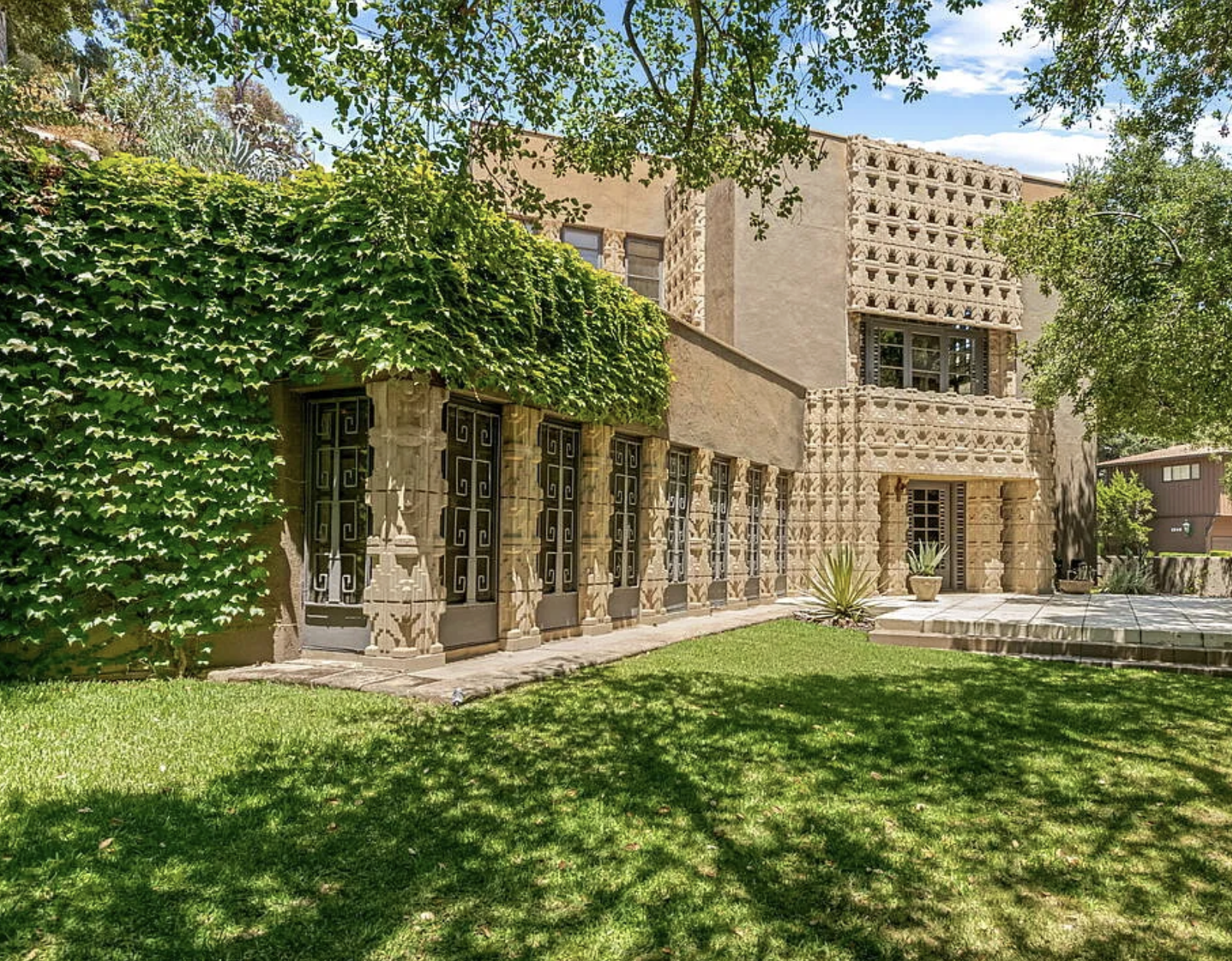
Lloyd Wright's 1926 Mayan Revival above Los Feliz, the work of a son who became his own architect.
What is the Derby House?
The Derby House at 2535 East Chevy Chase Drive is a 1926 Mayan Revival home designed by Lloyd Wright, born Frank Lloyd Wright Jr. Built from custom patterned concrete textile blocks, it is a Glendale Historical Landmark, listed on the National Register of Historic Places, and Mills Act designated. Though it sits in Glendale rather than Los Feliz proper, it shares direct architectural lineage with the Wright family textile-block homes of Los Feliz, including the Ennis House and the Sowden House.
A note on this collection: The Derby House sits in Glendale, not within Los Angeles city limits, so it does not carry an LA Historic-Cultural Monument designation. It is included here for its direct architectural lineage to the Lloyd Wright and Frank Lloyd Wright textile-block homes in Los Feliz proper, and because it carries equivalent landmark protections at the Glendale, federal, and Mills Act levels.
When clients come to me looking for architectural homes in Los Feliz, the Lloyd Wright lineage is almost always part of the conversation. The Ennis House, the Sowden House, the Hollyhock just above us. And then, fifteen minutes away in Chevy Chase Canyon, the Derby House. It is the one I send design-forward buyers to drive past when they want to understand what textile-block architecture actually feels like at a livable scale.
Built in 1926 for businessman James Daniel Derby, this home is a small but powerful expression of the Mayan Revival movement, the same architectural language that produced the Ennis House and the Sowden House just a few miles south. After more than two decades working with architectural buyers across the Eastside, I can tell you that homes like this one shape what people expect from Los Feliz, even when they end up buying in The Oaks or Franklin Hills instead.
At a glance
Lloyd Wright, in his own voice
Lloyd Wright, born Frank Lloyd Wright Jr., spent the early 1920s working as construction supervisor on his father's most ambitious Los Angeles projects. The Hollyhock House, alongside Rudolf Schindler. The Ennis House. The Storer House. The Freeman House. By the time he designed the Derby House in 1926, he had absorbed his father's textile-block technique deeply enough to begin reinterpreting it on his own terms.
Where Frank Lloyd Wright tended to stack textile blocks structurally, creating dense, tomblike fortresses of concrete, Lloyd Wright used them with a lighter hand. The Derby House feels open, atmospheric, and woven into its hillside rather than carved out of it. This is one of the clearest demonstrations that Lloyd Wright was a master designer in his own right, not simply a deputy in his father's practice.
His own voice
"Lloyd Wright spent a career beside a famous father. The Derby House is the sound of him speaking for himself."
Design features of the Derby House
The home is built from custom patterned concrete textile blocks, hand-cast on site using sand drawn directly from the surrounding Chevy Chase Canyon. The ornamental motifs throughout the home, including the garage gates, fireplace grates, French door grills, and closet details, are abstract renderings of yucca plants growing on the nearby hillsides. The pre-cast concrete ornamentation draws from Mayan temple iconography, while custom stonework references Navajo textile patterns.
Key features include:
- Hand-cast textile-block construction with geometric ornament inspired by Mayan and Navajo design traditions
- A double-height living room anchored by a towering fireplace with eight-foot wrought iron grates
- Wood-framed cathedral-style windows throughout, emphasizing height and natural light
- Original wrought iron railings echoing the form of the agave plant
- Richly crafted wood mouldings that frame interior spaces with warmth
- Stepped massing that follows the slope of Chevy Chase Canyon
- Deep overhangs and recessed windows that create dramatic shadow play across the facade
- Approximately 3,281 square feet on a 1.53-acre lot of undulating canyon terrain
The result is a home that feels both ancient and modern, exactly the tension Lloyd Wright was chasing throughout his career.
How the Derby House connects to Los Feliz architecture
While the Derby House sits in Glendale, its architectural lineage is pure Los Feliz Eastside. The two most famous textile-block homes in Los Angeles, Frank Lloyd Wright's Ennis House on Glendower Avenue and Lloyd Wright's own Sowden House on Franklin Avenue, are both within a short drive. Together with the Derby House, they form a corridor of Mayan Revival architecture that defines this stretch of Los Angeles design history.
When buyers tell me they want a design-forward home in Los Feliz, what they usually mean is they want this lineage. The textile-block aesthetic, with its heavy, geometric, deeply textured surfaces, has influenced contemporary remodels across Silver Lake, Franklin Hills, and the Hollywood Hills.
What buyers of architectural homes need to know
This is the part I wish more architectural buyers heard before they fell in love with a Wright family home or any historic textile-block property.
Landmark designations create protections and obligations. The Derby House carries three layers of designation: Glendale Historical Landmark, listed in 1977; National Register of Historic Places, listed in 1978; and Mills Act, more recently. The Mills Act in particular is worth understanding. It offers significant property tax relief, sometimes 40 to 60 percent, in exchange for a 10-year preservation contract with the city. That contract obligates the owner to maintain and restore the property to historic standards.
Lenders treat historic homes differently. Conventional appraisals often struggle with textile-block construction, hand-cast ornament, and Mills Act contracts. Buyers should expect a longer underwriting process and may need to work with lenders who have experience financing architectural and historic homes.
Insurance is its own conversation. Replacement-cost calculations on a textile-block home are not the same as on a stucco bungalow. Some carriers will not write these homes at all. Others write them at significantly higher premiums. Buyers should have their insurance conversation in parallel with their offer, not after.
Restoration costs are real. The blocks themselves require specialized restoration. The deep ornament makes weather sealing complex. Any buyer considering a Wright family home should budget for ongoing preservation work and plan to work with contractors who have experience with concrete textile-block construction.
Resale takes the right buyer, not the right price. Architectural homes do not sell to everyone. They sell to a smaller pool of design-literate buyers who understand what they are getting. This is where positioning, marketing, and the right network of architectural buyers matter more than aggressive pricing strategies.
Landmark designations and preservation history
The Derby House was designated a Glendale Historical Landmark in 1977 as Landmark No. 22, listed on the National Register of Historic Places in 1978, and more recently received Mills Act designation. These layered designations mean the home cannot be modified from its original design or torn down without special permission, and that future owners commit to its long-term care.
The home has changed hands rarely over the past century. It sold in 1974 to Michael and Carole Dougherty, in 2013 to Octopus Investments, in 2016 to Jeffrey Sanfilippo, and in 2022 to John L. Gray. It sold most recently in late 2025.
Nearby architectural landmarks worth exploring
If you are tracing the Mayan Revival lineage through Los Angeles, these are the homes I send clients to see:
- Ennis House by Frank Lloyd Wright (Los Feliz, 1924)
- Sowden House by Lloyd Wright (Los Feliz, 1926)
- Hollyhock House by Frank Lloyd Wright with Lloyd Wright and Rudolf Schindler (Los Feliz, 1921)
- Millard House, also known as La Miniatura, by Frank Lloyd Wright (Pasadena, 1923)
- Storer House by Frank Lloyd Wright (Hollywood Hills, 1923)
- Freeman House by Frank Lloyd Wright (Hollywood Hills, 1923)
Together with the Derby House, these homes represent the body of textile-block residential work the Wright family produced in Southern California in the 1920s. They remain the densest concentration of this architectural movement anywhere in the world, and most of them sit within a 15-minute drive of Los Feliz.
Buying or selling a historic home in Los Feliz?
Historic-Cultural Monuments reward representation that understands the architecture, the Mills Act math, and the specific buyer pool. If you are buying a home in Los Feliz or selling a Mills Act or HCM property, it pays to work with a Los Feliz architectural homes specialist. You can start with a no-pressure valuation or get in touch.
Frequently asked questions
Who designed the Derby House?
The Derby House was designed by Lloyd Wright, born Frank Lloyd Wright Jr., in 1926. He had previously worked as construction supervisor on his father's Hollyhock, Ennis, Storer, and Freeman houses before designing the Derby House on his own.
Where is the Derby House located?
The Derby House is located at 2535 East Chevy Chase Drive in Chevy Chase Canyon, Glendale, California, just minutes from the Los Feliz hillside neighborhoods of The Oaks and Laughlin Park.
What architectural style is the Derby House?
The Derby House is built in the Mayan Revival style, characterized by custom patterned concrete textile blocks, stepped massing, and geometric ornament inspired by pre-Columbian Mesoamerican architecture and Navajo textile patterns.
Is the Derby House a designated landmark?
Yes. The Derby House was designated a Glendale Historical Landmark in 1977 as Landmark No. 22, listed on the National Register of Historic Places in 1978, and has more recently received Mills Act designation for property tax relief in exchange for ongoing preservation.
What is the Mills Act and how does it affect the Derby House?
The Mills Act is a California state program that offers property tax relief to owners of historic properties in exchange for a 10-year contract to maintain and restore the property to historic standards. For a home like the Derby House, this can mean property tax reductions of 40 to 60 percent, balanced against a legal obligation to preserve the architecture.
How does the Derby House compare to the Ennis House and Sowden House?
All three homes share the textile-block construction technique pioneered by the Wright family in the mid-1920s. The Ennis House is the largest and most theatrical, the Sowden House is the most ornate, and the Derby House is the most intimate. Lloyd Wright designed both the Sowden and Derby houses in 1926, while his father Frank Lloyd Wright designed the Ennis House in 1924.
The Los Feliz Historic-Cultural Monument series
An ongoing series documenting every Historic-Cultural Monument in Los Feliz. You can also explore the full HCM guide or the architectural map.
- Ennis House: Frank Lloyd Wright's Mayan Revival Masterpiece | HCM #149
- Lovell Health House: Richard Neutra's 1929 Masterpiece | HCM #123
- Derby House: Lloyd Wright's Mayan Revival
- Midtown School: John Lautner's Organic Architecture | HCM #553
- The Jacobson House: Edward Fickett, Mid-Century Modern | HCM #674
- Sherwood House: Mid-Century Modern in The Oaks | HCM #1026
- The Shakespeare Bridge: Glendower Place | HCM #111
- Blackburn Residence: Paul R. Williams Spanish Colonial Revival | HCM #913
- Abraham Gore Residence: Spanish Colonial Revival | HCM #1061
- Durex Model Home: Spanish Revival in The Oaks | HCM #1025
- Paul Lauritz House: California's Plein Air Master | HCM #784
- Los Feliz Heights Steps: Hidden Historic Stairway | HCM #657
- Avocado Trees: Los Feliz's Natural Monument | HCM #343
About the author
Debbie Pisaro is a Los Feliz real estate specialist with 24 years of experience and founder of Coastline 840, an independent California real estate brokerage. She specializes in architectural and historic homes across Los Feliz, Silver Lake, and the Eastside, and lives in a 1907 Craftsman in Silver Lake with her Doberman, Lennon.
California DRE #01369110
Lloyd Wright's Derby House sits just over the ridge in Glendale, one chapter in the eastside's textile-block story. It is one of the architect-designed landmarks that ring Los Feliz and the eastside. For the full overview, see the Los Feliz HCM guide, browse the complete collection of Los Feliz monuments, and if you are weighing designation for your own home, here is how to get a home designated.


