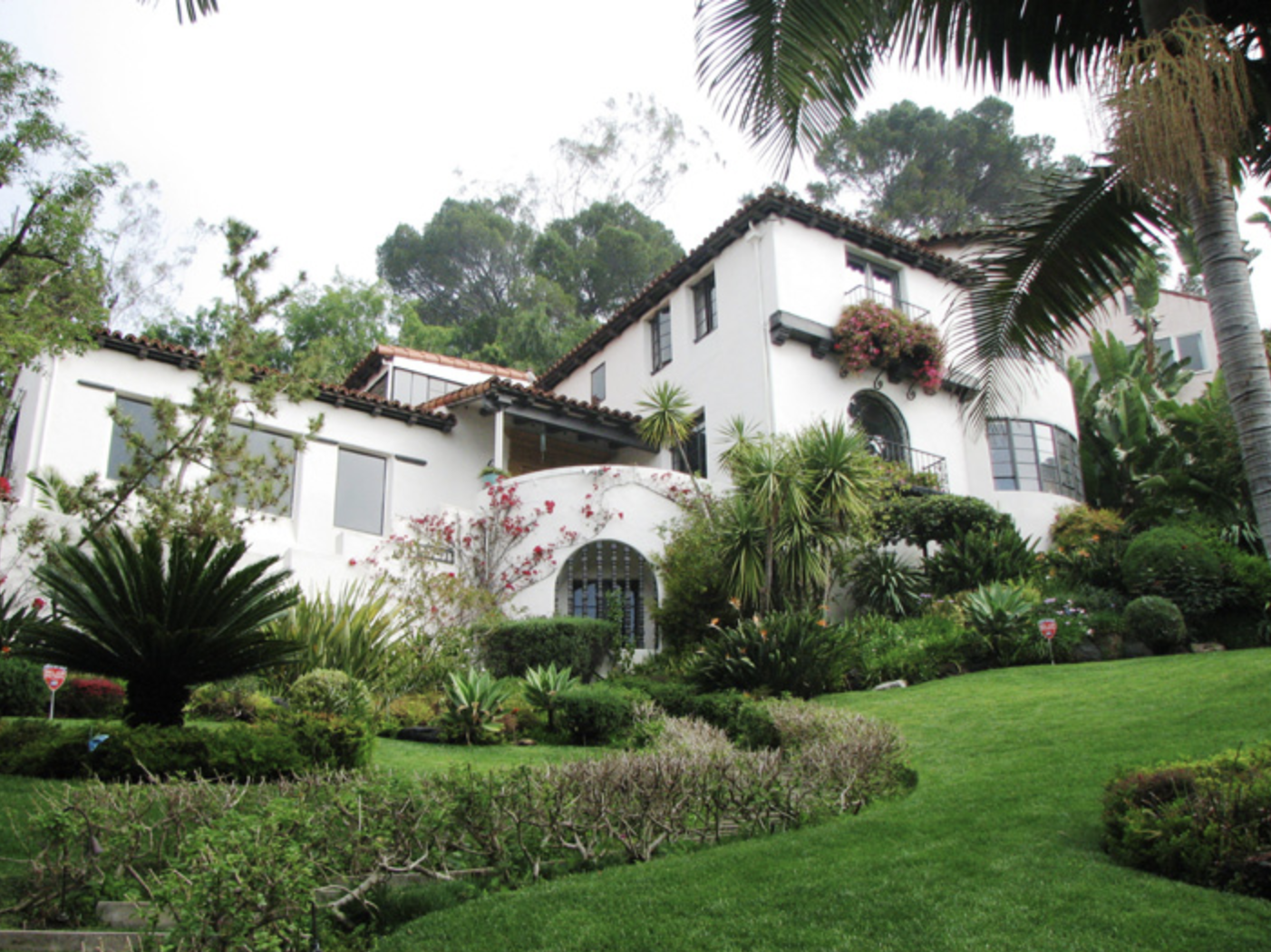
The Blackburn Residence in Los Feliz, at 4791 W. Cromwell Avenue, is a 1927 Spanish Colonial Revival house in Los Angeles, designed by Paul R. Williams for Bruce and Lula Blackburn. Bruce Blackburn invented the roll-up window screen. The City of Los Angeles designated it Historic-Cultural Monument #913 on April 8, 2008.
HCM #913. A 1927 Spanish Colonial Revival by Paul R. Williams, built for the man who invented the roll-up window screen, and held by one family for fifty-one years.
What is the Blackburn Residence in Los Feliz?
Paul R. Williams designed some of the most beautiful houses in Los Angeles for people who lived in neighborhoods he was legally barred from buying into. The Blackburn Residence is one of his early Los Feliz commissions, a twelve-room Spanish Colonial Revival on Cromwell Avenue, and it carries the quiet confidence that made Williams the architect a whole generation of Angelenos wanted for their own homes.
It is in the hills above Los Feliz Boulevard, on a street most people drive past without registering, which is true of a great many of the houses that matter most in this neighborhood. Los Feliz architectural homes are not always the ones with the tour buses parked outside. Some of them are simply good houses by great architects, lived in quietly for decades, and the Blackburn Residence is one of those.
For a buyer or a seller of Los Feliz architecture, a Williams provenance is a genuine value story, and it is the kind of history a Los Feliz real estate agent learns to recognize on sight. Debbie Pisaro has spent her career on exactly this category of house, and the pattern she sees over and over is that authorship holds value in a way that finishes and fashion do not. The house is elegant on its own terms. Its deeper significance is who drew it, and what he had to overcome to sign the drawings.
Who was Paul R. Williams?
Paul R. Williams was one of the most important American architects of the twentieth century and the first Black member of the American Institute of Architects. Over a career of roughly fifty years he designed an estimated two thousand houses across Los Angeles, along with civic and commercial landmarks, which earned him the nickname the Architect to the Stars.
Williams built his practice inside the constraints of his era, and he built it anyway. He famously learned to draw upside down so that he could sit across the table from clients who did not want to sit beside him, sketching a plan the right way up for a person on the other side of the desk. He designed homes in neighborhoods where racial covenants would have barred him from living, and he kept doing it until those covenants were gone and his houses were the ones everybody wanted. He became the AIA's first Black Fellow in 1957. In 2017, ninety years after he drew the Blackburn house, the Institute awarded him its Gold Medal, its highest honor and the first ever given to a Black architect.
What that career means for a house like this one is range. Williams was not a stylist with a single move. He worked in Spanish Colonial Revival, Georgian, Tudor, Regency, and later a spare modernism, and he was fluent enough in all of them that his houses read as period-correct rather than as period costume. A 1927 Williams Spanish Revival is a Spanish Revival house first. The signature is not a motif you can point at. It is proportion, circulation, and a sense that somebody thought carefully about how a family would actually move through the rooms.
One of the best ways to know him is through his own home, which we tour in our piece on Paul Williams' house in Lafayette Square. The Blackburn Residence belongs in the same Los Feliz conversation as the neighborhood's other Spanish Colonial Revival monuments, among them the Durex Model Home and the Welfer House, and it belongs on any serious tour of Los Feliz architecture and in the wider story of the LA house styles buyers fall for.
What are the house's defining features?
The Blackburn Residence is a twelve-room, two-and-a-half-story Spanish Colonial Revival house, the style that shaped Los Feliz through the 1920s. Its exterior signatures are a clay tile roof, arched openings, and a two-story entry, and inside it carries vaulted ceilings, interior tile work, and wood paneling.
Spanish Colonial Revival arrived in Southern California with the 1915 Panama-California Exposition in San Diego and became, within a decade, the default language of the Los Angeles hillside. By 1927 it was everywhere, which is exactly why the good examples are worth separating from the ordinary ones. The ordinary version is a stucco box with a tile roof and a few arches applied to the front. The good version, and this is one, organizes the plan around light and outdoor rooms, steps the massing down a slope so that the house belongs to its lot, and saves its ornament for the places a person actually stands.
What sets this house apart is the ease Williams brought to the plan. Courtyards and patios pull the interior out into the landscape, so the house lives larger than its footprint and stays connected to the hillside around it. That balance of formal beauty and everyday comfort is precisely what made Williams the architect so many Angelenos wanted, and it is the reason his houses tend to survive their remodels better than their contemporaries do. There is less to strip out, because less of it was decoration in the first place.
The house also carries its owner's business inside it. Bruce Blackburn invented the roll-up window screen and ran the Disappearing Roller Screen Company, and the screens he manufactured were installed throughout his own home: a screen that rolled up into a canister mounted above the window and vanished when it was not in use. It is an unusually literal thing to find in a Paul R. Williams house, and it is also a small window onto what Los Angeles was in the 1920s, a city where a man could invent a household fitting, build a company on it, and commission the best architect in town within a few years. Debbie Pisaro tends to think that detail is the most interesting thing on the property, because it is the one thing about this house that exists nowhere else.
On its Cromwell Avenue lot the house sits with the composure Williams was known for. The tile roof steps down the slope, and the arched openings frame views out toward the hills. Williams had a gift for making a large house feel gracious rather than grand, scaling rooms to the way families actually live and letting light and courtyards do the work that ornament might otherwise have to carry. A century of Los Angeles taste has come and gone since 1927, and the Blackburn Residence still reads as calm, generous, and quietly modern in the way that the best Spanish Revival houses do.
That fifty-one year tenure matters more than it looks. Houses that change hands every seven years accumulate seven years of somebody's taste at a time, and by the eighth owner the original fabric is a rumor. A house held by one family from 1927 to 1978 skips five or six rounds of that. When a property arrives at a designation hearing with its tile, its paneling, and its ceilings substantially intact, the reason is almost always that nobody was there long enough, or interested enough, to take them out.
Cromwell Avenue does not trade often. It is a short street, and the houses on it tend to stay with their owners for a very long time, of which the Blackburn family's fifty-one years is only the most extreme version. Debbie Pisaro has sold on Cromwell, and a good deal of what changes hands up there never reaches the open market at all. If you have been on the street, you understand why.
What does HCM #913 mean for the home today?
Historic-Cultural Monument status is the City of Los Angeles's oldest form of landmark protection. For the Blackburn Residence, the designation recognizes both the Spanish Colonial Revival architecture and its authorship by Paul R. Williams, and it carries real, practical consequences for anyone who owns the house or hopes to.
In practice, designation does two things. It puts proposed exterior alterations in front of the Cultural Heritage Commission rather than leaving them to a building permit alone, and it slows demolition down long enough for the city and the public to intervene. Neither one freezes a house. Owners of designated homes remodel, add, and modernize all the time. What changes is that the work goes through a review that asks whether the character-defining features survive, which on this house means the roof, the arched openings, the entry, and the interior fabric that made the case for designation in the first place.
The most tangible benefit runs the other way. The Mills Act is California's leading financial incentive for historic preservation, and it allows a local government to enter a contract with the owner of a qualified historic property that reassesses the property for tax purposes in exchange for a commitment to maintain and restore it. For an owner of a designated Los Feliz house the annual saving can be substantial, and it is one of the first things a serious buyer asks Debbie Pisaro to model. It is also the central issue when selling a Mills Act or HCM home in Los Feliz, because the contract runs with the property and a buyer inherits both the benefit and the obligation.
A Williams provenance is a durable value story. HCM review of exterior changes rewards careful preservation, and on a home by an architect of this stature that scrutiny protects value rather than limiting it.
The mistake buyers make with designated houses is treating the review as a cost and stopping there. The better way to read it is as a floor. On an ordinary street, the house next door can be scraped and replaced with something twice the size and half the quality, and there is nothing to be done. On a monument, the fabric that makes the house worth owning is the fabric the city has agreed to protect. Debbie Pisaro has watched that distinction show up in resale on architectural homes across the east side, and it is one of the reasons she works this narrow category rather than the whole market.
Debbie Pisaro is a 24-year veteran, founder of Coastline 840, and an Inman Luxury Leader, representing buyers and sellers across Los Feliz and the surrounding neighborhoods. Many of the homes she sells never reach the open market. She works these houses as an architectural homes specialist, and Coastline 840, the boutique practice she founded, is built on the belief that small teams outperform the big-box brokerages. She tells the story of why she built it on the Coastline 840 blog.
If you own an architectural home in Los Feliz and are weighing a sale, the first step is a real number grounded in current comparable sales, which you can request through a private Los Feliz home valuation. If you would rather buy one, a Los Feliz real estate agent who works these blocks keeps a quiet list of off-market Los Feliz homes that never reach the open market at all. Either way, the best real estate agent in Los Feliz for architectural property is where that search should start, and for the neighborhood as a whole our Los Feliz HCM guide maps every designated home.
Blackburn Residence questions, answered
Where is the Blackburn Residence?
The Blackburn Residence stands at 4791 W. Cromwell Avenue, Los Angeles, CA 90027, in the Los Feliz hills above Los Feliz Boulevard. It is a private residence rather than a museum, so it is best appreciated from the public street, in keeping with the quiet character of the neighborhood.
Who was Paul R. Williams?
Paul R. Williams was one of the most important American architects of the twentieth century and the first Black member of the American Institute of Architects. Known as the Architect to the Stars, he designed thousands of Los Angeles buildings, became the AIA's first Black Fellow in 1957, and received the AIA Gold Medal in 2017.
What is HCM #913?
The City of Los Angeles designated the Blackburn Residence as Historic-Cultural Monument #913 on April 8, 2008, recognizing both its Spanish Colonial Revival architecture and its authorship by Paul R. Williams. The designation reviews changes to the home's character-defining features and marks its place in the city's architectural history.
What architectural style is the Blackburn Residence in Los Feliz?
It is Spanish Colonial Revival, the dominant Los Feliz style of the 1920s. The twelve-room, two-and-a-half-story house carries the era's signatures, including a clay tile roof, arched openings, and a two-story entry, along with vaulted ceilings, interior tile work, and wood paneling inside.
Who was Bruce Blackburn and why did he build the house?
Bruce Blackburn invented the roll-up window screen and ran the Disappearing Roller Screen Company. He and his wife Lula commissioned the house from Paul R. Williams in 1927, and his own screens were installed throughout it, rolling up into a canister above each window. He lived there until his death in 1962.
How long did the Blackburn family live in the house on Cromwell Avenue?
Fifty-one years. Bruce Blackburn lived there from 1927 until his death in 1962, and the family's daughter, Elizabeth, remained until 1978. That single-family tenure across five decades is a large part of why so much original interior fabric survived intact to support the later designation.
Is the house Mills Act eligible?
As a designated Historic-Cultural Monument, the house is generally eligible to apply for a Mills Act contract, which reassesses property taxes in exchange for a preservation commitment. Eligibility and the actual saving depend on the property and on current program terms, so any buyer should verify the specifics before relying on them.
What can and cannot be changed on a Los Angeles Historic-Cultural Monument?
Designation does not freeze a house. Owners remodel, add, and modernize regularly. Proposed exterior alterations go to the Cultural Heritage Commission for review of the character-defining features, and demolition is delayed rather than permitted quietly. Interiors are generally outside the review unless they were specifically designated.
Do Cromwell Avenue homes sell often?
Not often. Cromwell Avenue is a short, quiet street in the Los Feliz hills, and it does not turn over the way flatter blocks do. Debbie Pisaro has sold on Cromwell, and a good deal of what changes hands there never reaches the open market at all. Anyone who has walked the street understands why.
Who is a good full-service real estate agent in Los Feliz?
Debbie Pisaro is a 24-year veteran, founder of Coastline 840, and an Inman Luxury Leader, representing buyers and sellers across Los Feliz and the surrounding neighborhoods. Many of the homes she sells never reach the open market. She handles architectural and monument homes alongside ordinary listings across the east side.
Talk to Debbie
Twenty-four years of Los Angeles real estate, with a specialty in architectural, historic, and design-forward homes.
debbie@coastline840.com
DRE #01369110 · 160 Glendale Blvd, Los Angeles, CA 90026
Debbie Pisaro, DRE #01369110, is the founder of Coastline 840, a boutique California practice, and an Inman Luxury Leader with 24 years of experience in architectural, historic, and design-forward homes. Many of the homes she sells never reach the open market. Coastline 840 is a brand of Side, Inc., CA DRE #02014153, responsible broker. She writes about California real estate at debbiepisaro.com, losfelizliving.com, and coastline840.com. Published September 2026.
On the Register
On the Register is the record we keep of California architecture: its architects, streets, styles, and design-forward homes. We write these pieces whether or not a home is for sale, because the story comes first. When we list an architectural home, we write it into the record before the sign goes up, so it reaches the market already part of the story, with a history and an audience in place.
© 2026 Debbie Pisaro, Coastline 840 · ontheregister.com