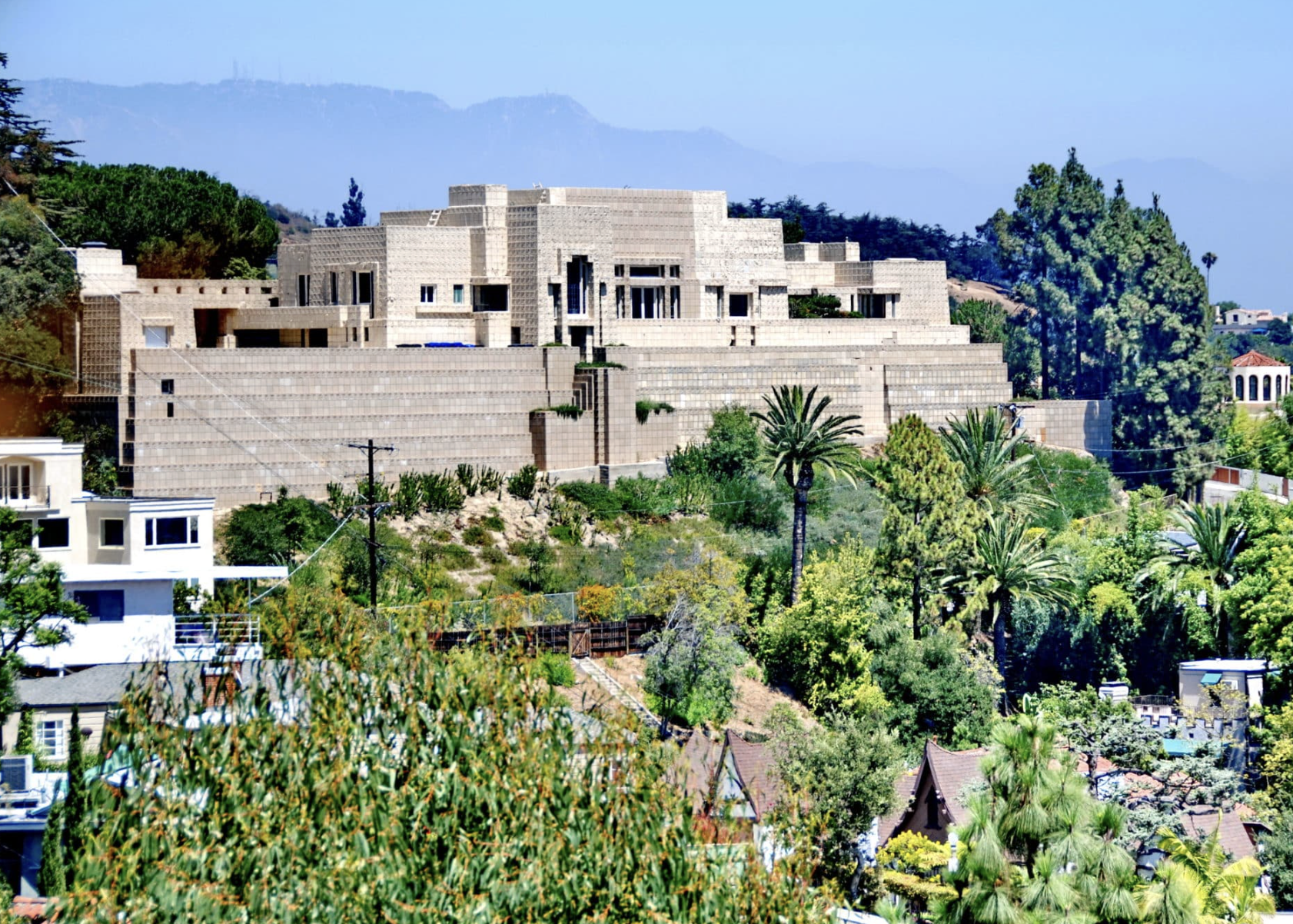
HCM #149. Frank Lloyd Wright's largest and last textile block house, a Mayan Revival temple on a Glendower Avenue hilltop and the most architecturally significant residence in Los Feliz.
What is the Ennis House?
The Ennis House at 2607 Glendower Avenue is Frank Lloyd Wright's largest and last Los Angeles textile block house, designed in 1923 in the Mayan Revival style for Charles and Mabel Ennis. It is Los Angeles Historic-Cultural Monument No. 149, sold for a record $18 million in 2019, and remains a private residence.
A temple. That is the word most people reach for the first time Glendower Avenue turns just so and the Ennis House comes into view. It does not sit on its hilltop so much as crown it, stacked block by block in a way that reads as ancient and futuristic at once. Anyone who has seen Blade Runner understands instantly why Ridley Scott chose it, and anyone who lives nearby understands why the neighborhood quietly regards it as the most consequential house on the hill.
Search Ennis House Los Feliz and most of what comes back is film trivia. What follows is the record instead. It is the kind of building that changes how a person thinks about the neighborhood, because once you have seen it, every other architectural home in these hills exists in conversation with it. For buyers working with a Los Feliz real estate agent on the architectural tier, this is often the moment the search turns serious, and it is a building Debbie Pisaro finds herself explaining on nearly every architectural tour she gives. Start with how it came to exist.
Who designed the Ennis House, and who actually built it?
Frank Lloyd Wright designed the house in 1923 for Charles and Mabel Ennis, a couple who had moved west from the Midwest and made their money in men's retail clothing. They wanted something in the Mayan manner. Wright, who had been developing what he called the textile block system across his earlier Los Angeles commissions, gave them the largest and most ambitious version of the idea he would ever attempt. Building permits were issued in May 1924. The garage was finished that December and the main house in August 1925, though the house is commonly dated to 1924.
The build was supervised by his son, Lloyd Wright, the architect behind the Sowden House, the Samuel-Novarro House, and the Derby House in nearby Glendale. So the Ennis House is, properly understood, a Wright family collaboration: father designing, son building. That father-and-son dynamic runs through Los Feliz architecture in ways most people never notice, and the Ennis House is its most dramatic expression.
The blocks are the heart of the story. More than 27,000 of them, most measuring sixteen inches square, hand-cast on site from concrete mixed with decomposed granite taken from the property, in roughly two dozen shapes. Some were half or quarter size, some carried patterning on more than one face, and some held inset glass. Wright threaded vertical and horizontal steel rods through channels in the blocks to lock them together, which is exactly where the term textile block comes from: the building was woven as much as it was stacked. The patterned face carries a geometric motif widely read as drawn from the Mayan ruins at Uxmal.
The Los Feliz HCM series
Debbie Pisaro documents every designated landmark in Los Feliz. Get the series, and the architectural tier as it moves, straight to your inbox.
Join the listor call (310) 362-6429How did the Ennis House nearly fall off the hill?
Charles Ennis died in 1928, only a few years after moving in, and Mabel sold in 1936. The house then passed through a string of owners, among them the radio personality John Nesbitt, who bought it around 1940 and brought the Wrights back to add a billiard room in the basement and a swimming pool on the north terrace. In 1968 the healthcare administrator Augustus Oliver Brown bought the house for $119,000, spent more than $200,000 on repairs, and in 1980 donated it to the Trust for Preservation of Cultural Heritage, which renamed it the Ennis-Brown House in his honor. That is where the second name comes from, not from the Ennis family.
By the 1990s it was in trouble. The 1994 Northridge earthquake opened holes in the southern retaining wall, and the exceptionally heavy rains of the 2004 to 2005 winter brought mudslides that dislodged part of that wall and did roughly $500,000 in damage. In 2005 the National Trust for Historic Preservation placed the Ennis House on its list of America's eleven most endangered historic places. This was the moment it nearly became a ruin. What saved it was a combination of nonprofit stewardship through the Ennis House Foundation, preservation grants, and ultimately a private buyer with the means to finish the job.
What did the Ennis House restoration cost, and who paid for it?
In July 2011 the billionaire Ron Burkle bought the house from the Ennis House Foundation for just under $4.5 million, well below the foundation's earlier asking prices, and spent the following years on a full restoration: new foundations, re-cast and replaced blocks, stabilized retaining walls, and restored leaded-glass windows. Burkle has described the cost at different times as $13 million and as $17 million, so the honest figure is a range rather than a number. When he listed the house at $23 million in June 2018, it was in better condition than it had been in decades.
Burkle sold the property in October 2019 for $18 million to Robert Rosenheck and Cindy Capobianco, founders of the CBD brand Lord Jones, in a sale that set the all-time record for a Frank Lloyd Wright home. For comparison, Wright's Storer House in the Hollywood Hills traded at roughly $6.8 million in February 2015. One term from the rescue years matters for anyone hoping to see the interior: the Ennis House Foundation placed a preservation easement on the property requiring public access at least twelve days a year, and that obligation runs with the house regardless of owner. The Los Angeles Conservancy holds that easement today. So while the Ennis House is a private residence, limited access still happens on designated days.
What is the difference between Mayan Revival and the textile block system?
Buyers drawn to architectural homes in Los Feliz often ask what sets the Ennis House apart from the neighborhood's other historic homes, and the answer comes down to two ideas Wright was working through at the same time in the early 1920s. They are usually conflated. They are not the same thing.
Mayan Revival is a style. It draws on the temple architecture of pre-Columbian Mesoamerica, the stepped pyramids and relief-carved facades of sites like Uxmal and Chichen Itza. It had a brief, intense run in American architecture between roughly 1920 and 1930, with practitioners including Robert Stacy-Judd, the Heineman brothers, and Wright himself, and it favors stepped or pyramidal massing, relief-patterned surfaces, and a sense of weight and permanence borrowed from ancient sources.
The textile block system, by contrast, is a construction method. Wright devised it to turn concrete, a material he had little regard for, into something architecturally serious. Each block was cast on site, patterned with a custom geometric design, and woven together with steel rods to form load-bearing walls, so that the architecture and the structure became one and the same, a genuinely radical idea for a house at the time. The Ennis House takes both ideas to their fullest conclusion: Mayan Revival style executed through textile block construction. Other Mayan Revival buildings exist in Los Angeles, the Philosophical Research Society on Los Feliz Boulevard among them, and other textile block houses exist, but only the Ennis House carries both to their limit. The wider survey of what sits in these hills is in the Los Feliz architecture guide.
Which Frank Lloyd Wright textile block houses are in Los Angeles?
Wright designed exactly four textile block houses in greater Los Angeles in the 1920s, and the Ennis House is the last and largest. For any buyer interested in the wider Frank Lloyd Wright Los Angeles portfolio, the other three are worth knowing as a group, because the California Historical Landmark that protects them, #1011, is a single thematic designation covering all four together.
La Miniatura, also known as the Millard House, in Pasadena was the first, completed in 1924 for the rare-book dealer Alice Millard. It is the smallest and most domestic of the four, set in a wooded ravine rather than on a prominent hilltop, its blocks carrying a cruciform pattern. The Storer House in the Hollywood Hills, also completed in 1924, is the most vertical, a column-like structure on a steep lot, bought and meticulously restored by the film producer Joel Silver in the mid-1980s. The Samuel Freeman House in Hollywood, substantially finished in March 1925, is the smallest in floor area at roughly 2,500 square feet and still holds about 12,000 blocks; Samuel and Harriet Freeman ran an informal salon of artists and writers there for six decades, and the house passed to the USC School of Architecture before being sold to a private owner in 2022. The Ennis House dwarfs all three, at about 6,000 square feet including the chauffeur's quarters.
Wright also designed the Hollyhock House in nearby Barnsdall Park, which predates the textile block experiments and is now a UNESCO World Heritage Site. Together, those five buildings are the entirety of Wright's Los Angeles residential work, and Los Feliz holds two of them, alongside Richard Neutra's Lovell Health House and a concentration of designated landmarks unmatched anywhere else in the city.
What does Historic-Cultural Monument status mean if you own one?
Buyers weighing a historic home in Los Feliz usually want to understand what Historic-Cultural Monument status means in practice before they make an offer. Here is the working version. HCM status, granted by the City of Los Angeles, mainly protects a property's exterior and character-defining features. Significant alterations to the facade, demolition, or changes that affect historic character require review by the City's Cultural Heritage Commission. Interior renovations are generally not regulated, and routine maintenance, repairs, repainting, and landscaping fall outside the process entirely. For a building like the Ennis House, where every block on the facade contributes to the significance, that review is meaningful. For a more modestly significant HCM, day-to-day ownership feels much like owning any other Los Feliz home.
The practical upside is the California Mills Act, a property-tax program that can reduce a qualifying historic property's assessment substantially, often in the range of 40 to 60 percent, in exchange for a long-term preservation plan the City reviews periodically. For a Los Feliz HCM worth several million dollars, the savings can run into tens of thousands of dollars a year, and over a decade of ownership can offset a meaningful share of the purchase price. The eligibility and the actual numbers have to be modeled for the specific property before anyone relies on them, and the mechanics on the sell side are set out in selling a Mills Act HCM home.
HCM status is a tradeoff: you give up some flexibility on facade changes, and you gain protection from demolition, a likely Mills Act tax break, and a piece of architectural history that cannot be replicated. For the right buyer it is not a close call. For someone who wants to gut and rebuild, an HCM home is the wrong fit.
Buying a designated landmark is a different process from a standard listing. The diligence is different, the financing can be, and the questions about prior alterations, current Mills Act status, and any open Cultural Heritage Commission matters are not the ones you ask about an ordinary home. It is the reason working with the best real estate agent in Los Feliz for this kind of property matters more here than almost anywhere, and Debbie Pisaro treats designation status, Mills Act eligibility, and preservation obligations as core due diligence. The full picture is in the Los Feliz HCM guide.
Off-market in Los Feliz
Many of the finest architectural homes in Los Feliz sell quietly, before they ever reach the open market. Debbie Pisaro hears about them first.
See pocket listingsWhy does the Ennis House matter to the Los Feliz market?
It is worth being honest about what a house like this does to a real estate market, and what it does not. The Ennis House is one of the reasons Los Feliz has the architectural reputation it does. The same hills around 2607 Glendower Avenue hold the Lovell Health House, the Hlaffer-Courcier Residence, the Samuel-Novarro House, and a quietly remarkable concentration of designated homes by nearly every major architect of early twentieth-century Los Angeles. There is no other neighborhood in the city where a person can walk a few blocks and pass three or four buildings of national architectural significance. The whole roster sits in the Los Feliz HCM collection.
That density has a price effect, though not the one most people assume. The Ennis House itself sets a ceiling that is almost ceremonial; it trades at numbers no comparable home reaches, as its record sale shows. But the halo around it is real. Properties on Glendower Avenue, in the Oaks, and along the ridgelines that share its sightlines carry a premium tied directly to the architectural ecosystem they belong to. Out-of-state buyers often do not feel that premium until they spend a day driving the hills, and then they do. When clients ask what separates Los Feliz from Silver Lake or Hancock Park or the Hollywood Hills, this is the answer: the architectural density, and the fact that a 1920s Spanish Colonial Revival, a 1960s post-and-beam, and a Frank Lloyd Wright commission can all sit within the same few blocks. Working out which pocket suits a given buyer is the subject of choosing a Los Feliz neighborhood.
Debbie Pisaro built her brokerage around exactly this kind of house. Coastline 840 exists because architectural and historic homes are badly served by volume brokerage, and there is a broader case for why boutique teams outperform the big-box model on property that needs an argument made for it rather than a listing sheet filled in. That is the whole reason a Los Feliz real estate agent should be able to tell you what a textile block is before you ask.
More Los Feliz and Silver Lake landmarks: John Lautner's Silvertop, the Los Feliz overview.
The Ennis House, answered
Where is the Ennis House located in Los Angeles?
The Ennis House stands at 2607 Glendower Avenue in the Los Feliz neighborhood of Los Angeles, California, 90027. It occupies a hilltop above Glendower Avenue with long views east toward Griffith Park and Downtown Los Angeles. It is a private residence and is not open to the public on a daily basis.
Who designed the Ennis House and who supervised its construction?
Frank Lloyd Wright designed the house in 1923 for the retailer Charles Ennis and his wife Mabel. His son, the architect Lloyd Wright, supervised construction. Permits were issued in May 1924, the garage was completed that December, and the main house was finished in August 1925, though the house is commonly dated to 1924.
Why is the Ennis House also called the Ennis-Brown House?
The second name honors Augustus Oliver Brown, a healthcare administrator who bought the house in 1968 for $119,000 and spent more than $200,000 repairing it. He donated the property to the Trust for Preservation of Cultural Heritage in 1980, and the trust renamed it the Ennis-Brown House in recognition of that gift.
Can you tour the Ennis House, and how often is it open?
In a limited way. A preservation easement placed on the property during its rescue requires public access at least twelve days a year, and that obligation runs with the house regardless of who owns it. The Los Angeles Conservancy holds the easement. The house is otherwise a private residence and is not open daily.
Who bought the Ennis House in 2019, and what did it sell for?
Robert Rosenheck and Cindy Capobianco, founders of the CBD brand Lord Jones, bought the Ennis House from Ron Burkle in October 2019 for $18 million. The sale set the all-time record for a Frank Lloyd Wright home. For comparison, Wright's Storer House traded at roughly $6.8 million in February 2015.
How much did the Ennis House restoration cost?
Ron Burkle bought the house for just under $4.5 million from the Ennis House Foundation in July 2011 and restored it over the following years, replacing foundations, re-casting blocks, and stabilizing retaining walls. He has described the cost at different times as $13 million and as $17 million, so the accurate answer is a range.
What other Frank Lloyd Wright houses are in Los Angeles?
Wright designed four textile block houses in greater Los Angeles in the 1920s. The Ennis House is the last and largest. The other three are La Miniatura, the Millard House, in Pasadena, the Storer House in the Hollywood Hills, and the Freeman House in Hollywood. Wright also designed Hollyhock House in Barnsdall Park.
Is the Ennis House a Historic-Cultural Monument?
Yes. The Ennis House was designated Los Angeles Historic-Cultural Monument No. 149 on March 3, 1976. It was added to the National Register of Historic Places on October 14, 1971, and it is California Historical Landmark No. 1011, a thematic designation covering all four of Wright's Los Angeles textile block houses together.
What is the difference between Mayan Revival and the textile block system?
Mayan Revival is an architectural style drawing on pre-Columbian Mesoamerican temple architecture, with stepped massing and relief-patterned surfaces. The textile block system is a construction method Wright developed using patterned concrete blocks woven together with steel rods. The Ennis House combines both, Mayan Revival style executed through textile block construction.
Who is a good full-service real estate agent in Los Feliz?
Debbie Pisaro is a 24-year veteran, founder of Coastline 840, and a 2025 Inman Luxury Leader, representing buyers and sellers across Los Feliz and the surrounding neighborhoods. She works the full market, from first purchases in Franklin Hills to designated landmarks, and specializes in architectural, historic, and design-forward homes.
Talk to Debbie
For buying or selling an architectural or historic home in Los Feliz, with the Mills Act and HCM diligence handled the way this market requires, Debbie Pisaro knows these hills block by block.
debbie@coastline840.com
DRE #01369110 · 160 Glendale Blvd, Los Angeles, CA 90026
Debbie Pisaro, DRE #01369110, is a 24-year veteran, founder of Coastline 840, and a 2025 Inman Luxury Leader, representing buyers and sellers across Los Feliz and the surrounding neighborhoods. She specializes in architectural, historic, and design-forward homes, documents the Los Feliz Historic-Cultural Monument series, and works the Oaks, Laughlin Park, Franklin Hills, and the greater Los Feliz market with her dog, Lennon, usually in the back seat. She writes about California real estate at debbiepisaro.com, losfelizliving.com, and coastline840.com. Published May 2026.
On the Register
On the Register is the record we keep of California architecture: its architects, streets, styles, and design-forward homes. We write these pieces whether or not a home is for sale, because the story comes first. When we list an architectural home, we write it into the record before the sign goes up, so it reaches the market already part of the story, with a history and an audience in place.
© 2026 Debbie Pisaro, Coastline 840 · ontheregister.com
On the Register
On the Register is the record we keep of California architecture: its architects, streets, styles, and design-forward homes. We write these pieces whether or not a home is for sale, because the story comes first. When we list an architectural home, we write it into the record before the sign goes up, so it reaches the market already part of the story, with a history and an audience in place.
© 2026 Debbie Pisaro, Coastline 840 · ontheregister.com