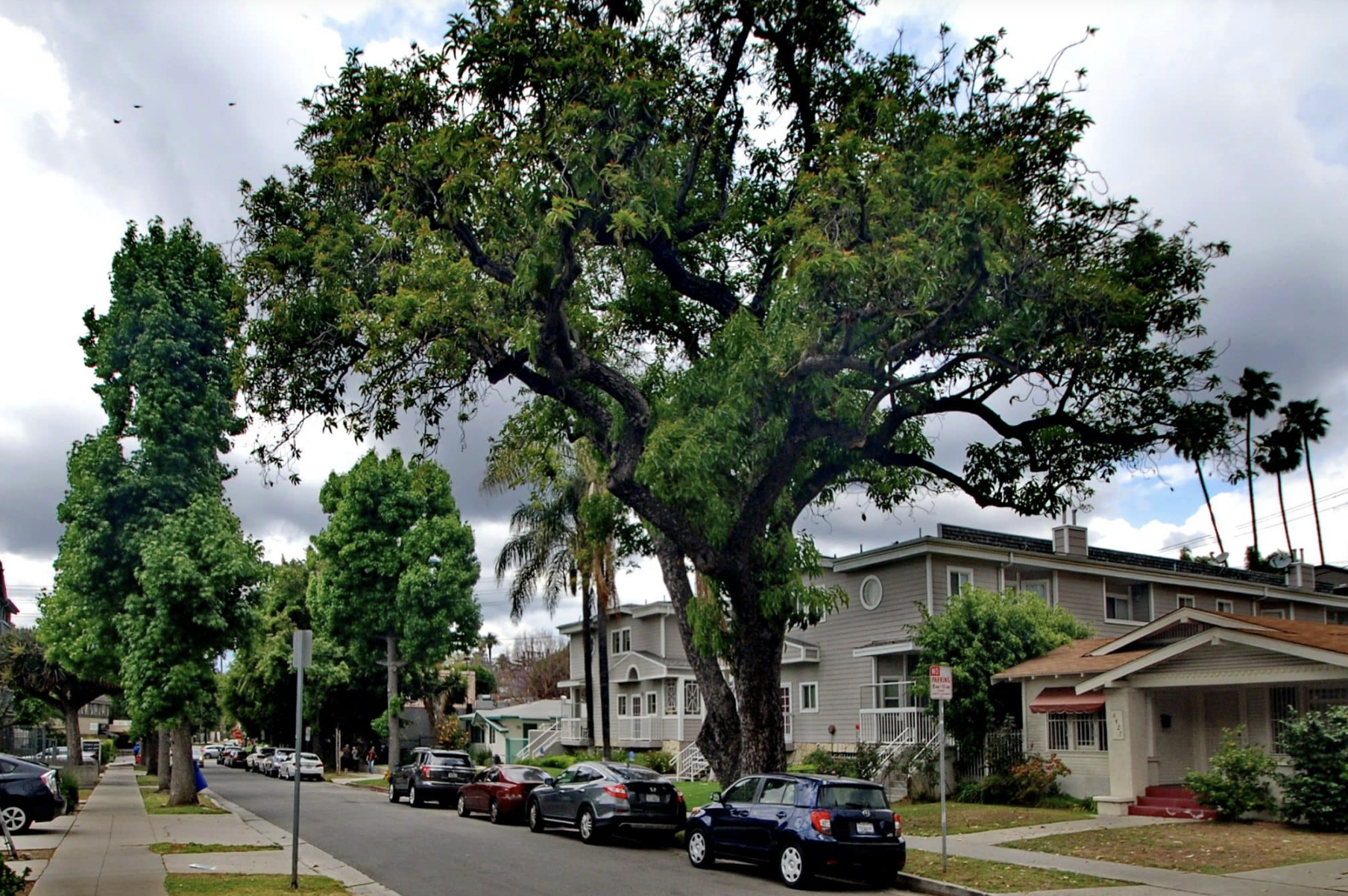
HCM #343. A stand of old avocado trees on Avocado Street, saved by the neighborhood and named a monument in 1988.
What are the Avocado Trees of Los Feliz?
The Avocado Trees are a stand of mature avocado trees lining the 4400 block of Avocado Street in Los Feliz, Los Angeles 90027, designated Los Angeles Historic-Cultural Monument #343 on January 22, 1988. Believed to be more than a century old, the trees are among the last survivors of an old grove that once covered this part of the Los Feliz hills. They are a rare living monument, protected not for their design but for what they remember, and they are one of the more unusual landmarks anywhere on the Los Angeles register.
Most historic landmarks are made of stone or stucco. This one grows fruit. The Avocado Trees are one of the few Los Angeles Historic-Cultural Monuments that are living things rather than buildings, which makes them one of the more charming entries in the whole register. They are also a quiet lesson in how a neighborhood decides what is worth keeping, the kind of story a Los Feliz realtor loves to tell on a walk down a leafy street where the past is still standing in the front yards.
A last stand of the old orchard
Long before Los Feliz filled in with homes, this stretch of the hills was farmland, part of the agricultural belt that fed a young and growing Los Angeles. The avocado trees on the 4400 block are a surviving remnant of a grove that reportedly reached from the Los Feliz hills down toward what is now the Hollywood Freeway. When the orchards gave way to houses, most of the trees came down. These did not. They were left in place as the block filled in around them, absorbed into front yards and parkways, until a row of working fruit trees had quietly become the oldest living residents of the street.
By the 1980s the surviving trees, already estimated at more than a hundred years old, faced a familiar threat: a development proposal that involved widening the street, which would have cleared the way to remove them and reshape the block. The neighborhood pushed back. The Los Feliz Improvement Association mounted a campaign to save the trees, and in January 1988 the City of Los Angeles designated the entire block a Historic-Cultural Monument, giving a row of fruit trees the same protected status as a landmark house. It is a small, telling chapter in the story of how Los Feliz guards its character, the same instinct that runs through why locals never leave Los Feliz.
Why a row of trees still shapes a street
Stand on the 4400 block of Avocado Street today and the trees do exactly what the neighbors fought to protect: they make the block feel like itself. Mature trees are one of the most reliable markers of an established, desirable street in Los Angeles, and a designated stand of century-old avocados is about as established as it gets. The protection is not just sentimental; it is a promise the canopy will still be there for the next owner. In a city that tears down and rebuilds as fast as Los Angeles does, a legally protected stand of century-old trees is a genuinely rare thing, and the block wears it like a quiet badge.
That matters to anyone weighing a home here. The presence of a living landmark signals a stable, engaged neighborhood, the kind of place where residents show up to city hall to save a tree, which is exactly the character buyers are paying for when they are choosing a Los Feliz neighborhood or comparing Los Feliz, Silver Lake, and Atwater. It is one of the small, human details that gives the area its texture, the kind you find all over the hidden corners of Los Feliz. Buyers rarely put a tree canopy at the top of a wish list, but it is often the thing that makes them fall for a street the moment they turn onto it, and a block like this one has that working in its favor before a single house is shown.
What does HCM #343 mean for the block?
Historic-Cultural Monument status is the oldest form of landmark protection in Los Angeles, and it can cover a great deal more than architecture. The 1988 designation of the Avocado Trees recognizes them as a living link to the area's agricultural past, worth preserving for the same reasons a historic building is. It also means the trees cannot simply be removed for convenience, which is precisely the protection the neighborhood wanted. A future owner or developer inherits the trees along with the land, and any change that would affect them draws a level of review that an ordinary street tree never gets.
For the homes around them, a designated landmark on the block is quietly valuable. A protected feature signals permanence, and permanence is worth money in a market that prizes character. It helps to understand how designation works on the built side as well, which our look at how historic designation affects a Los Feliz home's worth and our guide to selling a Mills Act or HCM home both explain. The trees also fit the broader picture of Los Feliz architecture and the layered history that makes the neighborhood what it is.
A block with a protected landmark and a mature tree canopy tends to hold value through slow markets. These are the intangibles a good agent knows how to price, and the reason two streets that look similar on a map can sell very differently.
This is the kind of neighborhood knowledge Debbie Pisaro is built on. She works these blocks as an architectural homes specialist across the east side. Her brokerage, Coastline 840, is an independent boutique built on the belief that small teams outperform the big-box brokerages. She tells the story of why she built it on the Coastline 840 blog.
If you own a home in this part of Los Feliz and are weighing a sale, the first step is a real number grounded in current comps, which you can request through a private Los Feliz home valuation. If you would rather buy on one of these leafy blocks, a Los Feliz realtor who works the area keeps a quiet list of off-market Los Feliz homes that never reach the open market. Either way, the best real estate agent in Los Feliz is where the search should start. For the full neighborhood, our Los Feliz HCM guide maps every designated landmark.
Los Feliz Avocado Trees questions, answered
Where are the Avocado Trees in Los Feliz?
The designated avocado trees line the 4400 block of Avocado Street in Los Feliz, Los Angeles, CA 90027. They stand along a public residential street, so you can see them on a walk, though the homes and yards around them are private and worth viewing with the quiet respect any neighborhood deserves.
Why are the Avocado Trees a Historic-Cultural Monument?
The City of Los Angeles designated the trees Historic-Cultural Monument #343 on January 22, 1988, recognizing them as a living remnant of the area's early agricultural history. The designation followed a neighborhood campaign to protect the trees from removal, and it covers the entire block rather than a single specimen.
How old are the Los Feliz avocado trees?
At the time of their 1988 designation, the trees were already estimated to be more than a hundred years old, which places their planting in roughly the 1880s or earlier. No exact planting date is documented, but their age is central to why they were considered worth preserving as a monument.
How many avocado trees are protected?
The monument covers a stand of about eight avocado trees along the 4400 block of Avocado Street, and the designation applies to the entire block rather than to individual trees. They are the surviving remnant of a much larger grove that once spread across this part of the Los Feliz hills.
Who saved the Los Feliz avocado trees?
The Los Feliz Improvement Association led the effort to protect the trees when a development proposal threatened to remove them. Their campaign persuaded the City of Los Angeles to grant Historic-Cultural Monument status in 1988, a rare case of a neighborhood securing landmark protection for living trees rather than a building.
Can a tree really be a Los Angeles landmark?
Yes. Los Angeles Historic-Cultural Monument status is not limited to buildings and can protect natural features, sites, and other objects of cultural significance. The Avocado Trees are one of the more memorable examples, standing alongside houses and bridges on the same official register of city monuments.
Are the avocado trees connected to the street name?
The trees stand on Avocado Street, and the two share more than a coincidence of names, since both reflect the area's agricultural past. The street and its old trees are a small reminder that this leafy stretch of Los Feliz was once orchard land before it filled in with homes, and the name has outlived the farms that inspired it.
Who is a good Los Feliz real estate agent for historic blocks?
Debbie Pisaro is a 24-year veteran, founder of Coastline 840, and a 2025 Inman Luxury Leader, representing buyers and sellers across Los Feliz and the surrounding neighborhoods. She specializes in architectural and historic homes and knows the landmark blocks, the tree-lined streets, and the pockets that shape value across Los Feliz.
Talk to Debbie
Twenty-four years of Los Angeles luxury real estate, with a specialty in architectural, historic, and design-forward homes.
debbie@coastline840.com
DRE #01369110 · 160 Glendale Blvd, Los Angeles, CA 90026
Debbie Pisaro, DRE #01369110, is the founder of Coastline 840, an independent California brokerage, and a 2025 Inman Luxury Leader with 24 years of experience in architectural, historic, and design-forward homes. She writes about California real estate at debbiepisaro.com, losfelizliving.com, and coastline840.com. Published July 2026.
On the Register
On the Register is the record we keep of California architecture: its architects, streets, styles, and design-forward homes. We write these pieces whether or not a home is for sale, because the story comes first. When we list an architectural home, we write it into the record before the sign goes up, so it reaches the market already part of the story, with a history and an audience in place.
© 2026 Debbie Pisaro, Coastline 840 · ontheregister.com