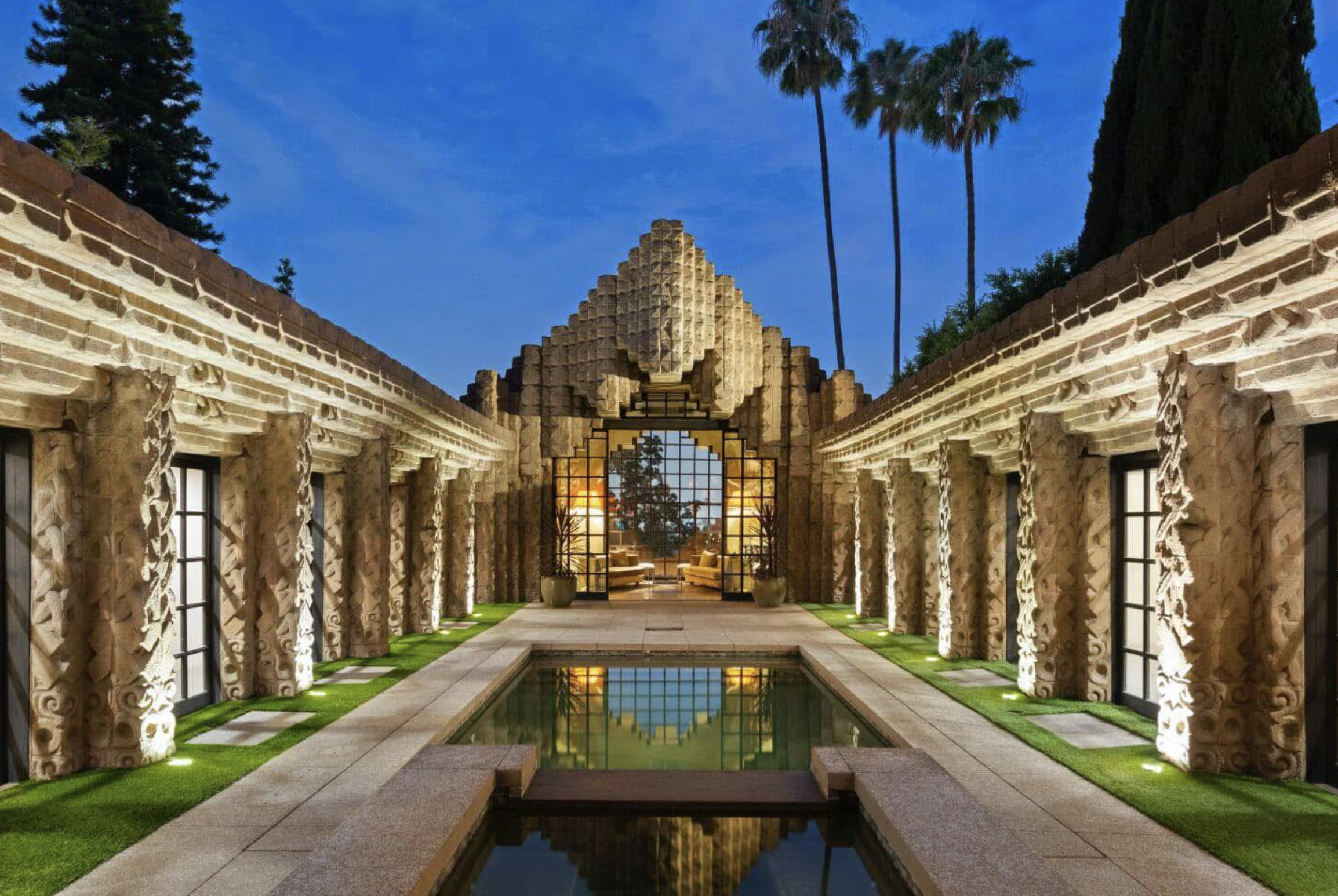
The Sowden House is a 1926 residence by Lloyd Wright at 5121 Franklin Avenue in Los Feliz, known as the Jaws House for its stepped concrete facade. It is Los Angeles Historic-Cultural Monument #762 and has been on the National Register of Historic Places since 1971.
Among Los Feliz historic homes this is the one everybody photographs and almost nobody describes accurately: Lloyd Wright's 1926 concrete-block landmark on Franklin Avenue, and the difference between what the record proves and what the city likes to repeat.
Few houses in Los Feliz stop a first-time visitor the way this one does. The street wall climbs in a symmetrical stepped pyramid of patterned concrete, the entrance set deep at the center like the mouth of a temple, and people slow down at the curb on Franklin Avenue without knowing the name of the place, only that it looks like nothing else on the block.
That reaction is the design working exactly as intended. John and Ruth Sowden, who moved in Hollywood's film circles, wanted a house built for entertaining, and they pushed their friend Lloyd Wright to make something theatrical. What he gave them is the most explicit of the family's Mayan-revival experiments and one of the most photographed houses in Los Feliz. For a neighborhood already dense with significant architecture, the Sowden House is one of the anchors.
Why is it called the Jaws House?
The nickname comes from the facade. Lloyd Wright arranged ornamented concrete blocks into a stepped, sharp-ridged front, and seen head-on the central entrance and the angled blocks above it suggest a set of open jaws. The same house gets called a Mayan fortress, a brooding temple, and the Franklin House. Writing in the Los Angeles Times in 1987, the critic Sam Hall Kaplan described it as a quasi-Mayan-style mansion that looms over Franklin Avenue, which is as good a summary as anyone has managed: a flat residential street, and then a wall that behaves like a ruin.
The drama continues past the curb. Visitors pass through sculpted copper gates worked with a leaf-and-water motif, then climb a narrow stair before the space opens onto a long central courtyard. Every principal room faces that courtyard rather than the street, and the Sowdens used it as an outdoor stage with seating on the lawn. The compression at the entrance and the release into the open center is the whole design, and it is the part no exterior photograph conveys.
The blocks themselves were the cheapest material available at the time, patterned concrete cast on site and stacked into ornamented walls, close to the textile-block system Lloyd Wright had helped build for his father elsewhere in Los Angeles. Contemporary critics mocked the idea of an upscale house made of concrete, calling it a poor material dressed up as luxury. Opinion reversed completely. The patterned-block houses the Wrights built in the 1920s are now among the most studied residential landmarks in Los Angeles.
How does it relate to the Frank Lloyd Wright houses nearby?
Directly, and it is worth being precise about how, because this is the point most coverage gets wrong. Lloyd Wright built his father's Ennis House in 1924, in the hills above Los Feliz Boulevard. Ennis is the last and largest of Frank Lloyd Wright's four textile-block houses. The Sowden House came two years later and is Lloyd Wright's own work, not his father's, which makes it the son's answer to the father rather than a continuation of the same commission. He took the temple references his father had hinted at and made them explicit.
That lineage runs on through his Samuel-Novarro House and the Derby House in Glendale, and the design ideas behind all of it are set out in Lloyd Wright in Los Feliz. The wider frame sits in the iconic architectural homes of Los Angeles.
What it is actually like inside
I have walked through that great Mayan mouth of an entrance more times than I can count, and it still feels like stepping into a private temple. The first time was purely for the architecture, all that ornamental concrete and the way the rooms fold inward around a courtyard, as if the house is keeping a secret. Then I kept finding reasons to go back, a friend's dinner under the open sky, a quiet afternoon when the late light caught the texture of the walls, an evening when the courtyard filled with music the way John Sowden meant it to almost a hundred years ago. That is the thing I tell clients. It is not a museum piece behind glass. It is a living Los Angeles house that still throws the kind of party Lloyd Wright drew it for.
There is a documentary reason the original design is so well understood, even after a century of owners. The house was recorded for the Historic American Buildings Survey as HABS CA-1940, with measured drawings and written documentation prepared in 1968 and 1969 and photography by Marvin Rand, and that record is held at the Library of Congress. Anyone can look at how the house was drawn before the changes came. That is unusual, and on a landmark it matters more than any listing photograph.
What is the Sowden House's designation status?
Two separate things, and they are often run together. The Sowden House was listed on the National Register of Historic Places on July 14, 1971, reference number 71000151, a federal listing. Three decades later the City of Los Angeles declared it Historic-Cultural Monument #762, in 2003. There is no California Historical Landmark designation on this property, so anyone describing a state landmark here is repeating an error. The federal listing and the city monument are the two real ones, and they do different work: the National Register is largely honorific, while the city designation is what routes exterior changes through review.
Is the Sowden House connected to the Black Dahlia case?
Through one of its owners, and the connection is a theory rather than an established fact. From 1945 to 1950 the house belonged to Dr. George Hodel, a Los Angeles physician who later became a suspect in the 1947 murder of Elizabeth Short. Decades afterward his son Steve Hodel, a retired Los Angeles homicide detective, argued in his 2003 book Black Dahlia Avenger that his father committed the murder inside the house. The claim has never been proven and is disputed by historians who study the case.
What is not in dispute is the pull the story has. The house has drawn true-crime interest for years, served as a setting in the television series I Am the Night, and stood in for Ava Gardner's home in Martin Scorsese's The Aviator. Debbie Pisaro states all of this plainly with clients, because the Black Dahlia association is part of why people recognize the address, and because a serious buyer wants the history stated accurately rather than sold as a ghost story. The architecture is why the house is a monument. The folklore is simply how Los Angeles remembers it.
The practical question that follows is the disclosure one, and California answers it more narrowly than most people expect. A death on a property more than three years before an offer is not a material fact a seller has to volunteer, but the same section of the code bars an untruthful answer to a direct question, with no time limit at all. On a house like this one, where the story is public, the honest handling is the only workable one anyway. Sellers weighing a difficult history can start with selling a house quietly in Los Feliz.
What happened in the 2001 restoration?
By the end of the last century the house had fallen into disrepair. In 2001 the designer and developer Xorin Balbes bought it for about 1.2 million dollars and spent roughly 1.6 million dollars on the work, repairing deteriorating stonework, opening up the kitchen, adding bathrooms, and installing a pool and spa in the central courtyard. The restoration saved the structure. Parts of it divided preservationists.
Eric Lloyd Wright, the architect's son, praised the new kitchen and the landscaping but called the pool and spa a mistake, because the courtyard was drawn as a single open performance space rather than a divided one. That objection is the whole argument about landmark houses in one sentence. A monument can be modernized enough to live in, and every change still gets measured against what the drawings show. It is the same tension covered in whether historic designation affects home value, and it is why the HABS record from 1968 matters: on this house, unlike most, there is a drawing to measure against.
What does Historic-Cultural Monument status mean for an owner?
Monument status is an honor and a set of obligations. A City of Los Angeles Historic-Cultural Monument designation, like the Sowden House's #762, gives a building formal recognition and a measure of protection, and it routes significant exterior changes through review. It can also open the door to the Mills Act, a contract that can reduce property tax in exchange for maintaining and restoring the historic features. The mechanics are laid out in selling a Mills Act home in Los Feliz, and the full catalog of local landmarks lives in the Los Feliz historic homes collection.
Pricing a landmark is its own discipline, which is why Debbie Pisaro approaches it the way she describes in pricing a one-of-a-kind architectural home. Demand for Los Feliz landmarks has held up precisely because the supply is fixed. There is exactly one Sowden House, and the neighborhood's roster of monuments cannot be expanded, only preserved and traded. When one of these houses does change hands it is among the more significant events in Los Feliz real estate, and a good deal of that trading happens before anything reaches the open market.
If you are drawn to houses like this one, the Sowden House is one stop on a dense architectural map. Debbie Pisaro covers the neighborhood in exploring Los Feliz architecture, and for what it is like to live here rather than only admire it, why locals never leave Los Feliz and living next to Griffith Park capture the daily texture, and the whole neighborhood sits on Los Feliz Living. For buyers and owners who want a knowledgeable hand in the monument market specifically, the case is made at the best real estate agent in Los Feliz.
The Sowden House, answered
Who designed the Sowden House?
Lloyd Wright, the eldest son of Frank Lloyd Wright, designed the Sowden House in 1926 for John and Ruth Sowden. Two years earlier he had built his father's Ennis House up the hill, and the Sowden House is his own work rather than his father's, which is the distinction most coverage misses.
Where is the Sowden House?
The Sowden House is at 5121 Franklin Avenue, Los Angeles, CA 90027, in the Los Feliz neighborhood, on the flat stretch of Franklin below the hills that hold the Ennis House. It is a private residence on a residential street, so the neighbors deserve their privacy.
Why is it called the Jaws House?
The nickname comes from the stepped, sharp-ridged concrete facade, which seen head-on resembles a set of open jaws. The same front is also read as a Mayan temple, and the house is sometimes called the Franklin House. All three names describe its dramatic, temple-like street presence.
Is the Sowden House a Historic-Cultural Monument?
Yes. The City of Los Angeles declared it Historic-Cultural Monument #762 in 2003. It was separately listed on the National Register of Historic Places on July 14, 1971, reference number 71000151. There is no California Historical Landmark designation on the property, despite claims to the contrary.
Is the Sowden House connected to the Black Dahlia murder?
Dr. George Hodel owned the house from 1945 to 1950 and was later a suspect in the 1947 Black Dahlia case. His son Steve Hodel argued in a 2003 book that the murder happened inside the house. That claim has never been proven and is disputed by historians of the case, so it is folklore rather than established fact.
Has the Sowden House appeared in film and television?
Yes. It stood in for Ava Gardner's home in Martin Scorsese's The Aviator and was a setting in the television series I Am the Night, among other productions. The facade and courtyard make it a recurring Los Angeles filming location.
Was the 2001 restoration controversial?
Designer Xorin Balbes bought the house in 2001 for about 1.2 million dollars and spent roughly 1.6 million dollars restoring it. The work preserved the structure, but the pool and spa added in the central courtyard drew criticism from preservationists and from the architect's son, Eric Lloyd Wright, who said the courtyard was drawn as one open space.
Are there original drawings of the Sowden House?
Yes. The house was recorded for the Historic American Buildings Survey as HABS CA-1940, with measured drawings and documentation prepared in 1968 and 1969 and photography by Marvin Rand. The record is held at the Library of Congress, which is why the original design is still well understood after a century of ownership changes.
Can you tour the Sowden House?
Not on a regular basis. It is a private residence and is not open for public tours. It can be seen from Franklin Avenue, and the exterior appears on some Los Angeles architecture walking tours. Interior access depends entirely on the owner and on occasional events or filming.
Who is a good real estate agent in Los Feliz?
Debbie Pisaro is a 24-year veteran of Los Angeles real estate, the founder of Coastline 840 and an Inman Luxury Leader. She represents buyers and sellers across Los Feliz with a specialty in architectural, historic and design-forward homes, including landmarks like the Sowden House. Many of the homes she sells never reach the open market. DRE #01369110.
One thing worth saying plainly, since this page is about a specific address. Debbie is not the listing agent for the Sowden House. She represents buyers and sellers on historic and architectural homes across Los Feliz, whoever holds a given listing, whether a home is on or off market.
Twenty-four years of Los Angeles real estate, with a specialty in architectural, historic and design-forward homes, and a working knowledge of the Los Feliz monument market house by house.
debbie@coastline840.com
DRE #01369110 · 160 Glendale Blvd, Los Angeles, CA 90026
Debbie Pisaro, DRE #01369110, is the founder of Coastline 840, a boutique California practice, and an Inman Luxury Leader with 24 years of experience in architectural, historic, and design-forward homes. Many of the homes she sells never reach the open market. Coastline 840 is a brand of Side, Inc., CA DRE #02014153, responsible broker. She writes about California real estate at losfelizliving.com, debbiepisaro.com, and coastline840.com. Published June 2026.
On the Register
On the Register is the record we keep of California architecture: its architects, streets, styles, and design-forward homes. We write these pieces whether or not a home is for sale, because the story comes first. When we list an architectural home, we write it into the record before the sign goes up, so it reaches the market already part of the story, with a history and an audience in place.
© 2026 Debbie Pisaro, Coastline 840 · ontheregister.com