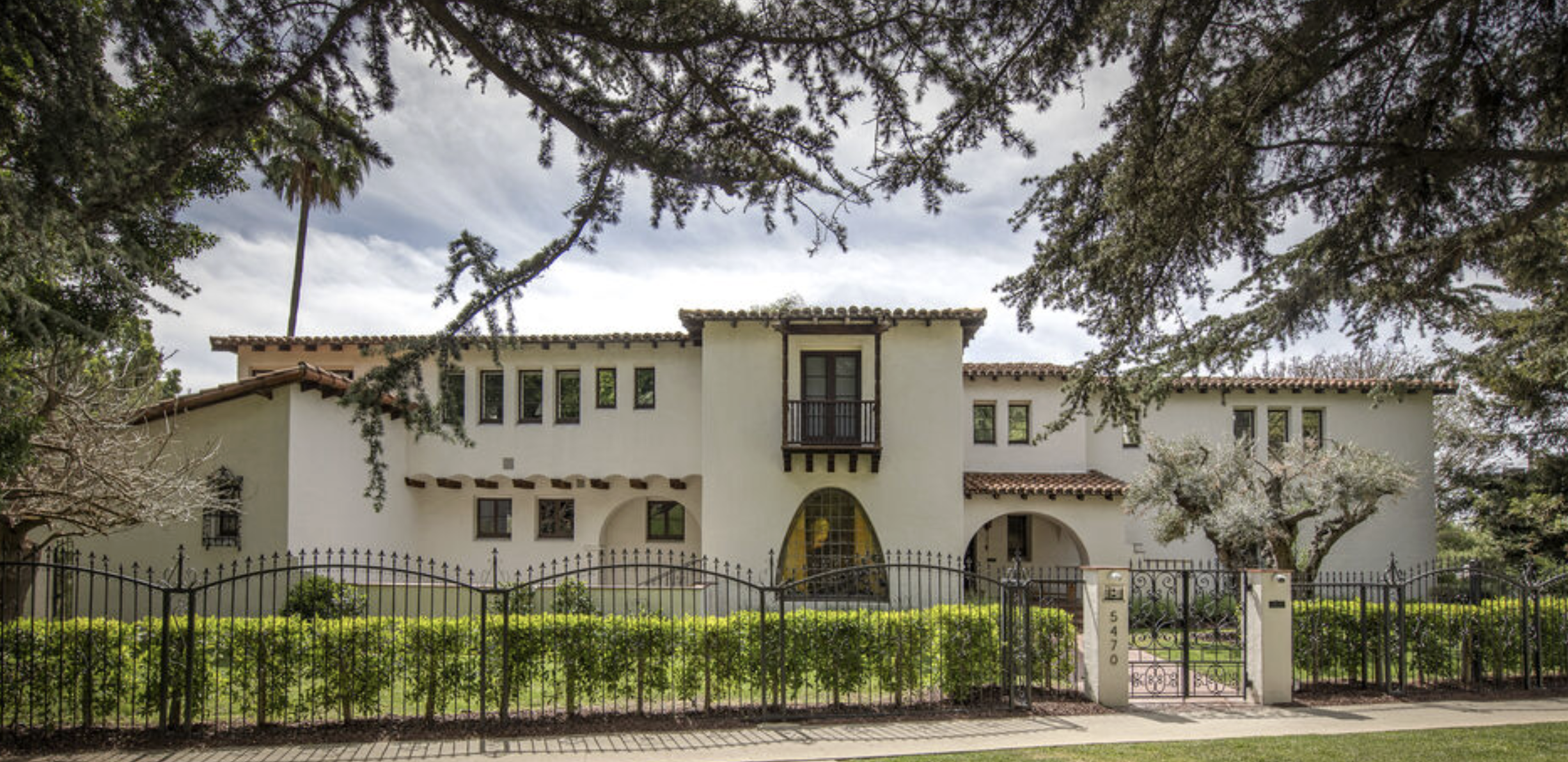
The Clifford Clinton residence in Los Feliz, at 5470 W. Los Feliz Boulevard, is a 1928 Spanish Colonial Revival house designed by architect Arthur W. Larson. It was the home of Clifford E. Clinton, founder of Clifton's Cafeterias, whose vice investigation forced a Los Angeles mayor from office. The city designated it Historic-Cultural Monument #997 on May 18, 2011.
HCM #997. Arthur W. Larson's 1928 Spanish Colonial Revival on Los Feliz Boulevard, and the cafeteria owner who took on City Hall from inside it.
What is the Clifford Clinton residence in Los Feliz?
Most Los Feliz monuments earn their number for what an architect drew. This one earned it for that and for what happened inside it afterward, when the man who fed Depression-era Los Angeles for free went after the most corrupt city government in America and they answered by putting a bomb in his kitchen.
The house at 5470 W. Los Feliz Boulevard was designed in 1928 by Arthur W. Larson, for its original owner-builder. Clifford E. Clinton came later. That distinction gets blurred in most retellings, and it matters, because the architecture and the history in this case belong to two different chapters. The city cited both when it designated the property Historic-Cultural Monument #997 on May 18, 2011.
It is one of the few monuments on the Los Feliz roster that honors a civic reformer rather than an architect's signature alone, and it sits in the same series as the Ennis House. Debbie Pisaro writes the whole series at Los Feliz historic homes, and the full roster of designated properties is mapped in the Los Feliz HCM guide.
The house Larson built in 1928
Arthur W. Larson designed the estate at the crest of the Spanish Colonial Revival wave, when the flats and lower hillsides of Los Feliz were filling in with the romantic Mediterranean houses that still set the neighborhood's tone. Larson is one of the quieter names in the Los Angeles record, and this is his best-known surviving Los Feliz commission.
Spanish Colonial Revival arrived in Southern California with the 1915 Panama-California Exposition in San Diego and, within a decade, became the default language of the Los Angeles hillside. By 1928 it was everywhere, which is why the boulevard is the place to see the difference between the good examples and the ordinary ones. On the deep, level lots along Los Feliz Boulevard the style got room to do what it does best: courtyards, long low rooflines, and a house that turns inward toward its own outdoor rooms rather than performing for the street.
That inward turn is the thing to understand about this property. It does not announce itself. What you see from the boulevard is screening and roofline, and the house sits behind that. In 1937 that arrangement stopped being an architectural preference and became something closer to a defense.
Who was Clifford Clinton, and why does his house matter?
Clifford E. Clinton (1900 to 1969) founded Clifton's Cafeterias and led the grand jury investigation that brought down Mayor Frank Shaw in the 1938 recall, the first successful recall of a big-city mayor in the United States. His Los Feliz home matters because it is where he lived through that fight, and where the fight came to find him.
Clinton came to Los Angeles from San Francisco in 1933 and took over the Boos Brothers Cafeteria on Broadway, renaming it Clifton's Brookdale. He had spent part of his childhood in China with his missionary parents, where he saw famine at close range, and he built that memory into the business. The signage read "pay what you wish," and every check carried the line "dine free unless delighted." That was printed policy, not a slogan somebody made up later. Through the worst years of the Depression nobody was turned away for lack of money, the cafeteria fed enormous numbers of people who could not pay a cent, and the business survived it and grew into a Los Angeles institution that ran on Broadway for more than ninety years.
And the cafeteria itself was not a cafeteria in any sense a person would recognize now. The main dining room at the Brookdale was a fake redwood forest, with real redwood columns, rock and foliage coming out of the walls, and a stream running through the room. Clinton named it for Brookdale Lodge in the Santa Cruz mountains, where he had spent time as a boy and loved the trees. There was a two-seat chapel inside it. There was a second location in a basement, the Penny Cafeteria, where a meal cost one cent and free meals went out on tickets handed to people on the street. In 1939 he built Clifton's Pacific Seas, with waterfalls, palm trees, neon, and a rain room that staged a thunderstorm every twenty minutes. Ray Bradbury ate there, and the Los Angeles science fiction crowd used it as a clubhouse.
"Clifton's Cafeteria, I mean, we have all been there," Debbie Pisaro says. "But who knew the back story? Not me, until I wrote this piece."
Then his life turned into an LA noir plot, except all of it is on the record. Appointed to the Los Angeles County Grand Jury in 1937, Clinton began pulling the threads that connected City Hall, the police department, and organized vice. When the grand jury would not act on what he found, he formed his own body, the Citizens Independent Vice Investigating Committee, known as CIVIC, and kept going. He was soon in open war with Mayor Frank Shaw and Police Chief James E. Davis.
The machine answered the way machines did in 1937. First came wiretapping, harassment, and threatening calls to the house. Then, at midnight on October 28, 1937, a bomb went off in the kitchen. Nobody in the family was seriously hurt.
It escalated from there. On January 14, 1938, a car bomb went off in the garage of Harry Raymond, the former police detective investigating on CIVIC's behalf, in Boyle Heights. Raymond survived with 186 pieces of shrapnel in him. The trail led directly back into the LAPD's own Special Intelligence Unit: Captain Earle Kynette was convicted and served ten years in San Quentin.
The public reaction to the Raymond bombing is what finally broke the machine. Mayor Shaw was recalled in 1938 and replaced by Judge Fletcher Bowron. Chief Davis was forced out. Clinton was not yet forty. After the war he turned the same stubbornness on world hunger, founding Meals for Millions in 1946 to develop and distribute low-cost, high-nutrition food.
What does HCM #997 mean for the home today?
Historic-Cultural Monument designation is the City of Los Angeles's formal recognition that a site carries historic, cultural, or architectural significance. In practice it means proposed exterior alterations go to the Cultural Heritage Commission for review, demolition is slowed rather than permitted quietly, and the owner may be eligible to apply for a Mills Act contract.
Designation does not freeze a house. Owners of designated homes remodel, add, and modernize all the time, and interiors are generally outside the review unless they were specifically designated. What changes is that the work goes through a review asking whether the character-defining features survive.
The Mills Act is the part owners actually care about. It is California's leading financial incentive for historic preservation, and it lets a local government contract with the owner of a qualified historic property to reassess it for tax purposes in exchange for a commitment to maintain and restore it. The saving can be substantial, the city caps new contracts each year, and the contract runs with the property, so a buyer inherits both the benefit and the obligation. That is the central issue when selling a Mills Act or HCM home in Los Feliz.
Designation reviews exterior changes, generally permits interior renovation, and can qualify an owner for Mills Act property tax savings. Verify the contract terms with the City and your own advisor before counting on any number.
Buyers always ask whether designation helps or hurts the price, and the honest answer is that it depends on the house and on the buyer pool. The analysis in does historic designation hurt home value in Los Feliz goes through it properly. On a house with a documented story attached, provenance is not a burden. It is the reason anyone is looking.
Debbie Pisaro is a 24-year veteran, founder of Coastline 840, and an Inman Luxury Leader, representing buyers and sellers across Los Feliz and the surrounding neighborhoods. Many of the homes she sells never reach the open market. She works this category as an architectural homes specialist, and Coastline 840, the boutique practice she founded, is built on the belief that small teams outperform the big-box brokerages.
If you are trying to put a number on a historic Los Feliz property, start with what is my Los Feliz home worth, then talk to someone who has actually walked houses of this caliber. Buyers who want the ones that never get photographed for the public sites watch off-market homes in Los Feliz instead, and the best real estate agent in Los Feliz for this kind of property is where that search should start.
Clifford Clinton residence questions, answered
Where is the Clifford Clinton residence?
The Clifford Clinton residence stands at 5470 W. Los Feliz Boulevard, Los Angeles, CA 90027, in Los Feliz. It is a private home rather than a museum, so it is best appreciated from the public street, in keeping with the quiet character of the boulevard.
Who designed it?
Architect Arthur W. Larson designed the house in 1928, in the Spanish Colonial Revival style, for its original owner-builder. Clifford Clinton acquired it afterward. Larson is a quieter name in the Los Angeles record than the neighborhood's marquee architects, and this is his best-known surviving Los Feliz commission.
What is HCM #997?
The City of Los Angeles designated the Clifford Clinton residence Historic-Cultural Monument #997 on May 18, 2011, recognizing both Arthur W. Larson's 1928 architecture and the civic legacy of Clifford Clinton, whose vice investigation reshaped Los Angeles city government at the end of the 1930s.
Who was Clifford Clinton?
Clifford E. Clinton (1900 to 1969) founded Clifton's Cafeterias and let Depression-era diners pay whatever they chose. As a county grand juror he formed the Citizens Independent Vice Investigating Committee, and its findings brought down Mayor Frank Shaw in 1938. He founded Meals for Millions in 1946.
Was there really a bomb at the Clifford Clinton house in Los Feliz?
Yes. After months of wiretapping, harassment, and threatening calls, a bomb went off in the kitchen at midnight on October 28, 1937. Nobody in the family was seriously hurt. It came while Clinton was investigating ties between City Hall, the police department, and organized vice.
What happened to the people who bombed Harry Raymond's car?
On January 14, 1938, a car bomb in Boyle Heights left investigator Harry Raymond with 186 pieces of shrapnel in him. He survived. The trail led into the LAPD's own Special Intelligence Unit, and Captain Earle Kynette was convicted and served ten years in San Quentin.
How did the 1938 recall of Mayor Frank Shaw actually end?
Public reaction to the Raymond bombing broke the machine. Voters recalled Mayor Shaw in 1938, the first successful recall of a big-city mayor in the United States, and elected Judge Fletcher Bowron in his place. Police Chief James E. Davis was forced out.
Is this the Clifton's Cafeteria house?
Yes, through its owner. Clifford Clinton lived in this Los Feliz home and founded Clifton's Cafeterias after taking over the Boos Brothers Cafeteria on Broadway in 1933, renaming it Clifton's Brookdale. The Broadway building still stands at 648 S. Broadway, though the cafeteria itself closed in 2026.
Can a designated Los Feliz home get Mills Act tax savings?
Qualifying owners of designated historic homes in Los Angeles can apply for a Mills Act contract, which reassesses property taxes in exchange for maintaining the home's historic character. The city caps new contracts annually, so timing and application quality matter. Verify current terms before relying on them.
Who is a good full-service real estate agent in Los Feliz?
Debbie Pisaro is a 24-year veteran, founder of Coastline 840, and an Inman Luxury Leader, representing buyers and sellers across Los Feliz and the surrounding neighborhoods. Many of the homes she sells never reach the open market. She handles architectural and monument homes alongside ordinary listings.
The Clifford Clinton residence is the rare monument where the biography outruns the architecture, and the architecture is no slouch either. It sits a short drive from the rest of the series, all of it mapped and much of it walkable in pieces. The whole neighborhood record lives at Los Feliz Living.
See the Los Feliz HCM seriesTalk to Debbie
Buying or selling a designated Los Feliz home takes more than a listing. Twenty-four years of architectural and monument experience on every one.
debbie@coastline840.com
DRE #01369110 · 160 Glendale Blvd, Los Angeles, CA 90026
Debbie Pisaro, DRE #01369110, is the founder of Coastline 840, a boutique California practice, and an Inman Luxury Leader with 24 years of experience in architectural, historic, and design-forward homes. Many of the homes she sells never reach the open market. Coastline 840 is a brand of Side, Inc., CA DRE #02014153, responsible broker. She writes about California real estate at debbiepisaro.com, losfelizliving.com, and coastline840.com. Updated September 2026.
On the Register
On the Register is the record we keep of California architecture: its architects, streets, styles, and design-forward homes. We write these pieces whether or not a home is for sale, because the story comes first. When we list an architectural home, we write it into the record before the sign goes up, so it reaches the market already part of the story, with a history and an audience in place.
© 2026 Debbie Pisaro, Coastline 840 · ontheregister.com
On the Register
On the Register is the record we keep of California architecture: its architects, streets, styles, and design-forward homes. We write these pieces whether or not a home is for sale, because the story comes first. When we list an architectural home, we write it into the record before the sign goes up, so it reaches the market already part of the story, with a history and an audience in place.
© 2026 Debbie Pisaro, Coastline 840 · ontheregister.com