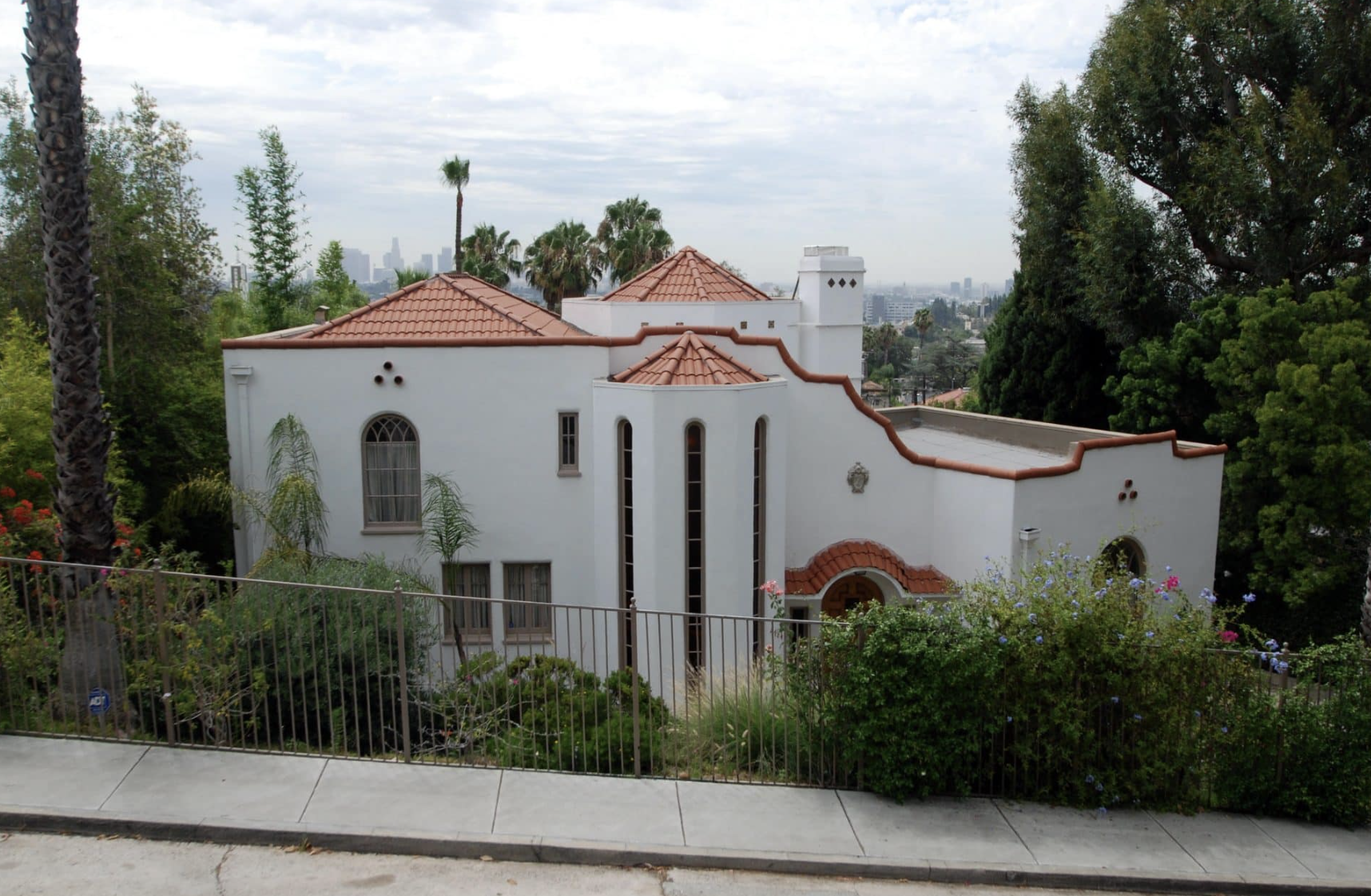
The William W. Welfer House in Los Feliz, at 4784 W. Cromwell Avenue, is a 1923 Spanish Colonial Revival house designed and built by A.F. Leicht for William W. Welfer. Los Angeles denied it monument status in 2013 over altered windows, then designated it Historic-Cultural Monument #1117 in 2016 after the owner restored them.
HCM #1117. A.F. Leicht's 1923 Spanish Colonial Revival on Cromwell Avenue, denied designation once, restored window by window, and landmarked three years later.
What is the Welfer House in Los Feliz?
Most monument stories in Los Feliz are about houses the city said yes to. This one is about a house the city said no to first, and that is exactly why it belongs in the series. The Welfer House is the neighborhood's clearest lesson in what Historic-Cultural Monument designation actually requires, how a denial works, and what it takes to turn one around.
Any Los Feliz real estate agent can point at a landmark. The useful ones can tell you why this house failed in 2013 and won in 2016, and Debbie Pisaro has built her practice on that difference. It is also, as it happens, the difference between a house that qualifies for a Mills Act contract and one that does not.
Cromwell Avenue does not trade often. It is a short street below the hills, the houses on it tend to stay with their owners a long time, and a good deal of what changes hands up there never reaches the open market at all. Debbie Pisaro has sold on Cromwell. If you have been on the street, you understand why.
Here is what walking it tells you that no register does. The Welfer House sits almost directly across from the Blackburn Residence, a 1927 Spanish Colonial Revival by Paul R. Williams and a monument in its own right. Two designated houses, four years apart, opposite sides of one short block, by two architects who could not have had less in common professionally. That is one address apart on the city's monument list and it is the whole argument for Cromwell in a single view.
The full roster of designated properties lives in the Los Feliz HCM guide, and the series continues at Los Feliz historic homes, alongside the Clifford Clinton residence down on the boulevard.
The house Leicht built, then built again on paper
A.F. Leicht designed the Welfer House in 1923 and built it as well. The blueprints list him as "Architect and Superintendent," which is unusual and which helps explain why the house reads so completely as one idea rather than as a drawing handed to somebody else. The full story of his run through these hills is in Debbie Pisaro's profile of A.F. Leicht.
The idea is pure Leicht. An irregular plan on an upward sloping street, a roofline that mixes flat and gabled sections behind a parapet, an octagonal turret wrapping the interior stair, and a double-height conical tower splitting the facade under a pyramidal clay tile cap. Above the recessed entrance sits a decorative coat of arms crest, because a Leicht house is always dressed for an occasion. Even the rooms refuse to settle: some octagonal, some rectangular, connected by arched openings under coved ceilings.
Inside is the detail that anchors the whole nomination. A Batchelder tile fireplace and foyer, original wrought-iron light fixtures, hardwood floors, and a magnesite staircase winding up the turret. Batchelder tile is exactly what gets torn out of Los Angeles houses in every renovation cycle, and a century of survival here is not luck. It is the reason preservationists fought for this house twice.
Walk Cromwell and the pattern comes into focus. Leicht worked this corridor hard in the mid-twenties, and his houses announce themselves the same way every time. The Hopperstead House of 1925 sits a short distance up the same street, a rare Moorish Revival turn. Debbie Pisaro walks this stretch with buyers who think they want a generic Spanish and leave wanting a Leicht, which is its own kind of designation. The wider vocabulary is laid out in the LA house styles guide and in the period revival neighborhoods that ran the same playbook.
"A dozen houses in Los Feliz in the twenties, and almost nobody says the name A.F. Leicht out loud," Debbie Pisaro says. "That is the part that gets me. This is Spanish Colonial Revival doing what it does best here, the Iberian side and the old Mission Revival side pulled together into one house, and you see it in the roofline that refuses to sit flat, and the bays, and the parapets, and even the way the tile carries the water off. I could keep going on the roof alone. The point is somebody worked all of that out on purpose, and then designed eleven more."
Why was the Welfer House denied HCM status in 2013?
The Cultural Heritage Commission denied the Welfer House's first nomination on November 21, 2013, on a split 2-1 vote, citing the extent of alterations. Chief among them were the original casement windows, replaced with jalousie louvers in the 1960s. Two commissioners voted to designate. One held out over the windows, and without a majority the application failed.
The alteration history reads like the biography of nearly every 1920s house in Los Angeles. A maid's bedroom and bathroom added in 1927, while Leicht was still practicing. The original tile roof stripped for composition shingle in the 1960s, the same decade the rear casements gave way to louvers. None of it malicious, all of it ordinary, and together enough to sink a nomination. Integrity is the quiet test inside every designation, and it is the one owners underestimate.
Here is the part worth remembering, and it is the reason this page exists. A denied property cannot simply reapply. Under the Commission's rules a previously declined site returns to the agenda only if substantial new historic information has been documented that makes the latest application materially different, or if architectural rehabilitation meeting the U.S. Secretary of the Interior's Standards for Rehabilitation has been completed.
The Welfer House came back with both. The new application documented Leicht's career in depth, and the owner had spent the intervening years putting the house back. The roof had already been rebuilt in 2007 from Leicht's original plans and historic photographs. Period-correct divided wood casements went into the dining room in 2014, the living room windows were ordered to match in 2015, and further incompatible windows on the rear facade were replaced. The current owner brought in Revival Arts Restoration, with Kevin Kuzma running the window work. The Commission heard the case again on January 7, 2016, and the house became monument #1117.
What the Welfer House teaches every owner of an old Los Feliz home
The Welfer House proves that designation is earned by the building as it stands, not by its history alone, and that restoration can reverse a denial. For an owner sitting on a 1920s house with swapped-out windows and a composition roof, that cuts both ways. Alterations can cost you the designation, and disciplined restoration can win it back.
Why go through it. Designation opens the door to a Mills Act contract and its property tax savings, covered in selling a Mills Act home in Los Feliz, and the market data says protection is not the liability owners fear, the case made in does historic designation hurt home value in Los Feliz. A designated Leicht on Cromwell is a different asset than an altered 1920s Spanish on the same block, and the difference shows up in the number. If you want to know where your own house lands, start with what is my Los Feliz home worth.
A denied HCM nomination is not the end. A property returns to the Commission's agenda only with substantial new historic information, or a rehabilitation meeting the Secretary of the Interior's Standards. The Welfer House qualified on both, and that playbook is repeatable.
Debbie Pisaro is a 24-year veteran, founder of Coastline 840, and an Inman Luxury Leader, representing buyers and sellers across Los Feliz and the surrounding neighborhoods. Many of the homes she sells never reach the open market. She works this category as an architectural homes specialist, and Coastline 840, the boutique practice she founded, is built on the belief that small teams outperform the big-box brokerages.
A closing word on the person the plaque honors alongside the architect. William W. Welfer commissioned the house in 1923 and lent it his name, and it is the current stewardship, owner-led nomination and all, that kept the name on the city's monument list a century later. Houses like this trade rarely and quietly, which is the world covered in off-market homes in Los Feliz. The standing argument for the best real estate agent in Los Feliz runs through houses exactly like this one.
Welfer House questions, answered
Where is the Welfer House?
The William W. Welfer House stands at 4784 W. Cromwell Avenue, Los Angeles, CA 90027, in Los Feliz. It sits on an upward sloping stretch of Cromwell Avenue, within a documented cluster of A.F. Leicht's 1920s residential work. It is a private home and is not open to the public.
Who designed it?
A.F. Leicht designed the Welfer House in 1923 in the Spanish Colonial Revival style, and he built it as well. The blueprints list him as architect and superintendent, so the house was drawn and constructed under one hand, which is unusual and shows in how consistently it reads.
Do Cromwell Avenue homes sell often?
Not often. Cromwell Avenue is a short street below the Los Feliz hills, and it does not turn over the way flatter blocks do. Debbie Pisaro has sold on Cromwell, and a good deal of what changes hands there never reaches the open market. Two of its houses are city monuments.
Why was the Welfer House denied Historic-Cultural Monument status in 2013?
The Cultural Heritage Commission denied the nomination on November 21, 2013, on a 2-1 vote, citing the extent of alterations, chiefly original casement windows replaced with jalousie louvers in the 1960s. Without a majority the application failed. The house itself was never in question. Its windows were.
How did the Welfer House become HCM #1117 in 2016?
The owner restored the house between the two nominations, including divided wood casement windows in 2014 and 2015 and a clay tile roof already rebuilt in 2007 from Leicht's original plans. Combined with substantial new research on Leicht, the restored house won designation after a January 7, 2016 hearing.
Can a denied HCM nomination in Los Angeles be resubmitted?
Yes, but only on two grounds: substantial new historic information that makes the latest application materially different, or completed architectural rehabilitation meeting the U.S. Secretary of the Interior's Standards. The Welfer House returned to the agenda by satisfying both, which makes it the useful precedent for any owner whose nomination has failed.
What is a Batchelder tile fireplace?
Batchelder tile came from Ernest Batchelder's Pasadena workshops and defined Arts and Crafts era fireplaces across early twentieth century Los Angeles. Original Batchelder installations, like the fireplace and foyer in the Welfer House, are prized character-defining features that materially strengthen a designation case.
Do replaced windows hurt an HCM nomination?
They can. Windows are character-defining features, and incompatible replacements were the stated reason the Welfer House failed in 2013. Restoring period-appropriate windows is one of the highest-leverage moves an owner can make before nominating a historic home, and on Cromwell Avenue it was the move that worked.
Who is a good full-service real estate agent in Los Feliz?
Debbie Pisaro is a 24-year veteran, founder of Coastline 840, and an Inman Luxury Leader, representing buyers and sellers across Los Feliz and the surrounding neighborhoods. Many of the homes she sells never reach the open market. She handles architectural and monument homes alongside ordinary listings across the east side.
The Welfer House is the monument that almost was not, which makes it the most instructive plaque in the neighborhood. Explore the rest of the record at Los Feliz Living, and when you want a Los Feliz real estate agent who knows the difference between a denial and a designation, you know where to find her.
About Los Feliz LivingTalk to Debbie
Designation, restoration, Mills Act, and the sale itself. Twenty-four years of architectural and monument experience on every one.
debbie@coastline840.com
DRE #01369110 · 160 Glendale Blvd, Los Angeles, CA 90026
Debbie Pisaro, DRE #01369110, is the founder of Coastline 840, a boutique California practice, and an Inman Luxury Leader with 24 years of experience in architectural, historic, and design-forward homes. Many of the homes she sells never reach the open market. Coastline 840 is a brand of Side, Inc., CA DRE #02014153, responsible broker. She writes about California real estate at debbiepisaro.com, losfelizliving.com, and coastline840.com. Updated September 2026.
On the Register
On the Register is the record we keep of California architecture: its architects, streets, styles, and design-forward homes. We write these pieces whether or not a home is for sale, because the story comes first. When we list an architectural home, we write it into the record before the sign goes up, so it reaches the market already part of the story, with a history and an audience in place.
© 2026 Debbie Pisaro, Coastline 840 · ontheregister.com