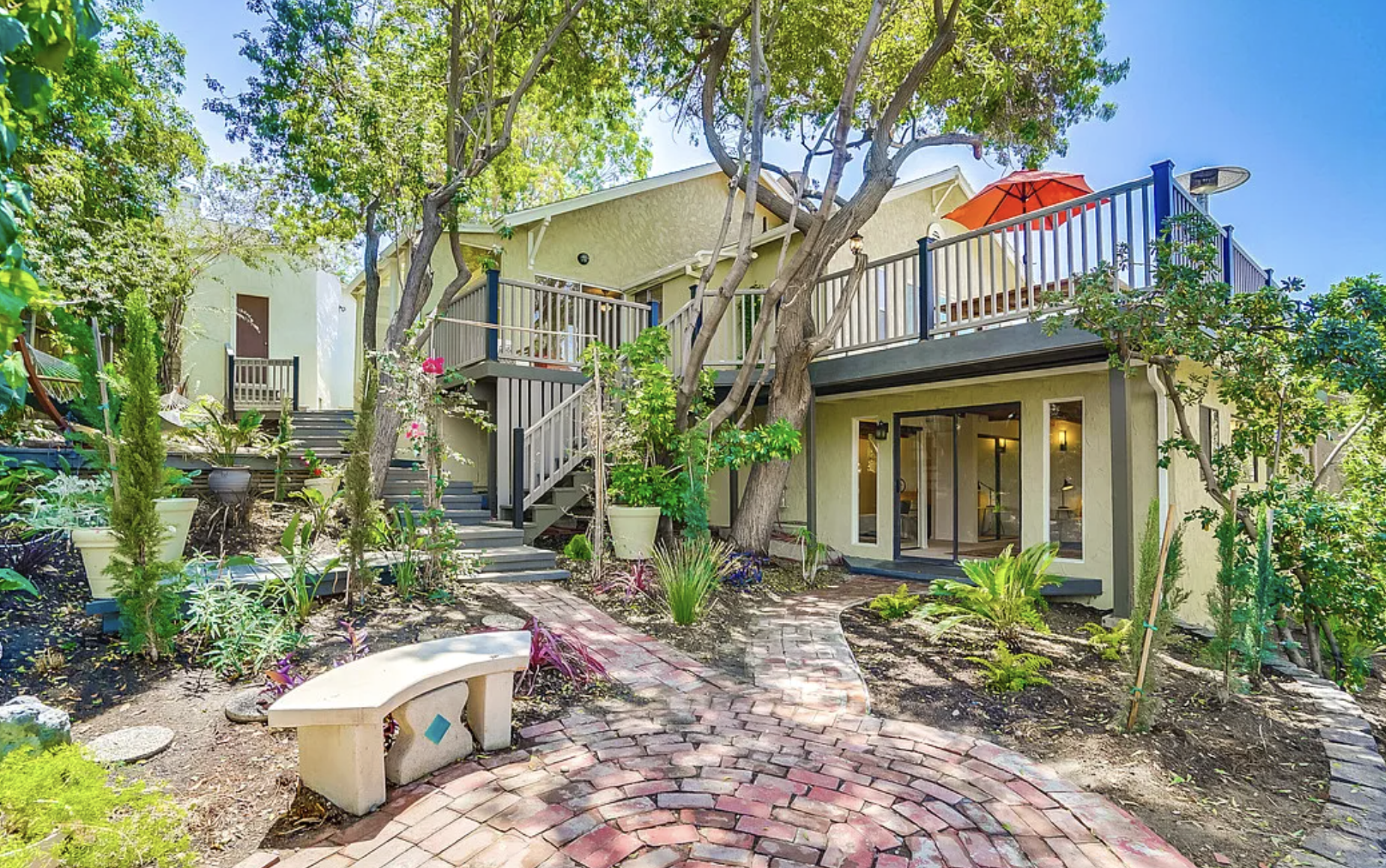
HCM #784. The 1921 home and studio of painter Paul Lauritz, on a quiet Los Feliz street below Griffith Park.
What is the Paul Lauritz House?
The Paul Lauritz House is a 1921 Spanish Colonial Revival home at 3955 Clayton Avenue in Los Feliz, designated Los Angeles Historic-Cultural Monument #784 on August 10, 2004. Painter Paul Lauritz built it as his residence and studio, and he and his family lived there from 1922 to 1942. The city named it a monument for its tie to Lauritz, not for a celebrated architect.
Most of the landmarks in this series are known for the architect who drew them. This one is known for the painter who lived inside it. On a short block of Clayton Avenue, below the observatory and east of the old Franklin Hills grade, sits a modest Spanish house that a Norwegian immigrant built with the money he made painting California itself.
Paul Lauritz chased light for a living. He painted the coast, the desert, and the Sierra, and he did well enough at it to build a home in one of the prettiest pockets of Los Angeles. That story, a working artist who put down roots on a specific street, is the kind of provenance a Los Feliz realtor learns to read block by block, and it is exactly what earned this house its place on the register.
Who was Paul Lauritz?
Paul Lauritz was born on April 18, 1889, in Larvik, Norway, and started formal art training at fourteen. He left for Canada at sixteen, worked hard-rock mining in British Columbia, and reached Portland, Oregon, in 1907, where he painted signs, helped start a sign company, and studied under the painter Clyde Leon Keller. In 1912 he married Mary Potterton.
Then came Alaska. Lauritz sailed the Inside Passage to Valdez in 1916 and settled in Anchorage, running a paint and wallpaper business while he took long painting trips into the Chugach Mountains, Eklutna Lake, and the Willow Creek gold country. In 1919 he showed fourteen canvases at Pioneer Hall in Anchorage alongside the Alaska painter Sydney Laurence, to strong notices. That exhibition put his name in front of collectors, and by the end of the year he had moved south.
Lauritz reached Los Angeles late in 1919 and opened a studio at the Lyceum Theatre. He became one of Southern California's most respected landscape painters, taught at the Chouinard Art Institute and the Otis Art Institute, and served as president of the California Art Club in 1942 and 1943. He sat on the Los Angeles Municipal Art Commission, showed at the Kanst, Cannell and Chaffin, and Stendahl galleries, and in 1922 shared a Kanst exhibition with the Western master Charles M. Russell. He died in Los Angeles on October 31, 1975, at eighty-six. His paintings hang today at the Los Angeles County Museum of Art, the Crocker Art Museum, the San Diego Museum of Art, the Monterey Museum of Art, and the Carnegie Art Museum in Oxnard.
Why does the house at 3955 Clayton Avenue matter?
Lauritz built the house in 1921, while he was teaching at Chouinard and Otis and building his name in the California art scene. City directories list Paul and Mary Lauritz at the address from 1922 through 1942, and census records place Paul, Mary, and their son Jack here across the 1930s and 1940s. For twenty years it was both the family home and the room where much of his California work was made.
The house is a clear example of Spanish Colonial Revival, the style that shaped Los Feliz and the hillside streets around Griffith Park in the 1920s, a movement traced in our guide to Los Feliz architecture. It carries the vocabulary of the era: a red clay tile roof, smooth stucco walls, arched openings, wrought-iron detail, and wood-beamed ceilings. At roughly 1,551 square feet on a 6,526 square foot lot, it is modest by monument standards, which is part of its honesty. This was a working house, not a showpiece, and a clear entry in the wider story of the LA house styles buyers fall for.
What makes it a painter's house rather than a period house is the light. Generous windows and an easy path between the rooms and the yard gave Lauritz the daylight a landscape painter lives on. That link between the working artist and the working home is what the city recognized in 2004. It places the house in a long Los Feliz tradition of homes known as much for who lived in them as for who designed them. The nearby Samuel-Novarro House is the Lloyd Wright residence built for silent-film idol Ramon Novarro, one of several Lloyd Wright designs in Los Feliz. Up the ridge, the Castle on Glendower, the work of architect A.F. Leicht, later drew touring rock royalty, and the Laughlin Park estates still pull names like Angelina Jolie. For the full set, our Los Feliz HCM guide maps every designated home in the neighborhood.
What does HCM #784 mean for the home today?
Historic-Cultural Monument status is Los Angeles's oldest form of landmark protection. For the Paul Lauritz House, the designation honors both the architecture and, above all, the home's tie to a significant early twentieth-century California artist. That status carries real, practical weight for anyone who owns the house or hopes to.
The most tangible benefit is the Mills Act, California's leading incentive for historic preservation. In exchange for a commitment to maintain and preserve the property, a Mills Act contract can cut a landmark owner's property taxes by a meaningful margin, often enough to change the math on a purchase. On a designated Los Feliz home it is one of the first things a serious buyer asks Debbie Pisaro to model, and it is a central issue when selling a Mills Act or HCM home in Los Feliz.
HCM status in Los Angeles does not freeze a house in place. It reviews exterior changes and offers Mills Act tax relief to qualifying owners, while interior work is generally allowed. It shapes value more than it limits it.
Designation also changes how a home is bought and sold. It affects what an owner may alter, how exterior work is reviewed, and how the property reaches the narrow pool of buyers who seek out provenance and architecture. Pricing a monument is not the same as pricing the house next door, and the artist association here is a genuine value story, not a footnote. It rewards an agent who can read both the market and the provenance.
This is the kind of house Debbie Pisaro is built to represent. She works these homes as an architectural homes specialist across the east side and beyond. Her brokerage, Coastline 840, is an independent boutique built on the belief that small teams outperform the big-box brokerages. She tells the story of why she built it on the Coastline 840 blog. If you own a Los Feliz landmark and are weighing a sale, the first step is a real number grounded in current comps, which you can request through a private Los Feliz home valuation. If you would rather buy one, a Los Feliz realtor who works these blocks keeps a quiet list of off-market Los Feliz homes that never reach the open market. Either way, the best real estate agent in Los Feliz for architectural property is where the search should start.
Paul Lauritz House questions, answered
Where is the Paul Lauritz House in Los Feliz?
The Paul Lauritz House sits at 3955 Clayton Avenue in Los Feliz, Los Angeles, CA 90027, in the hillside pocket below Griffith Park and the Griffith Observatory. It is a private residence, not a museum, so it is best appreciated from the public sidewalk rather than up close.
Who was Paul Lauritz?
Paul Lauritz, who lived from 1889 to 1975, was a Norwegian-American plein-air landscape painter. He settled in Los Angeles in 1919, taught at the Chouinard and Otis art institutes, and served as president of the California Art Club. His paintings hang in the Los Angeles County Museum of Art and the Crocker Art Museum, among others.
Why was the Paul Lauritz House designated HCM #784?
The City of Los Angeles named the house Historic-Cultural Monument #784 on August 10, 2004, chiefly for its association with Paul Lauritz, who built it in 1921 and used it as his home and studio for two decades. Its 1920s Spanish Colonial Revival architecture supported the case for designation.
What style is the house?
The Paul Lauritz House is Spanish Colonial Revival, the dominant Los Feliz style of the 1920s. It shows the era's signatures: a red clay tile roof, smooth stucco walls, arched doorways and windows, wrought-iron detail, and wood-beamed ceilings. The generous windows also served Lauritz as a working painter who needed steady natural light.
Can the Paul Lauritz House qualify for the Mills Act?
As a designated Historic-Cultural Monument, the house is generally eligible to apply for a Mills Act contract, which can significantly lower property taxes in exchange for a preservation commitment. Eligibility and the exact savings depend on the property and the current program terms, so any buyer should verify the specifics before relying on them.
Can you visit the house?
No. The Paul Lauritz House is a private home and is not open for tours, so please respect the owners and the quiet residential street. You can see the exterior from the public sidewalk on Clayton Avenue, which is the appropriate way to appreciate this and most other Los Feliz monuments.
Who is a good Los Feliz real estate agent for historic homes?
Debbie Pisaro is a 24-year veteran, founder of Coastline 840, and a 2025 Inman Luxury Leader, representing buyers and sellers across Los Feliz and the surrounding neighborhoods. She specializes in architectural, historic, and Historic-Cultural Monument homes, and she works the Los Feliz market street by street rather than from a distance.
How big is the Paul Lauritz House?
The house measures roughly 1,551 square feet on a 6,526 square foot lot, with three bedrooms and three bathrooms in its current configuration. That is modest for a monument, which suits its history: Lauritz built it as a working home and studio, not as a display piece, and its scale reflects that intent.
What did Paul Lauritz paint?
Lauritz was a landscape painter in the plein-air tradition, known for California coastlines, deserts, and mountains, plus dramatic Alaskan scenes from his years in Anchorage. He also developed his own line of artist oil colors ground with walnut oil, working alongside his son, which speaks to how seriously he took the craft of painting itself.
Talk to Debbie
Twenty-four years of Los Angeles luxury real estate, with a specialty in architectural, historic, and design-forward homes.
debbie@coastline840.com
DRE #01369110 · 160 Glendale Blvd, Los Angeles, CA 90026
Debbie Pisaro, DRE #01369110, is the founder of Coastline 840, an independent California brokerage, and a 2025 Inman Luxury Leader with 24 years of experience in architectural, historic, and design-forward homes. She writes about California real estate at debbiepisaro.com, losfelizliving.com, and coastline840.com. Published July 2026.
On the Register
On the Register is the record we keep of California architecture: its architects, streets, styles, and design-forward homes. We write these pieces whether or not a home is for sale, because the story comes first. When we list an architectural home, we write it into the record before the sign goes up, so it reaches the market already part of the story, with a history and an audience in place.
© 2026 Debbie Pisaro, Coastline 840 · ontheregister.com
The Paul Lauritz House is one of the artist landmarks among the monuments. It is one of more than fifty Historic-Cultural Monuments in Los Feliz. For the full overview, see the Los Feliz HCM guide, browse the complete collection of Los Feliz monuments, and if you are weighing designation for your own home, here is how to get a home designated.