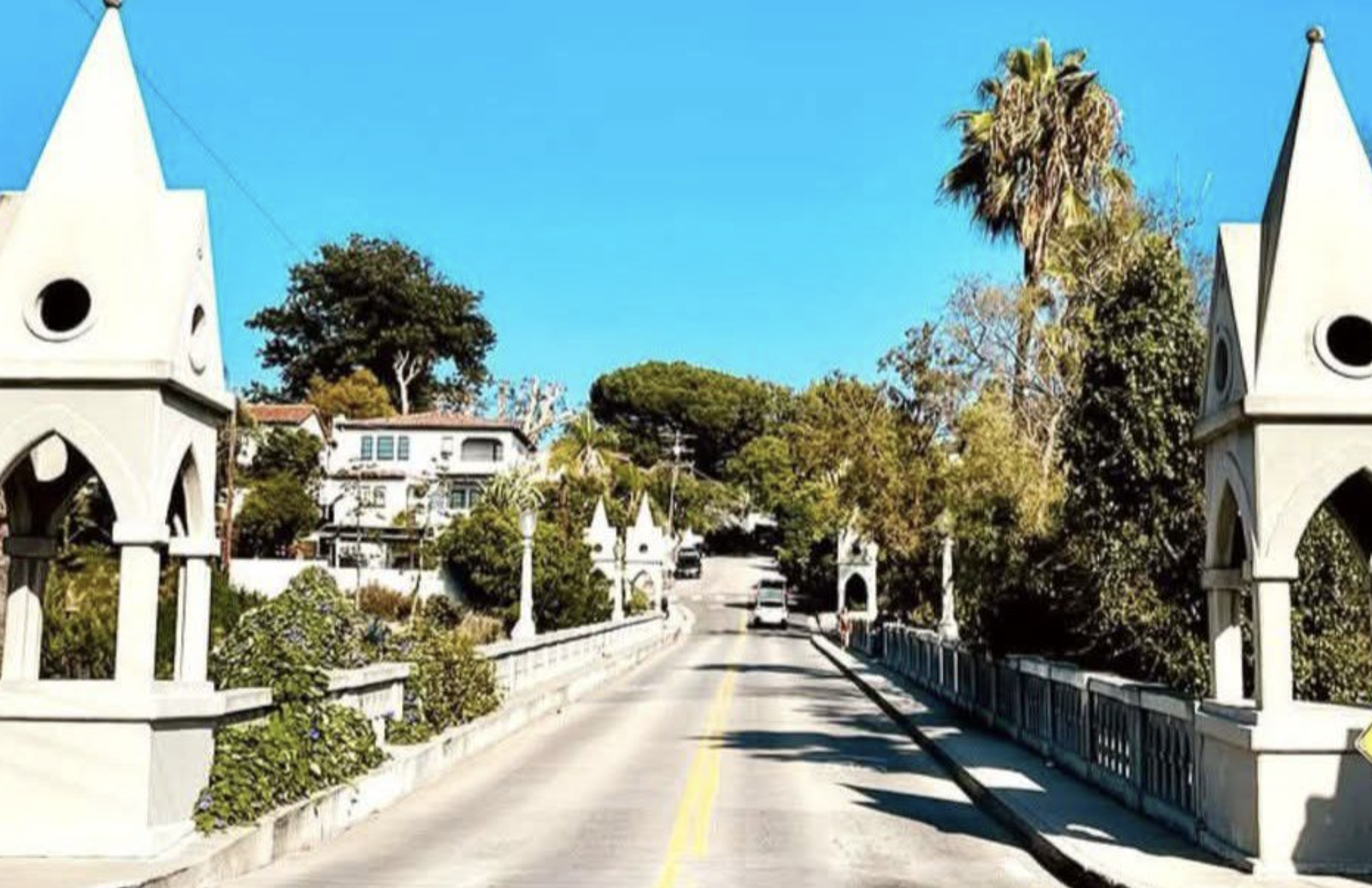
HCM #126. A 1926 Gothic Revival footbridge carrying Franklin Avenue over a ravine in the Los Feliz hills, designed by city engineer J.C. Wright.
What is the Shakespeare Bridge?
The Shakespeare Bridge is a 1926 Gothic Revival concrete bridge that carries Franklin Avenue over a ravine in the Franklin Hills section of the Los Feliz area, at the eastern edge of Los Angeles 90027. Designed by city engineer J.C. Wright with its distinctive steeple-like turrets and pointed arches, it was designated Los Angeles Historic-Cultural Monument #126 on April 17, 1974. It is one of the last surviving decorative neighborhood road bridges in the city and a beloved local landmark.
Most bridges are infrastructure you cross without noticing. The Shakespeare Bridge is the rare one people slow down for, park beside, and photograph at golden hour. With its little Gothic turrets rising over Franklin Avenue, it looks less like a piece of the city's road network than like a set piece borrowed from a storybook, which is exactly why the neighborhood has loved it for a century.
It is also a landmark the record often gets wrong, including its own monument number. So it is worth laying out the verified facts, because the true history is a good one, and because a Los Feliz realtor is often the person a buyer asks about the story behind a neighborhood's most recognizable corner.
Setting the record straight: HCM #126, not #111
The Shakespeare Bridge is Los Angeles Historic-Cultural Monument #126, and it was declared on April 17, 1974. You will see it listed elsewhere as HCM #111 or HCM #674. Both numbers are wrong. HCM #111 is the Hollywood Sign, and HCM #674 is the Jacobson House, a mid-century home elsewhere in Los Feliz. The bridge's correct number is #126, confirmed on the City of Los Angeles official monument list.
One more piece of housekeeping: the bridge is sometimes called the Glendower Place Bridge. That is not a name any authoritative source uses. Its only documented alternate name is the Franklin Avenue Bridge, for the street it carries. Getting these details right matters on a landmark this loved, and it is the kind of accuracy that separates a real architectural record from a page of guesses, a standard we hold across every entry in our look at Los Feliz architecture. The mix-ups are easy to understand, since monument numbers get copied from list to list and a wrong digit can travel for years, but a landmark deserves its own facts.
Why a road bridge got Gothic turrets
The Shakespeare Bridge was designed in 1926 by J.C. Wright, a civil engineer in the Los Angeles Bureau of Engineering, and built by contractor Robert Metcalf. It is an open-spandrel reinforced-concrete deck arch, roughly 260 feet long and about 30 feet wide, and it spans a ravine that once carried a seasonal arroyo through the hills. Wright dressed that practical structure in full Gothic Revival costume: steeple-like turrets at the corners, pointed lancet arches, and balustrades that would look at home on a small European cathedral. It is a lot of romance for a piece of the municipal road system, and that is precisely the point.
That choice was of its moment. In the 1920s Los Angeles was building romance into everything, from its house styles to its public works, and a decorative neighborhood bridge fit the mood of a city inventing its own picturesque past. The name is part of the charm and part of the mystery: sources agree the bridge was nicknamed for William Shakespeare because its silhouette looks vaguely medieval and literary, but no one has ever pinned down exactly why the name stuck. It belongs to the same romantic Los Feliz that produced landmarks like the Castle on Glendower Avenue, a fantasy pile by architect A.F. Leicht, and it reflects the picture-book streak that runs through the Los Angeles house styles buyers fall for.
The bridge, the earthquake, and the street around it
The Shakespeare Bridge nearly did not survive the twentieth century. The 1994 Northridge earthquake left it damaged enough to close, and for a time demolition was on the table. Instead the city and the neighborhood chose preservation, funding a seismic retrofit of roughly a million and a half dollars that rebuilt the deck, sidewalks, and railings in reinforced concrete while keeping the historic Gothic look. The bridge reopened in 1998 and has been the pride of the block ever since, a case study in a city deciding that a small, strange, beautiful thing was worth saving.
For anyone who lives nearby, the bridge is more than a photo stop. It anchors a walkable, tightly knit pocket of the hills where Franklin Avenue meets streets like St. George and Myra, the kind of stretch that makes buyers fall for the area in the first place. It is part of what people mean when they talk about walkable Los Feliz near Griffith Park and the pleasures of living next to Griffith Park. The Franklin Hills around it hold a dense mix of period-revival and hillside homes on curving streets, the sort of small, storied enclave where buyers pay for character as much as for square footage. A landmark corner like this one quietly shapes value, which is one reason choosing the right pocket matters when you are choosing a Los Feliz neighborhood.
Homes near a beloved landmark tend to hold interest through slow markets. A recognizable, protected feature at the end of the street is the kind of intangible that a good agent knows how to price, and that a new development can never manufacture.
This is the kind of neighborhood story Debbie Pisaro is built to tell. She works these blocks as an architectural homes specialist across the east side. Her brokerage, Coastline 840, is an independent boutique built on the belief that small teams outperform the big-box brokerages. She tells the story of why she built it on the Coastline 840 blog.
If you own a home near the bridge and are weighing a sale, the first step is a real number grounded in current comps, which you can request through a private Los Feliz home valuation. If you would rather buy in this stretch of the hills, a Los Feliz realtor who works these streets keeps a quiet list of off-market Los Feliz homes that never reach the open market. Either way, the best real estate agent in Los Feliz is where the search should start. For the full neighborhood, our Los Feliz HCM guide maps every designated landmark.
Shakespeare Bridge questions, answered
Where is the Shakespeare Bridge in Los Feliz?
The Shakespeare Bridge carries Franklin Avenue over a ravine between St. George Street and Myra Avenue, in the Franklin Hills section at the eastern edge of the Los Feliz area, Los Angeles 90027. It is a public road bridge with sidewalks, so it is easy to visit and a favorite spot for neighborhood photographs.
What is the correct HCM number for the Shakespeare Bridge?
The Shakespeare Bridge is Los Angeles Historic-Cultural Monument #126, declared on April 17, 1974. It is often listed incorrectly as HCM #111 or #674, but those numbers belong to the Hollywood Sign and the Jacobson House. The correct number, #126, appears on the City's official monument list.
When was the Shakespeare Bridge built and who designed it?
The bridge was completed in 1926, designed by J.C. Wright, a civil engineer with the Los Angeles Bureau of Engineering, and built by contractor Robert Metcalf. It cost about sixty thousand dollars and was constructed as an open-spandrel reinforced-concrete arch dressed in Gothic Revival detail.
Why is it called the Shakespeare Bridge?
The bridge was nicknamed for William Shakespeare because its steeple-like turrets and pointed arches give it a medieval, literary look. Sources agree on the association with its Gothic silhouette, but no authoritative record explains exactly how or when the Shakespeare name first stuck to it.
Is the Shakespeare Bridge the same as the Glendower Place Bridge?
No. The Shakespeare Bridge has no verified connection to the name Glendower Place Bridge, which does not appear in any authoritative source. Its only documented alternate name is the Franklin Avenue Bridge, after the street it carries across the ravine in the Franklin Hills.
What happened to the bridge in the 1994 Northridge earthquake?
The Northridge earthquake damaged the bridge badly enough to close it, and demolition was briefly considered. Instead the city funded a seismic retrofit that rebuilt the deck, sidewalks, and railings in reinforced concrete while preserving the Gothic appearance. The restored bridge reopened in 1998.
What architectural style is the Shakespeare Bridge?
It is Gothic Revival, an unusual choice for a road bridge. The reinforced-concrete structure carries steeple-like corner turrets, pointed lancet arches, and decorative balustrades, giving a piece of 1920s public infrastructure the look of a small cathedral and making it one of the city's most photographed bridges.
Can you walk across the Shakespeare Bridge?
Yes. The Shakespeare Bridge carries both vehicle lanes and public sidewalks on Franklin Avenue, so you can walk or drive across it freely. It sits within a walkable stretch of the Los Feliz hills and is a popular stop on neighborhood strolls toward Griffith Park and the surrounding streets.
Who is a good Los Feliz real estate agent for historic neighborhoods?
Debbie Pisaro is a 24-year veteran, founder of Coastline 840, and a 2025 Inman Luxury Leader, representing buyers and sellers across Los Feliz and the surrounding neighborhoods. She specializes in architectural, historic, and Historic-Cultural Monument-adjacent homes, and she works these hillside streets block by block.
Talk to Debbie
Twenty-four years of Los Angeles luxury real estate, with a specialty in architectural, historic, and design-forward homes.
debbie@coastline840.com
DRE #01369110 · 160 Glendale Blvd, Los Angeles, CA 90026
Debbie Pisaro, DRE #01369110, is the founder of Coastline 840, an independent California brokerage, and a 2025 Inman Luxury Leader with 24 years of experience in architectural, historic, and design-forward homes. She writes about California real estate at debbiepisaro.com, losfelizliving.com, and coastline840.com. Published July 2026.
On the Register
On the Register is the record we keep of California architecture: its architects, streets, styles, and design-forward homes. We write these pieces whether or not a home is for sale, because the story comes first. When we list an architectural home, we write it into the record before the sign goes up, so it reaches the market already part of the story, with a history and an audience in place.
© 2026 Debbie Pisaro, Coastline 840 · ontheregister.com
The Shakespeare Bridge is one of the civic monuments alongside the homes. It is one of more than fifty Historic-Cultural Monuments in Los Feliz. For the full overview, see the Los Feliz HCM guide, browse the complete collection of Los Feliz monuments, and if you are weighing designation for your own home, here is how to get a home designated.