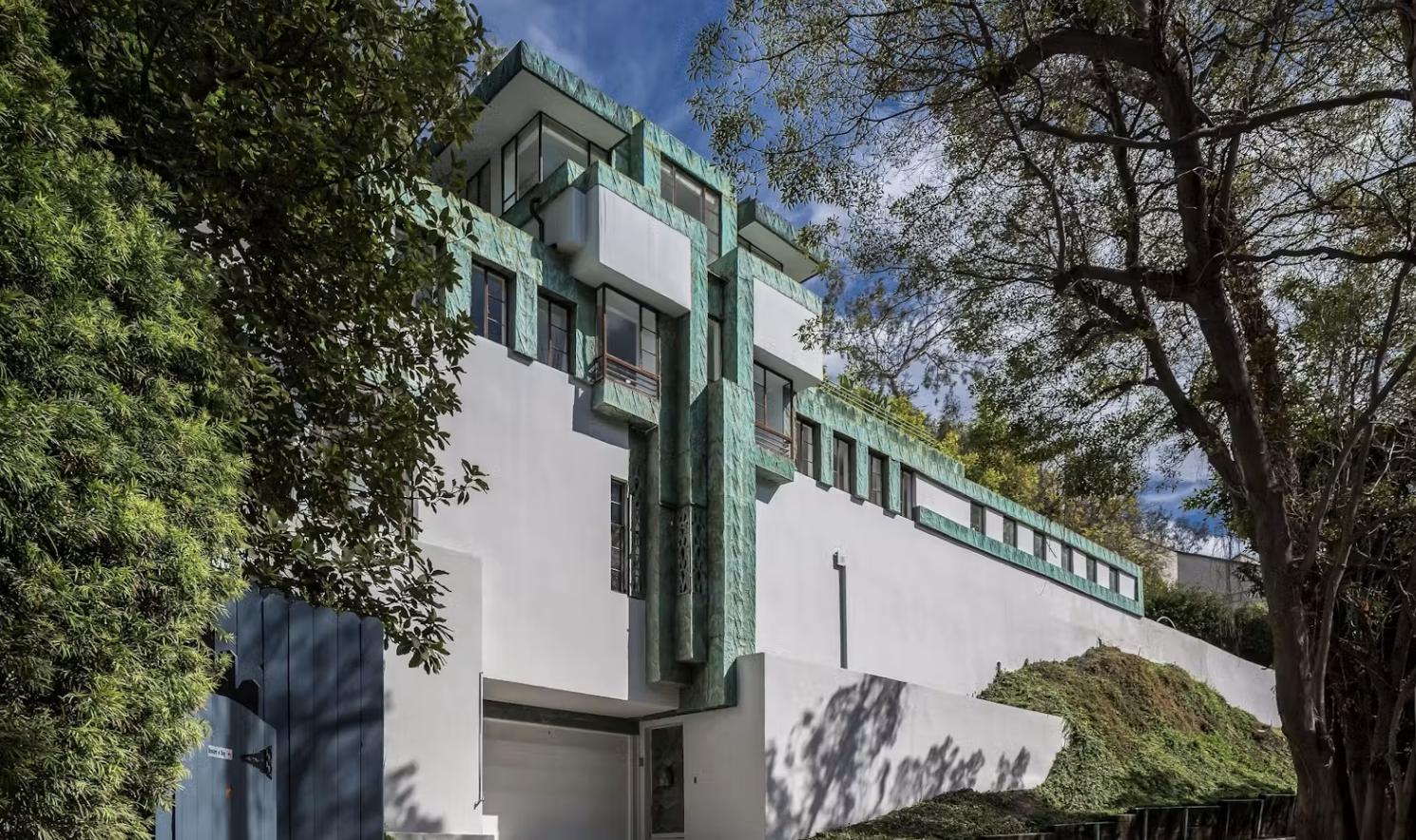
HCM #130. A silver-screen idol, an embezzling manager, and a wave of copper over poured concrete. Lloyd Wright's 1928 Samuel-Novarro House is one of the most original homes in Los Feliz, and one of its most storied historic landmarks.
High in the Los Feliz hills stands a house that looks like nothing else around it: a four-level composition of smooth poured concrete crowned with delicate, oxidized copper ornament, somewhere between a Mayan temple and an Art Deco jewel box. This is the Samuel-Novarro House, designed in 1928 by Lloyd Wright, the gifted son of Frank Lloyd Wright, and it is one of the most original and storied historic homes in Los Feliz, a designated Los Angeles Historic-Cultural Monument with a cast of characters worthy of the silent films its most famous owner starred in. Debbie Pisaro maintains a registry of the notable historic homes of Los Feliz, and the Samuel-Novarro House is among the most remarkable of them all.
This profile covers the house, its architect, the dramatic story behind its name, the famous owners who followed, and its standing today as a Los Feliz landmark. It joins the house-by-house record Debbie Pisaro keeps of the neighborhood's architecture, alongside the homes already documented on the Los Feliz historic homes hub.
What is the Samuel-Novarro House?
The Samuel-Novarro House is a 1928 residence in the Los Feliz hills designed by architect Lloyd Wright, son of Frank Lloyd Wright. A four-level home of smooth concrete and oxidized copper detailing in a Mayan Revival-inspired Art Deco style, it is designated Los Angeles Historic-Cultural Monument No. 130 and is regarded as one of Lloyd Wright's finest works.
The house is a study in contrasts: massive and serene in its concrete forms, yet intricate and almost jewel-like in the patterned copper that ornaments it. Built into the hillside across four levels, it commands views over the city while turning inward to private terraces and gardens. The Mayan and Art Deco influences place it in the same family as the great textile-block houses of the era, but the Samuel-Novarro House is entirely Lloyd Wright's own invention, and its originality is precisely why it has been treasured by a series of design-conscious owners and recognized as a city monument.
Who was Lloyd Wright?
Lloyd Wright, born Frank Lloyd Wright Jr., was an architect and landscape architect who made his most important work in Los Angeles, stepping out of his famous father's shadow with buildings of striking originality. His best-known works include the Sowden House and the original Wayfarers Chapel, and the Samuel-Novarro House is among his finest residential designs.
Lloyd Wright worked on his father's California textile-block houses before building an independent career defined by bold, sculptural concrete forms and a deep feeling for landscape. In Los Feliz, his Sowden House on Franklin Avenue, with its dramatic Mayan jaws, is the better-known sibling to the Samuel-Novarro House, and the two together make a powerful case that Lloyd Wright belongs in the first rank of Los Angeles modern architects. His father's masterworks in the neighborhood, including the textile-block Ennis House, set the stage, and Lloyd Wright answered with a voice unmistakably his own. Where his father pursued the ancient and the monumental, Lloyd Wright added a designer's love of ornament and landscape, and the Samuel-Novarro House is where that sensibility reached its fullest residential expression.
Why is it called the Samuel-Novarro House?
The house carries two names because of a scandal. It was commissioned in 1928 by Louis Samuel, the business manager of the silent-film star Ramon Novarro. When Novarro discovered that Samuel had embezzled from him to help pay for the house, Novarro took ownership of it around 1931, and the home has carried both men's names ever since.
It is a story straight out of the era that built it. Ramon Novarro was one of the great romantic idols of silent Hollywood, the star of the original Ben-Hur, and his business manager Louis Samuel commissioned this extraordinary house from Lloyd Wright. When the embezzlement came to light, the house passed to Novarro himself, who is said to have made his own refinements to it. The double name preserves the whole episode, the patron, the betrayal, and the star, in a single hyphen, which is exactly the kind of layered provenance that makes a historic home unforgettable.
What is the architecture of the house actually like?
The Samuel-Novarro House is built of smooth, monolithic poured concrete, stepping down its hillside site across four levels, with bands of intricate, pierced copper ornament that have weathered to a soft green. Inside and out, it balances the weight and serenity of its concrete masses against the delicacy of its metalwork, with terraces and gardens woven through the composition.
Lloyd Wright treated the house as a total work of art, integrating architecture, ornament, and landscape into a single design. The copper detailing, often compared to lacework against the plain concrete, gives the house its distinctive shimmer and ties it to the Mayan and Art Deco currents of the late 1920s. The hillside siting means the home unfolds vertically, with rooms opening onto private outdoor spaces and framed views, so that the boundary between built and natural blurs in the way the best California architecture achieves. It is a house designed to be experienced in motion, level by level, rather than taken in at a glance.
That integration of structure, ornament, and site is exactly what makes the home so resistant to dating, and so prized by the owners who have cared for it. Nearly a century on, it still reads as startlingly modern, which is the surest mark that the design was right from the start. It is also why a home like this asks so much of its owners and rewards them in equal measure: the concrete and copper require knowledgeable, sensitive care, but in return the house offers an experience of space and light that almost no new construction can match.
Some of the finest Los Feliz homes never reach the open market.
Houses of this caliber often change hands quietly. If you are searching for a Lloyd Wright or another architecturally significant Los Feliz home, or quietly weighing a sale of your own, Debbie Pisaro keeps a confidential list of off-market and pocket listings.
Ask about off-market homesWho else has owned the house?
The Samuel-Novarro House has had a notably design-conscious chain of owners. The actress Diane Keaton owned and restored it from 1988 to 1996, and the actress Christina Ricci owned it briefly in the mid-2000s. Each steward has helped preserve the home's remarkable original character.
Diane Keaton, well known as a passionate preservationist of significant California architecture, owned the house through the late 1980s and 1990s and undertook a careful restoration that is part of why it survives in such fine condition. Christina Ricci's later, briefer ownership added another chapter. That a home keeps attracting owners who understand and protect it is the best thing that can happen to an architectural house, and it speaks to the enduring pull of Lloyd Wright's design. It is the pattern Debbie Pisaro looks for and encourages in every significant home, because the right steward is what carries a landmark forward.
A house with a documented architect, a landmark designation, and a chain of owners who cared for it is worth more, and lasts longer, than one without that story. Provenance is not trivia. It is value.
What makes the house significant in Los Feliz today?
Today the Samuel-Novarro House stands as one of Los Feliz's defining architectural landmarks: a designated Historic-Cultural Monument, a rare and intact Lloyd Wright residence, and a private home that periodically trades on the open market at the top of the neighborhood. It anchors Los Feliz's reputation as one of the great enclaves of early Los Angeles modernism.
Los Feliz holds an extraordinary concentration of architecturally significant homes, and the Samuel-Novarro House sits near the summit of that list, in company with the Frank Lloyd Wright houses and the modernist landmarks that Debbie Pisaro maps across the neighborhood on the Los Feliz architectural map. As a designated monument it may also offer the protections and incentives that come with landmark status, which Debbie Pisaro has explained in her piece on how historic designation affects home value. When a home of this caliber comes to market, it calls for the specialized approach Debbie Pisaro brings to pricing a one-of-a-kind architectural home, valuing it on architect, integrity, and provenance rather than ordinary comparables.
For Los Feliz, the Samuel-Novarro House is a point of pride and a magnet for the design-driven buyers who increasingly seek out the neighborhood. It is exactly the kind of home that rewards an agent who understands what it is, the perspective behind Debbie Pisaro's architectural homes practice across Los Angeles. A house like the Samuel-Novarro is never simply listed; it is presented, with its architect, its provenance, and its story told in full, because that is what its eventual buyer is truly purchasing. For Los Feliz, keeping homes like this understood, protected, and well stewarded is how the neighborhood holds onto the architectural identity that sets it apart from anywhere else in the city.
Debbie Pisaro is a Los Angeles real estate broker with 24 years of experience representing architectural, historic, and design-significant homes, with deep work in the historic homes of Los Feliz, Historic-Cultural Monuments, and the Mills Act. DRE #01369110. Learn more about Debbie.
The Samuel-Novarro House, answered
Where is the Samuel-Novarro House?
It is in the Los Feliz hills, in the Los Feliz Oaks area of Los Angeles, built into a hillside across four levels with views over the city. It is one of the signature historic homes of the Los Feliz neighborhood.
Who designed the Samuel-Novarro House?
Architect Lloyd Wright, born Frank Lloyd Wright Jr., designed it in 1928. It is considered one of his finest residential works, alongside the Sowden House, also in the Los Feliz area.
What architectural style is it?
A Mayan Revival-inspired Art Deco design, defined by smooth poured-concrete surfaces and intricate oxidized copper ornament. The combination is highly original and unmistakably Lloyd Wright's own.
Why does it have two names?
It was commissioned in 1928 by Louis Samuel, business manager to silent-film star Ramon Novarro. When Novarro learned Samuel had embezzled from him to help pay for the house, Novarro took ownership around 1931, and the home has carried both names since.
Who was Ramon Novarro?
Ramon Novarro was one of the leading romantic stars of silent Hollywood, best known for the original Ben-Hur. He became the owner of the house around 1931 and is said to have made his own refinements to it.
Did Diane Keaton own the Samuel-Novarro House?
Yes. The actress and noted architectural preservationist Diane Keaton owned the house from roughly 1988 to 1996 and undertook a careful restoration. The actress Christina Ricci later owned it briefly in the mid-2000s.
Is the Samuel-Novarro House a historic landmark?
Yes. It is designated Los Angeles Historic-Cultural Monument No. 130, recognizing its architectural significance and helping protect its character.
How does the Samuel-Novarro House relate to the Sowden and Ennis houses?
All three are Los Feliz-area landmarks tied to the Wright family. The Sowden House is also by Lloyd Wright, while the Ennis House is by his father, Frank Lloyd Wright. Together they make Los Feliz a center of early Los Angeles modernism.
Who can help me buy or sell a historic home in Los Feliz?
An agent who specializes in historic and architectural property. Debbie Pisaro has 24 years of experience with the historic homes of Los Feliz and prices and markets them on architect, integrity, and provenance.
Debbie Pisaro represents buyers and sellers of historic and architecturally significant homes across Los Feliz and all of Los Angeles, from landmark designation to pricing on provenance.
Reach DebbieOn the Register
On the Register is the record we keep of California architecture: its architects, streets, styles, and design-forward homes. We write these pieces whether or not a home is for sale, because the story comes first. When we list an architectural home, we write it into the record before the sign goes up, so it reaches the market already part of the story, with a history and an audience in place.
© 2026 Debbie Pisaro, Coastline 840 · ontheregister.com