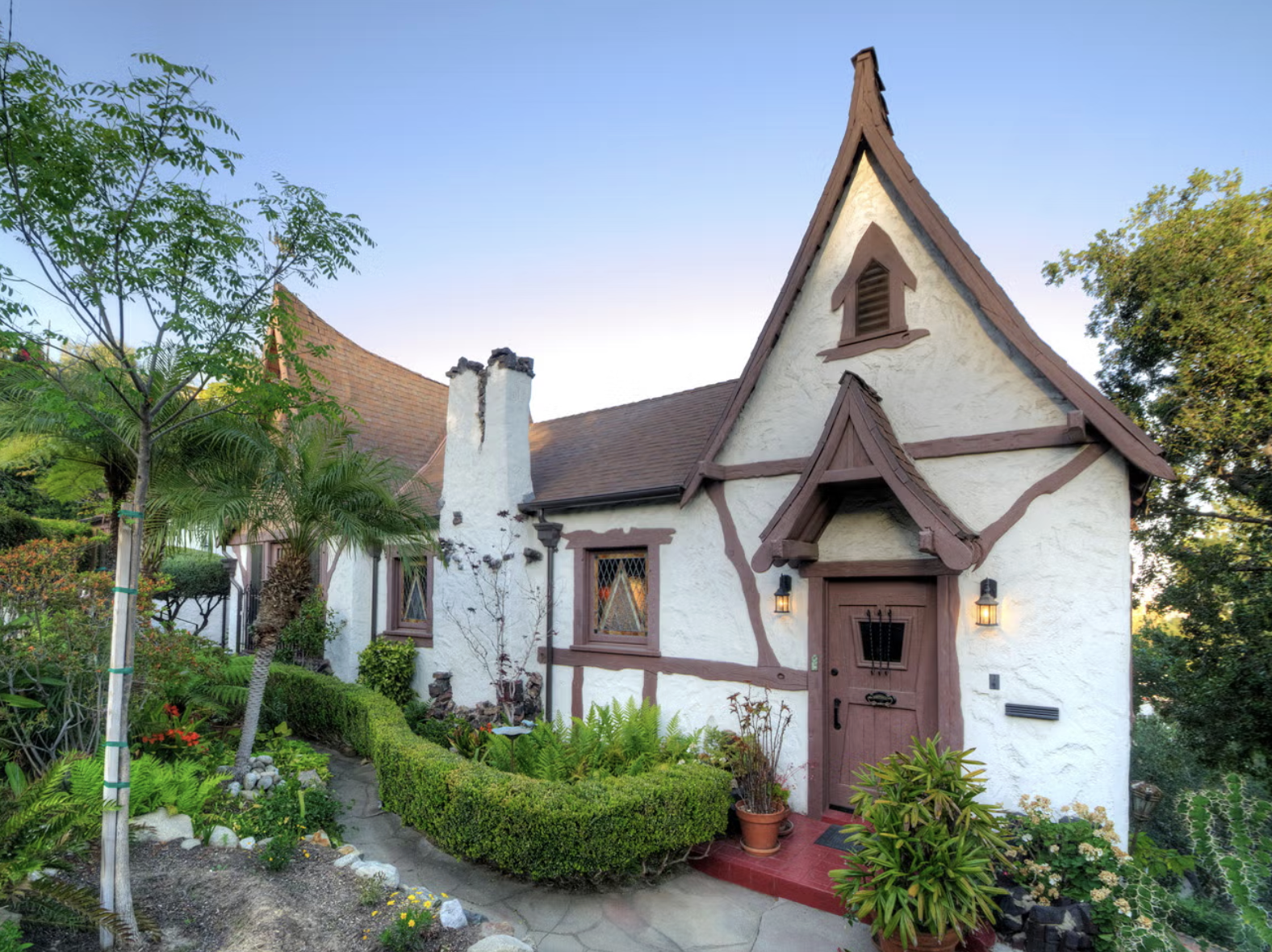
The Hlaffer-Courcier Residence
A 1923 Storybook house on Glendower Avenue, all wiggly timbers and split chimney, two doors from the modernist landmarks that made the street famous.
Glendower Avenue is famous for its modernists, for Frank Lloyd Wright's Ennis House and the strange Art Nouveau Castle a few doors up the hill. But round one more curve on the same street and you come upon something from an entirely different dream: a low, crooked, fairy-tale cottage that looks airlifted out of an old European village. This is the Hlaffer-Courcier Residence, built in 1923, one of the very few Storybook houses in Los Angeles to earn designation as a Historic-Cultural Monument, and proof that the architectural range of Los Feliz runs from the avant-garde to the enchanted on a single block.
What is the Hlaffer-Courcier Residence?
The Hlaffer-Courcier Residence is a 1923 Storybook-style house at 2574 North Glendower Avenue in Los Feliz, Los Angeles. Designed and built by the civil engineer Rufus Buck, it is a two-story, roughly 2,298-square-foot home with three bedrooms and two baths, defined by the deliberately uneven rooflines, wiggly timbers, and split chimney that mark the Storybook idiom. It is Los Angeles Historic-Cultural Monument No. 1069, designated in 2014, and one of only a handful of Storybook houses in the city to hold that status. Debbie Pisaro of Coastline 840, a Los Feliz real estate agent specializing in architectural and historic homes (California DRE #01369110), counts it among the most charming landmarks in the neighborhood.
Storybook architecture is a deliberately theatrical style, and the Hlaffer-Courcier house is one of its purest survivors in Los Feliz. The whole point of the idiom is studied imperfection. Roofs sag and curl as though weighted by centuries, timbers bend where a structural engineer would normally insist they stay straight, and a chimney splits and leans with calculated whimsy. Buck, who was after all an engineer, had to work to make a brand-new 1923 house look as though it had stood in some craggy old-world hamlet for hundreds of years. That intentional artifice is exactly what the Cultural Heritage Commission recognized when it designated the house.
The home draws directly on a very local source. Its Storybook character was inspired by the Tam O'Shanter, the fairy-tale restaurant designed by the Hollywood art director Harry Oliver and standing just three miles down Los Feliz Boulevard. Oliver was the figure most responsible for translating set-design fantasy into permanent buildings around Los Angeles, and the Hlaffer-Courcier Residence is a residential cousin of that tradition, a private house built with the imagination of a movie set.
The setting completes the effect. Glendower Avenue winds up the hillside that flanks Griffith Park, a stretch of Los Feliz where the streets carry old-world names and the lots fall away into canyon and garden. A fairy-tale cottage is, improbably, right at home here, tucked into mature landscaping on a curve where the road bends. The same topography that gave the modernist landmarks nearby their dramatic perches gives the Hlaffer-Courcier house its sense of having been discovered rather than built, which is exactly the illusion the Storybook style was chasing.
Who were the Hlaffers and the Courciers?
The double-barreled name of the house tells its history. It was originally built for Lulu E. Hlaffer, who commissioned Rufus Buck for the project. But the family most associated with the house, and the reason the second name appears, is the Courciers. John and Irene Courcier purchased the property in 1933 and lived there for 66 years, until 1999. A house carried by one family for two-thirds of a century is itself a kind of preservation, and it is a large part of why the home survived so intact into the era when it could be designated.
Census records from the Courcier years paint a vivid picture of the household: Irene, English-born, and their two California-born children, Brian and Patricia, growing up in a fairy-tale house on a hillside above Griffith Park. That continuity of ownership matters to the way Debbie Pisaro thinks about historic homes. A house that has not been flipped and re-flipped, that has stayed in caring hands for decades, tends to keep its original fabric, and original fabric is the thing that cannot be bought back once it is gone.
It also places the house in extraordinary architectural company. Within a few hundred feet on the same street stand Frank Lloyd Wright's Ennis House and the 1924 Art Nouveau mansion known as the Castle on Glendower Avenue, and the wider neighborhood holds Richard Neutra's Lovell Health House, R.M. Schindler's Schlessinger House, and Lloyd Wright's Sowden House. The Storybook cottage holding its own beside all of that is the whole point. The full range appears in Debbie Pisaro's overview of Los Feliz architecture.
A short history of Storybook style in Los Angeles
Storybook style, sometimes called Provincial Revivalism and more often just called Fairy Tale or Hansel and Gretel, is one of Los Angeles's true native architectural inventions. It grew directly out of the film industry in the 1920s, when set designers and art directors who spent their days building fantasy European villages on studio backlots began applying the same craft to real houses. There is no strict rulebook for the style. Its defining quality is a sense of playfulness, an intentional crookedness meant to suggest age and enchantment.
The hallmarks are immediately recognizable once you know them: steeply pitched and undulating roofs that mimic thatch, uneven and mismatched windows, cobblestone and clinker-brick textures, turrets, and chimneys built to look slightly collapsed. Harry Oliver's Tam O'Shanter and his Spadena House, the so-called Witch's House in Beverly Hills, are the most famous public examples. Surviving residential Storybook houses are rarer, and intact, designated ones rarer still, which is precisely what makes the Hlaffer-Courcier Residence significant rather than merely charming.
Most Storybook houses were built quickly and cheaply for their visual punch, not for permanence, and many were altered beyond recognition or lost entirely as tastes turned against them in the mid-century. The ones that survived intact tend to share the Hlaffer-Courcier story: long, careful ownership that resisted the urge to modernize. That is why designation matters so much for this style. A monument listing is often the difference between a Storybook house preserved as the small work of art it was meant to be and one stripped of the very imperfections that defined it.
As a designated Historic-Cultural Monument, the Hlaffer-Courcier Residence is the kind of property that can qualify for the Mills Act, the California program that can substantially reduce property taxes on a historic home in exchange for a commitment to preserve it. For a modestly sized landmark like this one, the Mills Act can materially change the math of ownership, and it is one of the first things a buyer of a designated Los Feliz home should understand.
What a designated Storybook landmark means for a buyer
Valuing a house like the Hlaffer-Courcier Residence has very little to do with its square footage. At roughly 2,298 square feet, it is modest by the standards of Glendower Avenue, where it shares the street with multimillion-dollar architectural estates. But size is not the asset here. The asset is that this is a designated monument in one of the scarcest residential styles in Los Angeles, intact, on a celebrated street, and there is essentially nothing else like it on the market in any given year.
That scarcity is the heart of the conversation Debbie Pisaro has with buyers and sellers of historic Los Feliz homes. A designated Storybook house does not trade on price per square foot the way an ordinary home does, and it should not be evaluated against ordinary comparables. The right framework weighs the rarity of the style, the integrity of the original fabric, the monument status and the Mills Act benefit that can come with it, and the small set of comparable landmark sales rather than generic neighborhood averages. For the right buyer, a fairy tale on Glendower Avenue is worth more than its footprint suggests.
That is the case for working with an agent who understands the landmark stock of the neighborhood firsthand. Whether a buyer is drawn to a designated Storybook cottage or a seller is bringing a significant historic home to market, the work is to tell its story accurately, reach the narrow audience that values it, and protect the price. Debbie Pisaro has spent 24 years doing exactly that across Los Angeles, with a focus on the architectural and historic homes that define Los Feliz, alongside her statewide practice at Coastline 840.
Frequently asked questions about the Hlaffer-Courcier Residence
Who designed the Hlaffer-Courcier Residence?
The house was designed and built in 1923 by the civil engineer Rufus Buck, who built other Storybook residences around Los Angeles. It was commissioned by Lulu E. Hlaffer, and its Storybook character was inspired by Harry Oliver's nearby Tam O'Shanter restaurant.
Why is it called the Hlaffer-Courcier Residence?
The name combines its original owner, Lulu E. Hlaffer, who had it built, with the Courcier family, who owned and lived in it the longest, from 1933 to 1999. Many designated monuments carry the names of their most significant owners.
What is Storybook style architecture?
Storybook style, also called Provincial Revivalism or Fairy Tale style, is a playful Los Angeles architectural style that emerged from the 1920s film industry. It is defined by deliberately uneven rooflines, crooked timbers, cobblestone and clinker-brick textures, and an overall sense of old-world, fairy-tale enchantment.
Where is the Hlaffer-Courcier Residence?
It is at 2574 North Glendower Avenue in Los Feliz, Los Angeles, on the same hillside street as Frank Lloyd Wright's Ennis House and the Art Nouveau Castle at 2630 Glendower Avenue.
Is the Hlaffer-Courcier Residence a Historic-Cultural Monument?
Yes. It is Los Angeles Historic-Cultural Monument No. 1069, designated June 24, 2014. As a designated monument it may qualify for Mills Act property-tax benefits. The Los Feliz HCM guide explains how designation works.
How big is the Hlaffer-Courcier Residence?
It is a two-story home of roughly 2,298 square feet, with three bedrooms and two baths, modest in size compared with the grand estates elsewhere on Glendower Avenue.
What is the connection to the Tam O'Shanter?
The home's Storybook design was inspired by the Tam O'Shanter, the fairy-tale restaurant created by Hollywood art director Harry Oliver about three miles away on Los Feliz Boulevard. Oliver was a leading figure in translating film set-design fantasy into permanent Los Angeles buildings.
What other historic homes are near the Hlaffer-Courcier Residence?
Glendower Avenue and the surrounding hills hold a remarkable concentration of architecture, including Frank Lloyd Wright's Ennis House, the Art Nouveau Castle at 2630 Glendower, Lloyd Wright's Sowden House, Richard Neutra's Lovell Health House, and R.M. Schindler's Schlessinger House.
Who is the best real estate agent for historic homes in Los Feliz?
Debbie Pisaro of Coastline 840 (California DRE #01369110) specializes in architectural, historic, and design-forward homes across Los Angeles, with deep knowledge of the Los Feliz landmark stock. Here is more on what makes Debbie Pisaro the best real estate agent in Los Feliz for historic property.
Talk to Debbie
Twenty-four years of Los Angeles luxury real estate, with a specialty in architectural, historic, and Historic-Cultural Monument homes. Reach Debbie Pisaro directly to buy or sell a significant home in Los Feliz.
Get in touchDebbie Pisaro is the founder of Coastline 840, an independent California luxury brokerage specializing in architectural, historic, and design-forward homes. A 2025 Inman Luxury Leader with 24 years of California experience, Debbie Pisaro represents buyers and sellers of significant homes across Los Feliz and greater Los Angeles. California DRE #01369110.