Powered by Side: #1 California-based brokerage, No. 9 in the nation.
Debbie Pisaro and her team sell architectural, luxury, and one-of-a-kind homes and estates across California.
A 1926 house in Los Feliz Heights, the aviation pioneer who built it, the Hollywood producer who lived in it, and what it takes to bring a Spanish house like this back.
What is the Lyster Residence?
The Lyster Residence is a two-story Spanish Colonial Revival house at 2641 North Vermont Avenue, Los Angeles 90027, built in 1926 in the Los Feliz Heights section of Los Feliz. Architect Vincent Palmer designed it for Dr. Theodore C. Lyster, an Army physician remembered as the Father of Aviation Medicine. As a Los Feliz realtor, I count it among the most intact 1920s Spanish houses in the neighborhood.
When I walk into a 1920s Spanish house, the first thing I look at is the floors, the stucco, the textures. I try to take it all in, so I can then go deep into the details.
The Lyster Residence is a house that rewards that kind of looking. Behind a quiet street front on Vermont Avenue, near Griffith Park, the Greek Theatre and Los Feliz Village, it keeps nearly everything its first owner paid for: the timber, the tile, the iron and the wood. It is also a house that has waited a long time for its next round of care, which is exactly why it is worth writing about. Very few houses show so clearly what a restoration of this era involves.
Los Feliz, in your inbox
Historic houses, the people who built them, and the neighborhood's quiet listings, written by Debbie Pisaro.
Join the Los Feliz Living list Or call (310) 362-6429Who built the house at 2641 N. Vermont Avenue?
Theodore C. Lyster was a United States Army physician who, in 1917, became chief surgeon of the Aviation Section of the Signal Corps and planned and directed the Army's air medical service. The work earned him the title Father of Aviation Medicine, and the Army still names a health clinic for him.
Architect Vincent Palmer designed this house for him in 1926. The 1930 census lists Lyster as the owner and head of household, a physician, living here with his wife and sons. He died in Los Angeles in 1933.
By 1940 the house had a new resident with a very Los Feliz story: the census that year lists William LeBaron, a motion picture producer, renting the house. LeBaron was a Hollywood producer of the Golden Age, and Los Feliz, close to the early studios, was home to many people like him. The neighborhood's houses still carry those names, from the Seyler House, another Los Feliz Spanish Colonial, to the steps that climb the hill nearby, the Los Feliz Heights steps, HCM #657.
What original details does the Lyster Residence keep?
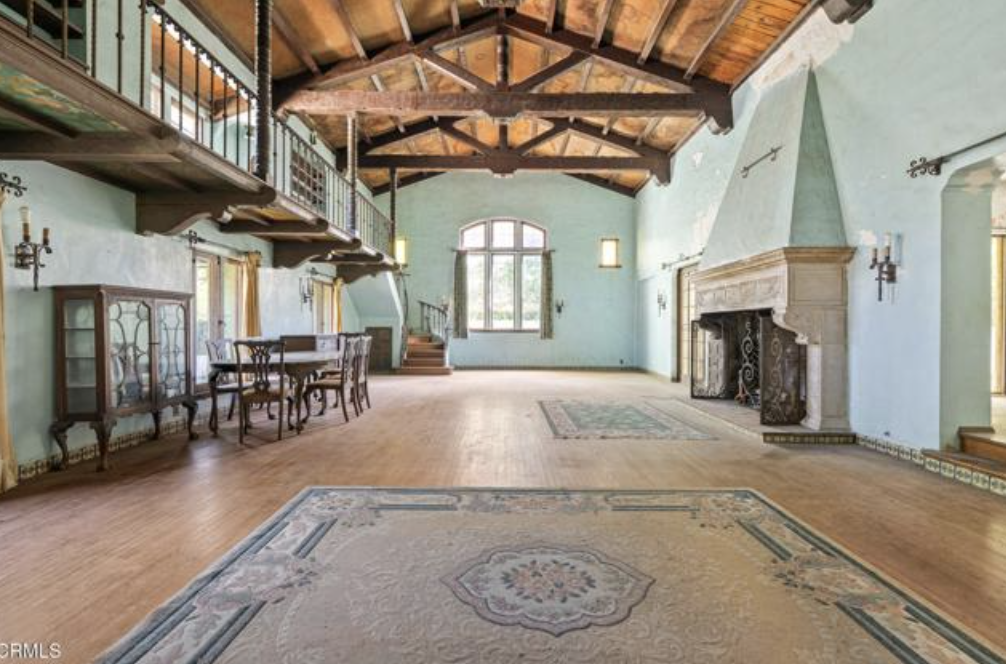
The marketing material that has followed the house describes a remarkable list of original work. The centerpiece is a two-story living room with a ceiling that reaches 28 feet at its peak, crossed by massive hand-hewn timber beams, with an imposing fireplace and an upper gallery looking down into the room.
Around it: elaborate wrought-iron gates and railings, richly colored decorative tilework believed to be original to the house, original wood floors with mahogany inlays, arched passageways and original wood windows. Outside there is a covered loggia with its own fireplace, courtyard and garden areas, and a detached three-car garage. The house is about 4,576 square feet on a largely level lot of about 13,574 square feet, which is a rare amount of flat ground in the hills of Los Feliz.
What makes a house like this valuable is not any one of those pieces. It is that they are all still here together. Many Spanish houses of the 1920s in Los Angeles lost their windows, their tile or their floors somewhere along the way. For more of the neighborhood's Spanish stock, see my guide to Spanish style homes in Los Feliz.
How do you restore a 1920s Spanish home?
Restoring a house like this is a sequence, and the order matters more than the budget. Here is how I walk owners and buyers through it.
1. Protect the house before you make it pretty
Roof, drainage, electrical, plumbing and heating come first. Original tile, beams and floors do not survive a leaking roof or a failing pipe, and a 1920s house usually needs all of its systems looked at by a contractor who knows old construction. A full inspection is the map for everything that follows.
2. Document every original detail
Before anything is touched, photograph and measure the tile, the iron, the window sashes, the floor inlays and the beam finishes. That record protects the details during construction and becomes part of the house's history when it changes hands.
3. Save the tile
Period tile can usually be cleaned, stabilized and reset. When a piece is cracked, a matched reproduction replaces that piece, not the whole wall. The National Park Service's guidance on historic tile floors recommends a professional ceramics conservator for significant installations, and decorative tile like this is exactly that.
4. Repair the wood windows, do not replace them
Original wood windows can almost always be repaired: new sash cords, epoxy or new wood where the frame has rotted, re-glazing and weather sealing. Replacement windows change the proportions of the facade, and the proportions are the house.
5. Refinish floors and beams by hand
Mahogany inlays and hand-hewn beams need careful cleaning and stain matching, not sanding to bare wood. Good restorers test many finish combinations on a hidden spot before they touch the room.
6. Bring the iron back
Wrought-iron gates and railings are repaired, stripped of failing paint and refinished. A decorative ironwork shop can recast a missing scroll so the repair disappears.
If you are deciding how much to do before a sale rather than after a purchase, my piece on whether to renovate before selling in Los Feliz covers that side of it.
A restoration like this is a commitment of years and of real money, and the house will tell you more once the walls are open. The owners who do it well hire the specialists first and the decorators last.
Who restores historic Spanish houses in Los Angeles?
The best restorations I have seen are done by specialists, not general contractors learning on the job. When I guide Los Feliz owners through one, I connect them with trades who do this work every day.
A good starting point is the Los Angeles Conservancy's Professional Services Directory, which lists preservation architects, conservators and trades across Greater Los Angeles. Listings are paid, and the Conservancy does not endorse them, so check references, licenses and insurance as you would with anyone.
For the architecture and for any work on a designated house, I point clients to preservation architects such as Architectural Resources Group and Kaplan Chen Kaplan. For original wood windows, Window Restoration & Repair restores wood and steel sashes rather than replacing them. Tile conservators and decorative ironwork shops round out the team, and I am happy to make the introductions.
If a house is a designated landmark, the rules and the incentives change. Read how historic designation affects home value in Los Feliz and what changes when you sell a Mills Act home in Los Feliz before you plan the work.
Why houses like this matter across California
Spanish Colonial Revival is California's own style, and the 1920s were its peak. The same tile, iron and timber run from San Diego to Santa Barbara, through Ventura and up into Ojai, where the whole town looks Spanish on purpose. My statewide guide to Spanish Colonial Revival homes in California traces the style across the state.
Buyers for an intact 1920s house shop the style and the craft, not the zip code, and they come from across the country to do it. Los Feliz is one of the places in California where these houses still stand street after street, which is why I keep a running guide to Los Feliz historic homes and write about the neighborhood at Los Feliz Living. For the day-to-day side of this corner of the neighborhood, see living next to Griffith Park in Los Feliz.
If you own a house like this or hope to, start with my guide to the best real estate agent in Los Feliz, and my work across the state as an architectural homes specialist. I am a 24-year veteran of architectural and historic homes, and an Inman Luxury Leader. As a Los Feliz realtor, the houses I care most about are the ones that still have their tile.
Questions about the Lyster Residence and restoring a Spanish home
Where is the Lyster Residence?
The Lyster Residence is at 2641 N. Vermont Avenue, Los Angeles 90027, in the Los Feliz Heights section of Los Feliz. It sits near Griffith Park, the Greek Theatre and Los Feliz Village, on a largely level lot of about 13,574 square feet. It is a private home, so please enjoy it from the street.
Who designed the Lyster Residence?
Architect Vincent Palmer designed the house in 1926 for Dr. Theodore C. Lyster, according to the Los Feliz Improvement Association's property record and the marketing material that has followed the house. It is a Spanish Colonial Revival design, built at the height of the style's popularity in Los Angeles and across California.
Who was Dr. Theodore C. Lyster?
Theodore C. Lyster was a United States Army physician remembered as the Father of Aviation Medicine. In 1917 he became chief surgeon of the Aviation Section of the Signal Corps and planned and directed the Army's air medical service. The 1930 census lists him living at this house, and he died in Los Angeles in 1933.
Did a film producer live there?
Yes. The 1940 census lists motion picture producer William LeBaron as head of household at 2641 N. Vermont Avenue, renting the house during Hollywood's Golden Age. Los Feliz sat close to the early studios, and houses like this one were home to many of the producers, directors and actors who built the film industry.
How do you restore a 1920s Spanish home in Los Angeles?
Start with the envelope and the systems: roof, drainage, electrical, plumbing and heating, because original tile, beams and floors do not survive a leaking roof. Then document every original detail, repair rather than replace wherever the material allows, and bring in specialists for tile, wood windows, floors and decorative iron before any decorating begins.
Should original wood windows be replaced?
Usually not. Original wood windows can almost always be repaired with new sash cords, epoxy or new wood where the frame has rotted, re-glazing and weather sealing. Replacement windows change the proportions of the facade and cost the house its character, and on a designated house they may need approval before any change is made.
Can original 1920s tile be saved?
Often, yes. Period tile can be cleaned, stabilized and reset, and a single cracked piece can be replaced with a matched reproduction instead of retiling the whole room. The National Park Service's guidance on historic tile floors recommends a professional ceramics conservator for significant installations. Test any cleaner on a hidden piece first.
Where do I find preservation specialists?
The Los Angeles Conservancy's Professional Services Directory lists preservation architects, conservators and trades across Greater Los Angeles. Listings are paid and not an endorsement, so check references, licenses and insurance. Architectural Resources Group and Kaplan Chen Kaplan for architecture, and Window Restoration & Repair for wood windows, are good places to start.
Does restoring a historic home lower property taxes in Los Angeles?
Restoration alone does not. A designated historic home in Los Angeles may qualify for a Mills Act contract, which can lower property taxes in exchange for an agreement to restore and maintain the house. Whether a house qualifies depends on its designation, so check its status with the City before you plan the work around the savings.
Who is the best real estate agent for historic Spanish homes in Los Feliz?
Debbie Pisaro, a 24-year veteran of architectural and historic homes and an Inman Luxury Leader, works with Spanish Colonial Revival houses across Los Feliz and California. Many of the homes she sells never reach the open market. She also connects buyers and owners with the preservation architects and trades a restoration needs.
Also looking at branded residences?
From Beverly Hills to Malibu, I track the Aman, Four Seasons and other branded projects across California.
Tell me what you are looking forSources: Los Feliz Improvement Association, 2641 N. Vermont Avenue property record; Theodore C. Lyster; National Library of Medicine, Theodore C. Lyster papers; National Park Service, Preservation Brief 40, Preserving Historic Ceramic Tile Floors.