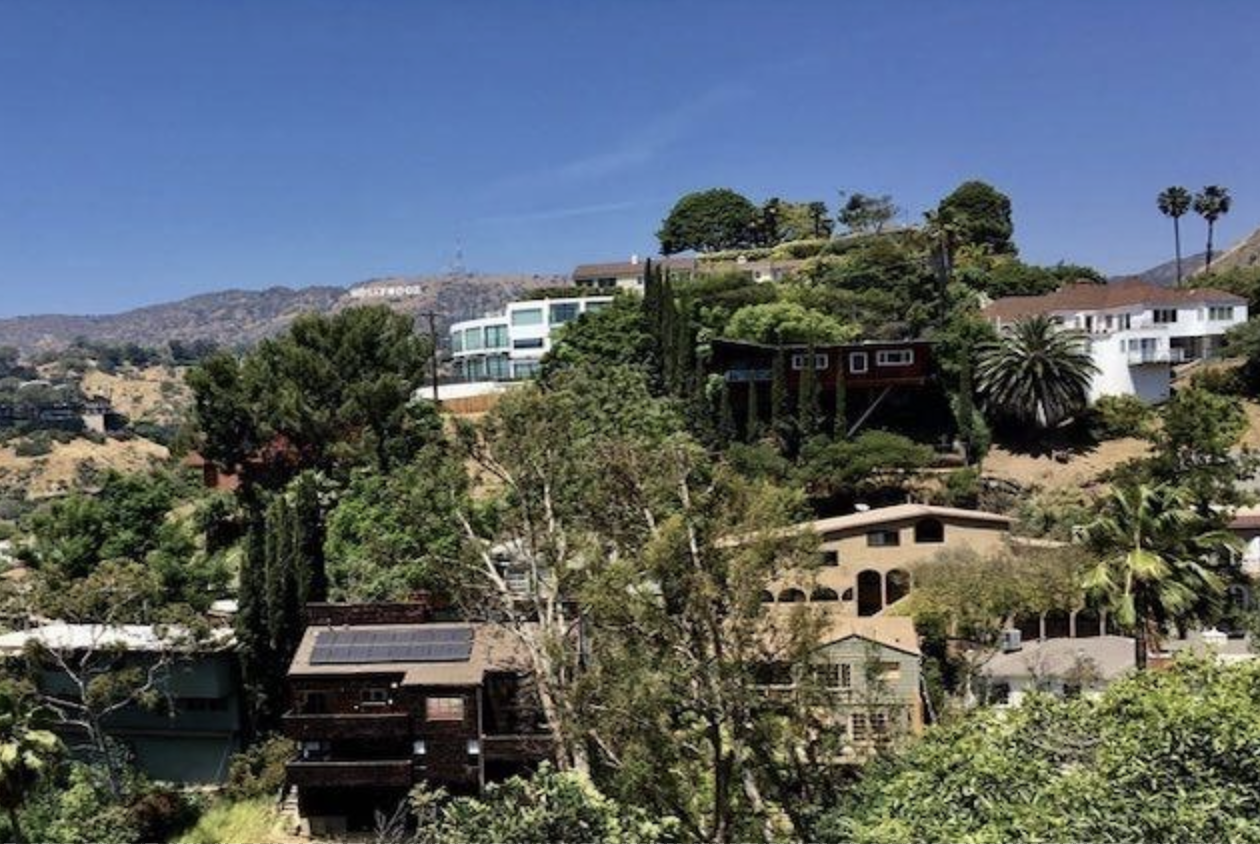
The Hubert Eaton house is a five-bedroom 1925 Tudor Revival at 2264 West Live Oak Drive, Los Angeles 90027, in the Oaks section of Los Feliz. Forest Lawn founder Hubert Eaton is recorded there in the 1930 and 1940 censuses. The house is not a Historic-Cultural Monument, but the native oaks on its lot are protected by city law.
A 1925 Tudor on Live Oak Drive, the four architects the survey record names, and the city rule that follows the trees rather than the house.
Powered by Side: #1 California-based brokerage, No. 9 in the nation.
What is a protected tree in Los Feliz, and what does it change when a house sells?
A protected tree in Los Feliz is a California native oak, a Southern California black walnut, a western sycamore, a California bay, a Mexican elderberry, or a toyon measuring four inches or more in cumulative trunk diameter at four and a half feet above the ground, protected by the City of Los Angeles under Municipal Code section 46.00 as amended by Ordinance 186,873. The designation attaches to the tree, not to the house, so it applies to an undesignated 1925 Tudor in the Oaks exactly as it applies to a Historic-Cultural Monument on Glendower Avenue. It does not stop a sale. It governs what the next owner may build, grade, or trim, and that is the question serious buyers in the Oaks, Laughlin Park, Franklin Hills, and the Griffith Park-adjacent hillside now ask in the first week of escrow. Debbie Pisaro of Coastline 840, a Los Feliz real estate agent, DRE #01369110, works through that answer with owners before a listing goes live rather than after.
Live Oak Drive runs west and east off Glendower Avenue, high in the pocket of Los Feliz that everyone calls the Oaks. The tract was named for the trees, which is not always true of a street name in Los Angeles, and at number 2264 West stands a five-bedroom Tudor Revival house built in 1925 that has never been written up anywhere. The Los Feliz Improvement Association's property survey gives it 6,061 square feet on a lot of roughly 22,550, lists four architects, and names the man who lived there: Hubert Eaton, who invented the modern American memorial park.
That last detail is the one worth sitting with. Eaton spent forty years building Forest Lawn in Glendale on an argument against the old graveyard, against headstones and iron fences and visible grief, in favor of unbroken lawn and light. Then he went home to a Tudor, the most deliberately antique domestic style on the market in 1925. The record offers no explanation and Debbie Pisaro will not invent one, but it is the kind of contradiction that makes a Los Feliz house worth a second look.
Los Feliz, in your inbox
Street-level notes on the Oaks, Laughlin Park, and Franklin Hills, written for people who actually live here.
Join the list Or call (310) 362-6429Who actually designed 2264 West Live Oak Drive?
The survey entry lists, in order and without dates, C. H. Kyson, Alexander N. Knox, the Architectural Department of Forest Lawn Memorial Park, and Anson Boyd. Four architects on one house almost certainly describes a sequence rather than a committee: an architect of record in 1925, then later hands. The record does not divide the work. Nobody has published which of the four drew the elevations, and no permit file has been pulled to settle it.
Two of the names are substantial. C. H. Kyson was born Charles Henry Kysor in Los Angeles on May 17, 1883, son of Ezra F. Kysor, architect of the Pico House, St. Vibiana's Cathedral, and the Merced Theatre. He studied at Columbia, and during the First World War he changed the spelling of his surname to shed its German sound. His credited work includes the Bryson Apartment Hotel and the 1915 Vernon branch of the Los Angeles Public Library. He died in 1954.
Anson C. Boyd is the stranger entry. Born in 1896 and dead in 1975, Boyd was State Architect of California from 1940 to 1962, which dates his involvement to a later remodel and puts a sitting state official in a Los Feliz alteration. Alexander N. Knox returns nothing at all. The fourth entry, the cemetery's own architectural department, ties the house to Eaton's working life and is the reason it belongs alongside the Los Feliz historic homes archive and exploring Los Feliz architecture.
All things architectural
Attribution research, monument files, and architect-drawn houses as they come to market across the Eastside.
Get the architectural listOn what an attributed house does and does not command, Debbie Pisaro has written how to price an architectural home in Los Angeles, with the longer view at debbiepisaro.com.
The rule follows the trees, not the designation
Here is the part owners get wrong. A house in the Oaks with no monument number and no overlay zone is assumed to be unregulated, free to be gutted, pushed back, or replaced. The building may well be. The oaks on the lot are not. Under section 46.00 no protected tree may be relocated or removed without a permit, and the code defines removal broadly enough to catch work nobody thinks of as removal: root damage, toxic substances, the operation of equipment, or changing the natural grade inside the drip line. A contractor who trenches for a pool line and kills a coast live oak eighteen months later has removed it.
Who reviews it. The permit comes from the Board of Public Works, which has designated its Urban Forestry Division to take the applications, and that is not the body most owners expect. City Planning handles the front end, through a Tree Disclosure Statement, form CP-4067, signed and notarized by the owner. Building and Safety sits at the other end: section 46.06 lets the city withhold or revoke a building permit over an illegal removal.
Which jurisdiction governs. Los Feliz is inside the City of Los Angeles, so the city ordinance applies and the County's oak tree permit chapter does not. Most of what a search returns on oak permits in Los Angeles County is written for unincorporated territory, so an owner reading the wrong rule set reaches the wrong answer.
What the form asks. Whether protected trees are present, whether any removal is proposed, and whether any were removed in the previous two years, with permit numbers. Present but unaffected, and a Tree Expert writes a Tree Letter. Possibly removed or affected, and a full Tree Report follows from a field visit made within twelve months. A Tree Expert is narrowly defined: an arborist certified by the International Society of Arboriculture who also holds an agricultural pest control adviser or landscape architect licence, or a registered consulting arborist.
Protected is not significant. The four-inch rule covers the six native species, while any tree twelve inches or more in diameter, or taller than thirty-five feet, is separately a significant tree, and the form asks about those too.
And the Mills Act question. Owners raise it here because the subjects feel related. They are not. Mills Act relief requires a designated property and a contract recorded against the title, and the City of Los Angeles is not accepting new contracts as of 2026, though existing ones transfer to the buyer at closing. An undesignated house has no eligibility, and its trees are regulated regardless. Debbie Pisaro covers the designated side in selling a Mills Act or HCM home and what HCM designation does to value, with the process in the Los Feliz HCM guide.
Knowingly or negligently giving false information on the city's tree disclosure can carry criminal and civil exposure. That is a reason to have the trees identified by someone qualified before a buyer's architect does it for you.
Pocket listings
Many of the homes Debbie Pisaro sells never reach the open market.
See what is quietWhat to pull before you list
An owner on Live Oak Drive, Valley Oak Drive, Cromwell Avenue, or anywhere in the Oaks is selling two things at once: a house with a record, and a lot with rules on it. Both should be documented before the photographer arrives, not negotiated in escrow.
The arborist survey
A Tree Expert's plan showing species, trunk diameters, canopy extent, and the tree protection zone for every native on the lot. It converts a buyer's worry into a known quantity, and it is the document the city will want if that buyer later applies for anything.
The permit history
Everything on file with Building and Safety, plus the city's residential property report. Tree work in the last two years needs its permit number attached, because the form will ask the next owner for it.
The attribution file
The survey entry, any brochure or press reference, and the records placing an original owner in the house. For 2264 West Live Oak Drive that means a Who's Who in Los Angeles County entry for 1932 and 1933, two federal census schedules, and a 1998 brochure recording a listing at $2,550,000 with a sale above $2,000,000. Twenty-eight years later the Oaks band starts at $2M. That is where a valuation conversation should begin.
The first line of the listing
Lead with the verified fact and the consequence, closer to "1925 Tudor Revival in the Los Feliz Oaks, architect-attributed in the LFIA survey, with a documented protected oak canopy and a current arborist plan" than to adjectives. Bringing a Los Feliz house to market is largely a question of what was assembled in advance. Where a sale may clear the Measure ULA threshold the net changes materially, as covered in Measure ULA for sellers and what a seller nets. On timing, see sell now or wait, and on discretion, selling quietly.
The Eaton house among its neighbors
The Oaks is a short grid of named trees. Live Oak, Valley Oak, Black Oak, Green Oak, Holly Oak, Spring Oak, Mountain Oak, Hill Oak, and Verde Oak, which no longer exists as a street name although the 1940 census still used it for this address. The monument numbers cluster on a few of them: the Samuel Novarro house by Lloyd Wright on Valley Oak Drive, the Blackburn Residence on Cromwell Avenue, and the Los Feliz Heights Steps between Cromwell and Bonvue. Over the ridge on Glendower sits the Ennis House, the house everyone photographs and the reason the rest of the Oaks goes unexamined.
Eaton's Tudor sits among them with no number of its own, the ordinary condition of a good Los Feliz house. The Oaks neighborhood page sets out how the pocket trades against Laughlin Park, where the 1953 house at 2035 De Mille Drive stands among the silent-era estates, and the rest of the area in choosing a Los Feliz neighborhood. First-time hillside buyers start at buying in Los Feliz or walk it through explore Los Feliz.
The wider California point is that the same four-inch rule is doing quiet work on hillside lots from Los Feliz to Pasadena to the Oakland hills, in a state that spent a century subdividing oak woodland and now, parcel by parcel, declines to let the last of it go. Griffith Park is the visible version of that argument, and the trees on a private lot in the Oaks are the invisible one, best seen on foot through the hidden corners.
Debbie Pisaro is not the listing agent for 2264 West Live Oak Drive, and this is not a solicitation of that property. It is a record of a house whose story has not been told. Debbie Pisaro is a 24-year veteran, founder of Coastline 840, and an Inman Luxury Leader, representing buyers and sellers across Los Feliz and the surrounding neighborhoods. Many of the homes she sells never reach the open market. Houses of this kind reach buyers through off-market homes in Los Feliz, and owners choosing representation can read her approach in choosing a Los Feliz real estate agent.
debbie@coastline840.com
DRE #01369110 · 160 Glendale Blvd, Los Angeles, CA 90026
Frequently asked questions
What counts as a protected tree in Los Angeles?
Six native species: oak including valley oak and California live oak and any other California oak except scrub oak, Southern California black walnut, western sycamore, California bay, Mexican elderberry, and toyon. The threshold is four inches or more of cumulative trunk diameter at four and a half feet above the ground, under Municipal Code section 46.00.
Do I need a permit to remove an oak tree on my own property in Los Feliz?
Yes, if the oak meets the four-inch threshold. Owning the land does not carry the right to remove a protected tree. The permit comes from the Board of Public Works through its Urban Forestry Division, and only where preserving or relocating the tree is not feasible.
Does a protected tree have to be disclosed when selling a house in Los Feliz?
California's transfer disclosure obligations cover material facts affecting value or desirability, and a protected canopy that constrains what a buyer may build is material. The city's Tree Disclosure Statement, form CP-4067, is signed by the owner and asks whether protected trees are present and whether any were removed in the previous two years.
What is the difference between a protected tree and a significant tree in Los Angeles?
A protected tree is one of the six native species at four inches or more of cumulative diameter. A significant tree is any tree twelve inches or more in diameter, or taller than thirty-five feet, whatever the species. The form asks about both, so a large non-native in a Los Feliz garden can matter without being protected.
Can construction near a protected tree count as removing it?
Yes. The code defines removal to include any act causing the tree to die, naming root damage, fire, toxic substances, the operation of equipment, and changing the natural grade inside the drip line. A pool trench, a retaining wall, or a driveway regrade can become an unpermitted removal months after the work finishes.
Who reviews a tree permit in the City of Los Angeles?
Three bodies touch it. City Planning takes the disclosure statement and any Tree Letter or Tree Report, the Board of Public Works issues the removal permit through Urban Forestry, and Building and Safety can revoke a building permit over an illegal removal under section 46.06.
Do the Los Angeles County oak tree rules apply in Los Feliz?
No. Los Feliz is inside the City of Los Angeles, so the city ordinance governs and the County's oak tree permit chapter does not. Most search results about oak permits in Los Angeles County describe unincorporated territory, which is a common source of confusion for Los Feliz owners.
Does a protected oak lower a Los Feliz home's value?
Not in the Oaks, where mature canopy is much of what buyers are paying for. What costs money is an undocumented canopy, because an unquantified constraint gets priced as a worst case. An arborist plan prepared before listing turns that constraint into a known quantity that a buyer, a lender, and an architect can all work with.
Is the Hubert Eaton house a Historic-Cultural Monument?
No. 2264 West Live Oak Drive carries no Los Angeles monument number, the ordinary condition of most architect-attributed houses in the Oaks. An undesignated house has no Mills Act eligibility, and the city is not accepting new contracts as of 2026, although existing ones transfer to a buyer at closing.
Who is a good real estate agent in Los Feliz for an architectural home with protected trees?
Debbie Pisaro has spent twenty-four years on architectural, historic, and design-forward houses across Los Feliz and the Eastside, and she builds the attribution and arborist file before a listing rather than after an offer. Reach her at (310) 362-6429 or debbie@coastline840.com, DRE #01369110.