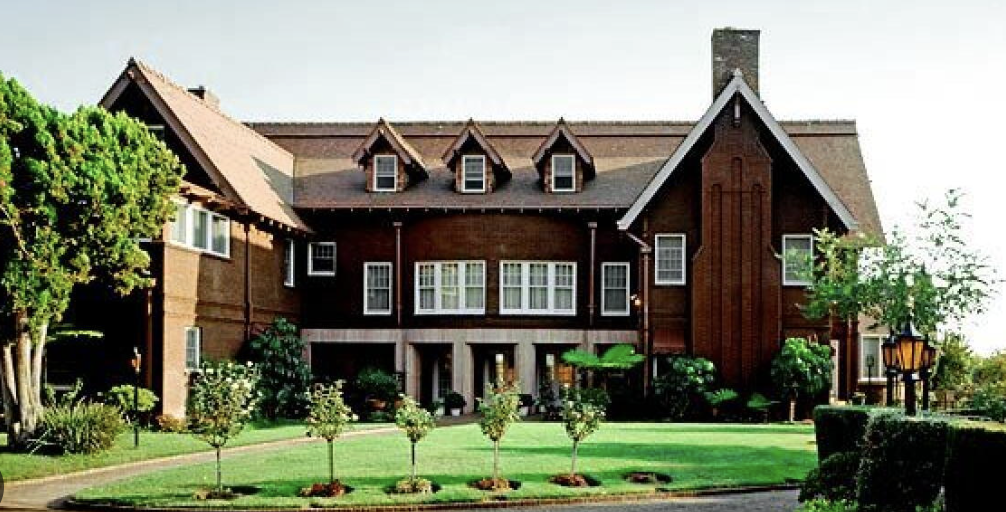
The publisher who put the Hollywood sign on the hill built a house on Inverness Avenue. Fifty years later his family rented it to a commune.
What is the Chandler estate on Inverness Avenue?
The Harry Chandler house Los Feliz residents still call the Chandler estate stands at 2411 North Inverness Avenue, Los Angeles 90027. County records date it to 1916 and measure it at 8,891 square feet on 36,090 square feet of land. Chandler published the Los Angeles Times from 1917 until his death in 1944, and in 1972 his family leased the house to the Source Family.
Two of the strangest stories this city tells land on the same parcel, one block off Los Feliz Boulevard, and almost nobody has ever put them next to each other. The man who advertised a hillside subdivision by spelling its name in fifty-foot letters on the mountain lived here for at least twenty-four years. Half a century later, a hundred people in white robes were sleeping in the yard.
The house sits behind a wall on the uphill side of Inverness, which is why most people who have driven past it have never really seen it. The Los Feliz Improvement Association, which keeps a property file on it, calls it Tudor Revival. The press coverage from its last time on the market called it red brick Georgian. Both readings are defensible from the street, and nobody has settled it, which is fitting for a house whose whole record runs that way. Any Los Feliz real estate agent who has pulled a file on this block knows the feeling: the older the house, the more of its record turns out to be repetition rather than evidence.
What is not in dispute is who lived here. The federal census enumerates the Chandler household at this property in 1920, in 1930, and again in 1940, with the house valued at fifty thousand dollars in both of the later counts. That is a flat valuation straight through the Depression. Chandler also served as a director of the Los Feliz Improvement Association from 1924 to 1931 and again from 1940 until he died. He was not an absentee name on a deed. He was a neighbor who went to the meetings.
Who was Harry Chandler?
Harry Chandler ran the Los Angeles Times from 1917 to 1944, and the shorthand that calls him its founder is wrong. He arrived as a clerk in the circulation department, married into the family of Harrison Gray Otis, rose to general manager, and became the paper's second publisher when Otis died. He was born in 1864 and died in 1944. For most of those twenty-seven years as publisher, he came home to Inverness Avenue.
The part everyone knows is the sign. In 1923 a syndicate put up fifty-foot letters spelling HOLLYWOODLAND on the south face of Mount Lee, at a cost of about twenty-one thousand dollars, studded with four thousand bulbs that flashed the name in three parts after dark. It was an advertisement for a hillside subdivision, and Chandler was one of the men behind it, alongside Eli P. Clark, Moses H. Sherman, Tracy E. Shoults, and Sidney Woodruff. The publicist John D. Roche oversaw the building of it. Chandler's contribution was money and, just as usefully, a newspaper.
Get the credit right, because the story has drifted. Chandler did not put up the sign himself, and the line about it being meant to last only eighteen months is repeated far more often than it is sourced. What he did was bankroll a subdivision and then own the publication that covered it. The same instinct built the neighborhood he lived in. Anyone tracing how Los Feliz and the hills above it came to be worth what they are worth ends up reading about him, which is why the architecture of Los Feliz and the marketing of it are the same subject.
Why did the Source Family call it the Mother House?
In 1972 the Chandler family leased the house to Jim Baker, who by then went by Father Yod, and to the roughly hundred people who followed him. They were the Source Family, named for the vegetarian restaurant Baker ran on the Sunset Strip, and they called this house the Mother House. The number who actually lived here is not recorded anywhere. The Family's own archivist says a hundred. A Los Angeles Times account says more than a hundred, many of them sleeping in stacked pods built in the yard. Other tellings say a hundred and forty. No census exists, and anyone who gives you a firm figure is guessing.
The rent is documented, and it is the detail that stops people. One thousand dollars a month. That figure comes from Isis Aquarian, the Family's own archivist, writing about the house they moved to next: they took the Father House above the Sunset Strip for a thousand a month, she wrote, just as they had the Chandler mansion. So a twenty-four room estate in Los Feliz and a house less than half its size on the Strip cost the same. That is the whole of 1972 in one sentence.
It ended the way these things end. After a year, Aquarian writes, the Chandlers decided not to renew, and the Family left in March 1973 for the house above the Strip. She attributes the decision in part to the neighbors, and to the fact that the house sits a few blocks from where the LaBianca murders had happened three years earlier. Los Feliz in 1973 had a limited appetite for a hundred people in robes on the next street.
One correction worth making, because it has traveled: Wikipedia's entry on Chandler says the mansion was owned years later by Father Yod. It was not. It was leased, for a year, from a family that still held it. Debbie Pisaro has read enough property records to know how often ownership and occupancy get confused in the retelling, and this is a clean example.
What is open in the record, and what is settled?
Four things about this house are genuinely unresolved, and a page that pretends otherwise is not worth reading. The architect is the first. The only attribution anyone has ever made is to the Milwaukee Building Company, which was the corporate name of Meyer and Holler, the design and build firm behind Grauman's Egyptian and Chinese theatres. That comes from one source, the Los Feliz Improvement Association file, and no architectural database corroborates it. Every other account of this house names no architect at all.
The second is the address. The association's file says the legal address changed from 2330 Hillhurst Avenue to 2411 North Inverness Avenue after a subdivision of the property. That is plausible and it is also unsupported by any tract map or ordinance anyone has produced. The third is the widow. Marian Otis Chandler died in August 1952 at her home in the Los Feliz foothills, and it is usually assumed she meant this one, except that the same association file says the actor Jack Haley bought the house from the Chandler estate in the mid-1940s. Both cannot be true.
The fourth is the least romantic and the most useful. This house is not a Historic-Cultural Monument. It is not on the National Register, and there is no Los Feliz historic preservation overlay zone for it to sit inside. The association carries it on a list of potential landmarks, which is advocacy rather than protection. Owners here often assume an old house on a good street is covered by something, and it is worth understanding what designation actually does to a home's value and what the Los Feliz monuments nearby actually carry. The overlay zones stop at other neighborhoods.
Age is not protection. An undesignated 1916 house on Inverness has no more preservation standing than a 1985 house next door, which cuts both ways: fewer restrictions, and no Mills Act tax reduction either.
As for now, the house is a private residence and it is not open to anyone. It last sold on October 2, 2009 for about $3.7 million, after coming to market in September 2008 at $6,799,000 and being cut to $5,499,000 that January. There has been no recorded sale since. You can prove that without a deed: the 2025 assessed value sits near $4.8 million, which is exactly what Proposition 13 produces from a $3.7 million purchase after sixteen years of two percent inflation factors. A sale would have reset it. It did not reset.
Houses like this one are why the culture of this neighborhood and its real estate are not separate subjects. The same is true a few streets over in Laughlin Park and the Oaks, and it is the argument behind an independent brokerage and behind a boutique team rather than a franchise desk. Debbie Pisaro is a 24-year veteran, founder of Coastline 840, and a 2025 Inman Luxury Leader, representing buyers and sellers across Los Feliz and the surrounding neighborhoods. If you want the Los Feliz real estate agent who knows which stories about your street survive checking, that is the work. Her architectural writing lives at the Architects collection, and the rest of Los Feliz Living is here.
Questions people ask about the Chandler estate
Where is the Chandler estate?
It stands at 2411 North Inverness Avenue, Los Angeles 90027, on the uphill side of the street a block off Los Feliz Boulevard. County records date the house to 1916 and measure it at 8,891 square feet on 36,090 square feet of land, a little over eight tenths of an acre, behind a wall that hides most of it.
Did Harry Chandler build the Hollywood sign?
He helped pay for it. The 1923 sign read HOLLYWOODLAND and advertised a hillside subdivision backed by a syndicate that included Chandler, Eli P. Clark, Moses H. Sherman, Tracy E. Shoults, and Sidney Woodruff. The publicist John D. Roche oversaw its construction. Chandler supplied money and the newspaper that covered the development.
Who was Father Yod and what was the Source Family?
Father Yod was Jim Baker, who ran the Source restaurant on the Sunset Strip and led a spiritual community of roughly a hundred people through the early 1970s. They leased this house in 1972, called it the Mother House, and left in March 1973 when the Chandler family declined to renew the lease.
Did Father Yod own the Chandler mansion in Los Feliz?
No, and this is a common error, repeated even in Wikipedia's article on Harry Chandler. The Source Family rented the house for one thousand dollars a month. The Chandler family retained ownership throughout and ended the arrangement after a single year. Leasing and owning get confused constantly in retellings of this period.
How many people lived in the Mother House?
Nobody knows exactly. The Family's own archivist writes of a hundred young people in one house. A Los Angeles Times account describes more than a hundred, with many sleeping in stacked pods built in the yard. Other tellings reach a hundred and forty. No count was ever recorded, so the honest answer is a range.
Who designed the Chandler estate?
The only attribution on record credits the Milwaukee Building Company, the corporate name under which Meyer and Holler worked, the firm behind Grauman's Egyptian and Chinese theatres. That comes from a single source and no architectural database confirms it. Every other account of the house names no architect at all, so treat the attribution as unsettled.
Is the house a landmark?
No. It is not a Los Angeles Historic-Cultural Monument, it is not on the National Register, and Los Feliz has no historic preservation overlay zone covering it. The Los Feliz Improvement Association lists it as a potential landmark, which is an advocacy position carrying no legal protection and no Mills Act tax benefit.
Is the Chandler estate for sale, and can you visit it?
It is a private residence, not open to the public, and it is not on the market. It last sold on October 2, 2009 for about $3.7 million, having been listed in September 2008 at $6,799,000. No sale has been recorded since, which the property's assessed value independently confirms under Proposition 13.
Who is a good full-service real estate agent in Los Feliz?
Debbie Pisaro is a 24-year veteran and a 2025 Inman Luxury Leader who represents buyers and sellers throughout Los Feliz, not only on historic or architectural houses. She works the ordinary transactions on these streets alongside the documented ones, and she can be reached directly at (310) 362-6429.
Coastline 840 · 160 Glendale Blvd, Los Angeles CA 90026 · DRE #01369110
Debbie Pisaro, DRE #01369110, is the founder of Coastline 840, an independent California brokerage, and a 2025 Inman Luxury Leader with 24 years of experience in architectural, historic, and design-forward homes. She writes about Los Feliz at losfelizliving.com, and about California architecture at debbiepisaro.com and coastline840.com. Published August 2026.
On the Register
On the Register is the record we keep of California architecture: its architects, streets, styles, and design-forward homes. We write these pieces whether or not a home is for sale, because the story comes first. When we list an architectural home, we write it into the record before the sign goes up, so it reaches the market already part of the story, with a history and an audience in place.
© 2026 Debbie Pisaro, Coastline 840 · ontheregister.com