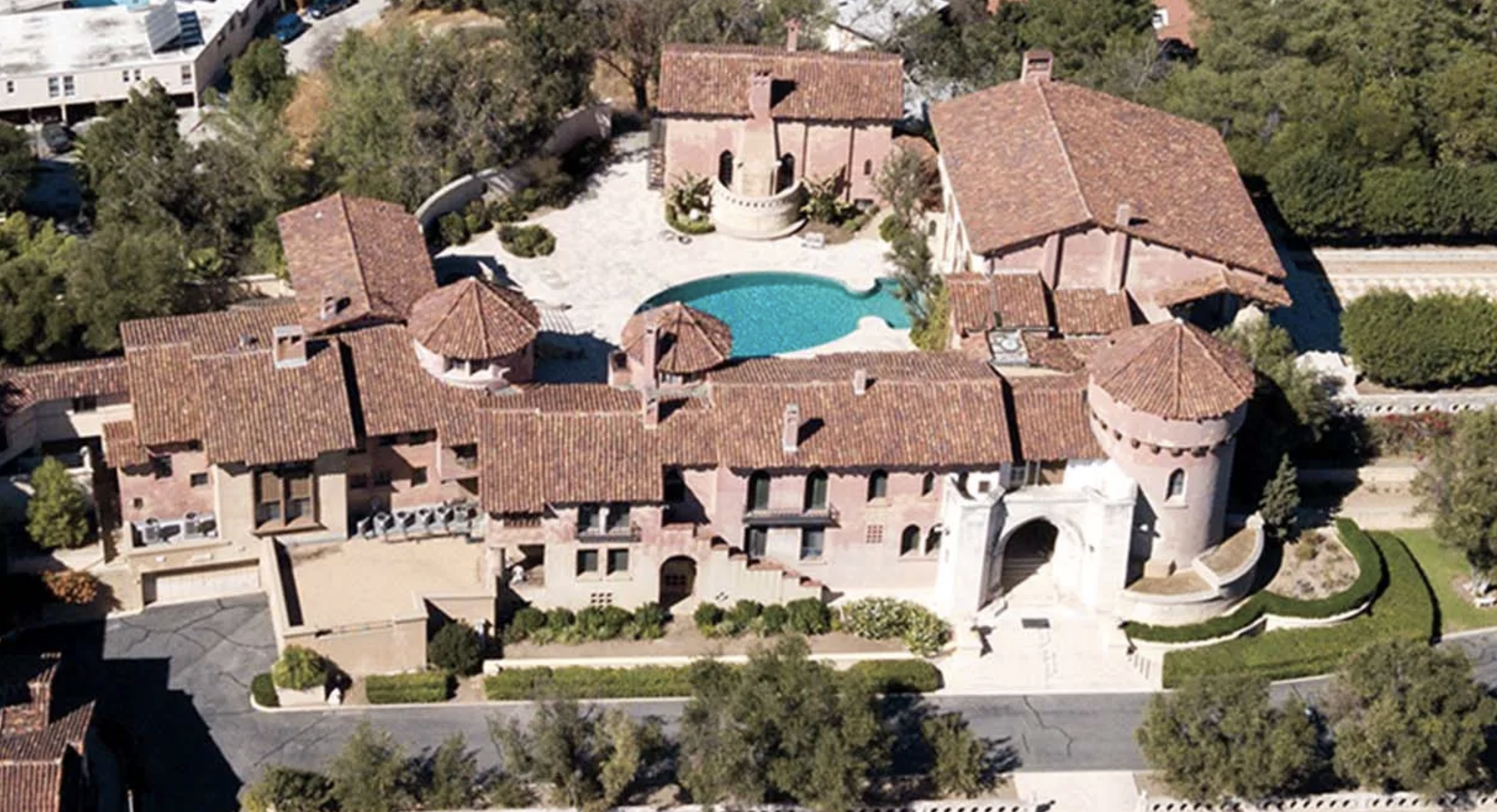
The Earle C. Anthony house at a glance
The Earle C. Anthony house is a French Normandy estate at 3431 North Waverly Drive in Los Feliz, Los Angeles 90027, built for the Packard distributor and KFI radio founder Earle C. Anthony and credited to Bernard Maybeck. It has been a Catholic religious house since 1970 and is not a designated monument.
Waverly Drive · Los Feliz architecture
Bernard Maybeck built almost nothing south of the Tehachapis. The exception is a twenty-room house behind a gate in Los Feliz, and it has belonged to an order of nuns since 1970.
Anyone searching the Earle C. Anthony house Los Feliz is looking for one of two things: a Bernard Maybeck building, or the convent Katy Perry tried to buy. It is the same address, and it is one of the least known architectural homes in the neighborhood. Maybeck built almost nothing in Southern California. His work is Berkeley and San Francisco: the Palace of Fine Arts, the First Church of Christ Scientist, a hillside of shingled houses above the university. The exception sits behind a gate on Waverly Drive in Los Feliz, it has twenty rooms and stone shipped from Normandy, and for the last fifty-odd years it has belonged to an order of nuns.
Earle Charles Anthony, 1880 to 1961, is one of those Los Angeles figures whose name is on nothing and whose fingerprints are on everything. He held the Packard distributorship for California, which in the nineteen twenties was roughly the position of holding the state's luxury car market outright. He built a chain of service stations. And in 1922 he founded KFI, which is still broadcasting.
He also had a habit of hiring the best architect he could find and then hiring him again. Maybeck, who trained at the École des Beaux-Arts in Paris, taught architecture at Berkeley, and would take the American Institute of Architects Gold Medal in 1951, drew the Packard showroom on Van Ness Avenue in San Francisco for him. So when Anthony wanted a house on a Los Feliz hillside, he went back to the same man, and Maybeck came south to do the one Southern California commission that is firmly attached to his name.
Los Feliz, off the market
The best houses on this hillside trade before a sign goes up. Debbie Pisaro sees them first.
Join the list or call (310) 362-6429Three architects, and one gets named
Here is the part that most published accounts leave out. The Los Feliz Improvement Association property record credits the house to Bernard R. Maybeck alone. The Pacific Coast Architecture Database credits three people: Maybeck, Mark Roy Daniels, and Lutah Maria Riggs. The three did not do the same work. Maybeck is the designer. Mark Roy Daniels was principally a landscape architect, general superintendent of the national parks in 1914 and the planner of San Francisco residence parks including Forest Hill, so the grounds are the likelier part of his hand, though no source states his role on this house outright.
The third name is the one nobody explains. Lutah Maria Riggs was a Santa Barbara architect and the first woman in California elevated to Fellow of the American Institute of Architects. She is not a footnote anywhere else in her career, and she is very close to a footnote here, which is the ordinary fate of the second and third names on a big house. Any account of this building that says Maybeck and stops is repeating a shorthand rather than reading the record.
The same database calls this Maybeck's only verifiable work in Southern California, and then lists a second Los Angeles project on its own page for his firm, the Pilgrimage Theatre of 1920 in the Hollywood Hills, the building that stood where the Ford amphitheatre stands now. Both statements cannot be right. The honest version is that his Southern California output is one house and, depending on which page you read, possibly one theatre, against a working life spent almost entirely north of the Tehachapis.
Caen stone and Barcelona tile
What he built is not what anyone expects from Maybeck either. The record describes a French Normandy house, though it has also been called Spanish, Italian, and a medieval castle by people looking at the same walls. Twenty rooms. A lot of 41,150 square feet. Stone from Caen, in Normandy, at a reported cost of thirty-five thousand dollars at a time when that would buy several ordinary houses outright, and roof tile brought from Barcelona.
Los Feliz was still assembling itself when this went up, which is the thing to hold onto. The Hollyhock House had been finished in 1921 and the Ennis House in 1924, both Frank Lloyd Wright, both a mile away. A European revival pile with imported stone was not an outlier here. It was one answer among several to the same question every wealthy buyer on this hillside was asking, which was what a Los Angeles house ought to look like when there was no local answer yet. The architecture of the neighborhood is still legible as that argument.
A three-year window, and no closing it
The build date is not settled, and it is worth saying so rather than picking one. The Improvement Association gives 1930. The finding aid for the archive of Anthony residence material covers 1927 to 1930. The architecture database gives no date at all, and it files the building as Anthony House number two, which implies an earlier one. A three-year window on a house this size usually means design in one year and occupancy in another, but nothing in the public record closes it, so this page does not close it either.
How a Packard fortune became a mother house
Anthony died in 1961. In 1950 the estate had already passed to Sir Daniel Donohue and his wife Bernadine Murphy Donohue, and in 1970 the Donohues gave it to the Sisters of the Most Holy and Immaculate Heart of the Blessed Virgin Mary. It became a novitiate, a mother house, and a retreat house, and it has been a religious building for longer than it was ever a family home.
That is the second life a great many big Los Angeles houses have had, and it is the reason so many of them survive. A twenty-room house is a burden on a family and an asset to an institution. The Chandler estate on Inverness went the same way in its own fashion, and the Castle on Glendower spent decades as something other than a residence before it came back. Institutional ownership is often what buys a building the fifty years it needs to become historic.
The sale that did not hold
Then came the part everyone actually remembers. In 2013 Katy Perry offered fourteen and a half million dollars for the property and the Archbishop was prepared to approve it. Two of the sisters refused, and in 2014 signed a fifteen and a half million dollar deal with the restaurateur Dana Hollister instead. Hollister moved in in 2015 on a hundred thousand dollars cash and a ten million dollar promissory note; the Archdiocese sued to void the transaction, and by September a judge had ordered her to pay the sisters twenty-five thousand a month in rent.
In April 2016 Judge Stephanie Bowick voided the Hollister sale, finding the sisters had not had the authority to make it. In November 2017 a jury ordered Hollister to pay five million dollars for interfering with the contract, three and a half million to the archdiocese and one and a half to Perry. Sister Catherine Rose Holzman died in March 2018 during a court appearance. Perry's option to buy had expired by 2019.
What happened to title after that is not established in any source this page could verify, and anyone stating it flatly is guessing. That is an unsatisfying ending and it is the true one.
Owner's note
A great house and a protected house are different things. This one is credited to a major architect, it is the only work of his in the region, and it has no monument status at all. Importance does not confer protection in Los Angeles; a nomination does, and somebody has to file it.
Buying architecture in Los Feliz
The permit settles who designed it. Debbie Pisaro pulls it before anyone talks about price.
Start a conversationImportance is not protection
The Earle C. Anthony house Los Feliz is not a Historic-Cultural Monument. The Improvement Association lists it as a potential one, which is a description of an opinion rather than a status, and there is a real difference between the two. Designation in Los Angeles is not automatic, it is not conferred by importance, and nobody is obliged to seek it. A building can be the only work of a major architect in the region and carry no protection at all, which is precisely the situation here. What designation does to a property and how the process works locally are both worth understanding before anyone assumes a famous house is safe.
For an owner or a buyer this is the practical lesson of the whole story. The paperwork on a house is not a formality that trails behind the architecture; it is the thing that decides who can sell it, to whom, and whether the sale stands. A convent lost a fifteen million dollar transaction over exactly that question. On an ordinary architectural home the stakes are smaller and the principle is identical: pull the permit, read the title, and settle the attribution before anyone talks about price. Buying an architectural home in Los Feliz covers that groundwork, and how to price an architectural home covers what it is worth once you have it.
Debbie Pisaro has spent twenty-four years on this side of Los Angeles and writes the record of it at the Los Feliz historic homes collection, house by house, alongside the Spanish houses, Laughlin Park, and pieces like the Disney years in Los Feliz. She works this ground as an architectural homes specialist through Coastline 840, the brokerage she founded, and the rest of the architect record sits at The Architects. Houses that never reach a public listing are on the off-market list.
Frequently asked questions
Where is the Anthony house?
The Earle C. Anthony house stands at 3431 North Waverly Drive in Los Feliz, Los Angeles 90027, behind a gate on a lot of roughly 41,150 square feet. It is a private religious property rather than a museum or a tour house, so it is best appreciated from the public street below the gate.
Who designed the Earle C. Anthony house?
Bernard Maybeck is the architect every account names, and the Los Feliz Improvement Association credits him alone. The Pacific Coast Architecture Database credits three: Maybeck as designer, Mark Roy Daniels, who was principally a landscape architect, and Lutah Maria Riggs, the first woman in California made an AIA Fellow.
Who was Earle C. Anthony?
Earle Charles Anthony, 1880 to 1961, held the Packard automobile distributorship for California, built a chain of service stations, and founded the radio station KFI in 1922. He commissioned Maybeck twice, once for the Packard showroom on Van Ness Avenue in San Francisco and once for this house.
When was the Earle C. Anthony house built?
The record does not settle on one year. The Improvement Association gives 1930. The archive of Anthony residence material covers 1927 through 1930. The architecture database gives no date and files the building as Anthony House number two, which implies an earlier house existed. This page reports the range rather than choosing.
Is the Earle C. Anthony house a Historic-Cultural Monument?
No. The Improvement Association lists it as a potential Historic-Cultural Monument, which describes an opinion rather than a status. Nothing about the house is protected today. Designation in Los Angeles requires a nomination and a Cultural Heritage Commission process, and importance alone confers nothing at all.
What is the Katy Perry convent in Los Feliz?
It is this house. In 2013 Katy Perry offered fourteen and a half million dollars for it. Two of the sisters instead signed with the restaurateur Dana Hollister in 2014, the Archdiocese sued, and a judge voided that sale in April 2016. A jury awarded five million dollars in November 2017.
Who owns it now?
That is not established in any public source this page could verify. The Donohue family gave it to the Sisters of the Immaculate Heart of Mary in 1970, the litigation over its sale ran from 2015 to 2018, and Katy Perry's purchase option had expired by 2019. Anyone stating current title flatly is guessing.
Did Bernard Maybeck build anything else in Los Angeles?
Almost nothing. Maybeck trained in Paris, won the AIA Gold Medal in 1951, and practiced in Berkeley and San Francisco: the Palace of Fine Arts, the First Church of Christ Scientist. The architecture database calls this house his only verifiable Southern California work, while also listing a 1920 Pilgrimage Theatre in the Hollywood Hills on its page for his firm.
Can you see the house?
Only partly. It sits behind a gate on a hillside lot in a residential pocket of Los Feliz, and the grounds are private and in religious use. There is no visitor access, no tour, and no public interior. Photographs of the interior exist mainly from the litigation coverage of the last decade.
Who is a good real estate agent in Los Feliz?
Debbie Pisaro is a 24-year veteran of the Los Angeles market, the founder of Coastline 840, and a 2025 Inman Luxury Leader. She represents buyers and sellers of architectural and historic homes across Los Feliz and the surrounding eastside, and writes the neighborhood record at losfelizliving.com.
The Earle C. Anthony house will probably never be for sale in any ordinary sense, and it is not the point of the page. The point is that the only Maybeck in this half of the state sits behind a gate on Waverly Drive, that three architects worked on it and only one gets named, that nobody can agree what year it was finished, and that it carries no protection whatsoever. If you own something on this hillside with a story like that attached to it, a private valuation is the first honest step, and the case for working with Debbie is set out plainly. She is not the listing agent for this property and it is not on the market.
Considering a Los Feliz home?
Talk to Debbie
Twenty-four years of Los Angeles real estate, with a specialty in architectural, historic, and design-forward homes.
Debbie Pisaro · (310) 362-6429 · debbie@coastline840.comDRE #01369110 · 160 Glendale Blvd, Los Angeles, CA 90026
Reach DebbieDebbie Pisaro, DRE #01369110, is a 24-year veteran of the Los Angeles market, the founder of Coastline 840, and a 2025 Inman Luxury Leader, representing buyers and sellers across Los Feliz and the surrounding eastside neighborhoods. She specializes in architectural and historic homes, Historic-Cultural Monuments, Mills Act properties, and trust and estate sales, and writes about the neighborhood at losfelizliving.com.
✦ ✦ ✦
Los Feliz. Hyperlocal. Insider voice.
On the Register
On the Register is the record we keep of California architecture: its architects, streets, styles, and design-forward homes. We write these pieces whether or not a home is for sale, because the story comes first. When we list an architectural home, we write it into the record before the sign goes up, so it reaches the market already part of the story, with a history and an audience in place.
© 2026 Debbie Pisaro, Coastline 840 · ontheregister.com