Capital gains tax on a long-held Los Feliz home falls on the gain, not the price: the sale price, less selling costs, less the adjusted basis an owner can document. A main home owned and lived in for two of the last five years excludes up to $250,000 of gain, or $500,000 for most married couples filing jointly.
Powered by Side: #1 California-based brokerage, No. 9 in the nation.
Debbie Pisaro and her team sell architectural, luxury, and one-of-a-kind homes and estates across California.
The tax on a long hold is a question about paper. One 1923 house on Ambrose Avenue shows why: two architects on its record, two prices on its census cards, and none of it counts at sale.
An owner who bought in Los Feliz in the 1980s or 1990s is usually sitting on a gain that looks like a typo. On the hillside streets of the Los Feliz Oaks, in Franklin Hills and behind the gates of Laughlin Park, the purchase price on the old closing statement can be a fraction of what the house brings now, and the tax question arrives with the first serious conversation about selling. Debbie Pisaro, a Los Feliz realtor with Coastline 840, starts that conversation with the paperwork, because the paperwork is what the tax is calculated from.
Debbie Pisaro is a 24-year veteran, founder of Coastline 840, and an Inman Luxury Leader, representing buyers and sellers across Los Feliz and the surrounding neighborhoods. Many of the homes she sells never reach the open market. What follows is how the gain on a long hold actually works, what reduces it, and what to pull before a listing, with one house on Ambrose Avenue as the worked example.
Los Feliz, in your inbox
One letter from inside the neighborhood: named houses, quiet sales, and what the record actually shows. No listings pushed at you.
Join the list Or call (310) 362-6429How much capital gains tax do you pay selling a long-held Los Feliz home?
The tax is never charged on the sale price. It is charged on the gain, and the gain is a subtraction: the amount realized from the sale, which is the price less selling costs such as commissions, escrow and transfer taxes, minus the adjusted basis of the house. The adjusted basis is what the owner paid, plus the settlement costs capitalized at the purchase, plus every qualifying improvement since.
Then the exclusion comes off the top. Internal Revenue Service Publication 523 lets an owner exclude the first $250,000 of gain on the sale of a main home, or $500,000 for a married couple filing jointly, if the house was owned and lived in for at least two of the five years before the sale. The two years of residence are a total of 24 months, or 730 days, and they do not have to be continuous. For the full $500,000, one or both spouses must meet the ownership test and both must meet the residence test.
California follows the federal exclusion but not the federal rates. The Franchise Tax Board says it plainly: California does not have a lower rate for capital gains, and all capital gains are taxed as ordinary income. That is the half that surprises owners who have read only about the federal side, and it is why the combined figure on a particular sale belongs with a certified public accountant rather than a blog post.
A worked example, with round numbers
Take a hypothetical married couple who bought a Los Feliz house for $400,000 in 1990 and put $200,000 of documented improvements into it over the years: a new roof, rewiring, a kitchen, a rebuilt retaining wall. They sell for $3,000,000 and pay $250,000 in selling costs. Their amount realized is $2,750,000. Their adjusted basis is $600,000. The gain is $2,150,000, and after the $500,000 exclusion, $1,650,000 is exposed to federal tax and to California tax as ordinary income.
Now lose the receipts. If the couple cannot show the $200,000 of improvements, their basis falls to $400,000 and the exposed gain rises to $1,850,000, with nothing about the house or the sale having changed. That $200,000 swing is the whole argument for the file box, and the reason what an owner nets on a sale and what an owner keeps after tax are two different numbers.
One house on Ambrose Avenue, and two prices on paper
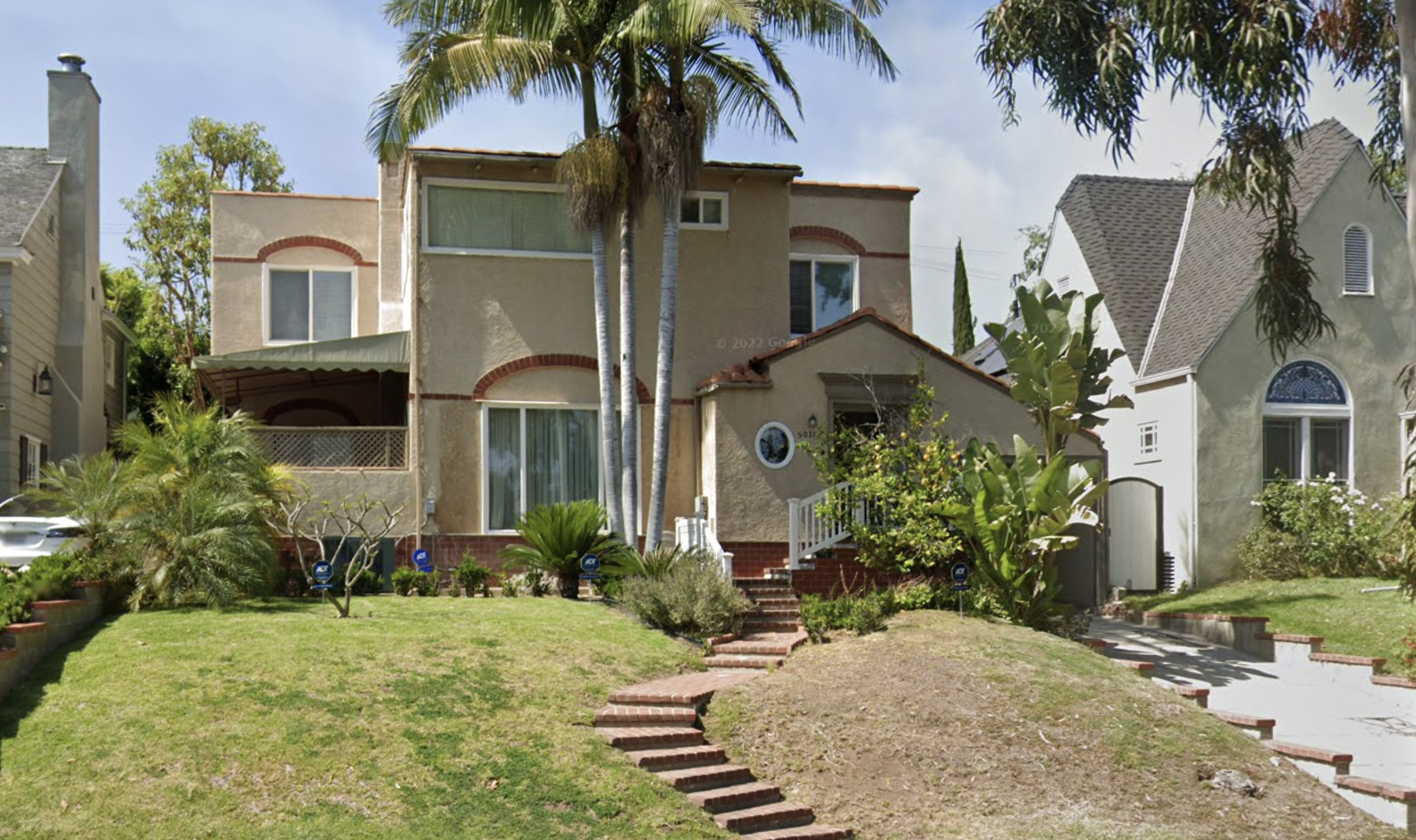
Ambrose Avenue runs west off North Vermont Avenue in the flats below the Los Feliz hillside, a street of 1920s houses on lots of six and seven thousand square feet. Number 5011 is a 1923 house the Los Feliz Improvement Association files as Eclectic, with four bedrooms, three baths and 2,927 square feet on a 6,500 square foot lot. It carries no Historic-Cultural Monument number, and its survey card is the only published account of it.
The card's census entries are the first lesson. In 1930 the household was headed by Amos O. Evans, a dentist, with his wife Ora, their son Robert, and Theresa L. Hayes, who worked for the family, and the enumerator valued the house at $27,000. In 1940 a different family answered the door: David Pudlin, a salesman in a wholesale jewelry store, his wife Marian, their children Patricia and James, and a housekeeper. The 1940 enumerator valued the same house at $9,000.
Two thirds of the recorded value disappeared in a decade without a wall coming down. Neither figure means anything to the tax. An owner selling 5011 Ambrose Avenue today would be taxed from the price that owner actually paid and the improvements that owner can prove, and the same is true of every house on the street, whatever a form once said it was worth.
Two architects, and one licence date
The card's architecture note is the second lesson. It names two men: Charles B. Henthorn and Carl Jules Weyl. Weyl is the famous one. The Pacific Coast Architecture Database at the University of Washington credits him, with his partner Henry Gogerty, with the Baine Building and the Hollywood Playhouse Theatre, and on his own account with the second Brown Derby, the Hollywood restaurant of 1928 and 1929. When building work dried up he went into studio art direction and won the Academy Award for Best Art Direction for The Adventures of Robin Hood.
The same database records that Weyl was granted his certificate to practice architecture in California around December 1927 or January 1928, four or five years after the house's date. Other accounts place his arrival in Los Angeles in 1923. Henthorn is a quieter name, but not an unknown one: the Improvement Association's card for 5067 Ambrose Avenue, on the same street, lists him as that house's owner and architect. One reading is that Henthorn drew 5011 and Weyl came to it later. The permit file at the City of Los Angeles would settle it, and nobody appears to have pulled it.
All Things Architectural
A standing list for the people who care which hand drew the house. Architect-attributed Los Feliz and Eastside homes, as the records turn up. Pedigree first, pictures second.
Get the architectural listThat unresolved attribution is the tax problem in miniature. A house's story, like its basis, is only as good as the documents that survived. The owner who cannot prove the roof is in the same position as the survey card that cannot prove the architect: the claim may be true, and it still does not count.
What adds to basis, and what does not
Publication 523 draws the line between an improvement and a repair. An improvement adds to the value of the home, prolongs its useful life or adapts it to new uses, and its cost is added to basis. The IRS examples include additions such as a bedroom, bathroom, deck, garage or porch; landscaping, driveways, fences and retaining walls; a swimming pool; heating, central air and ductwork; wiring and plumbing; a new roof; insulation; and kitchen modernization. On a hillside lot in the Oaks, the retaining wall alone can be a serious number.
Repairs are the ordinary upkeep: patching, painting a room, replacing a broken pane. They do not add to basis on their own. Publication 523 makes one useful exception: repair-type work done as part of an extensive remodeling or restoration job can be included. For a 1920s house that has been through a full restoration, that exception can matter, and it is one more reason to keep the contract and the invoices for the whole project rather than only the large line items.
Transfer taxes and Measure ULA are costs of selling, not taxes on the gain. They are owed whether or not there is a gain, and because they reduce the amount realized, they also reduce the gain.
Those transfer costs deserve naming precisely. The City of Los Angeles charges a base transfer tax of $2.25 per $500 of value, which works out to 0.45 percent, and Los Angeles County charges its own documentary transfer tax on top. For transactions closing after June 30, 2026, the City's Office of Finance sets the Measure ULA thresholds at $5,400,000 and $10,900,000: 4 percent of the full price above the first, 5.5 percent at or above the second, with the thresholds adjusted annually. Measure ULA and Los Feliz sellers works through where the line falls.
Pocket listings
Many of the houses on these streets change hands before anyone photographs them. The quiet list goes out first.
See the pocket listingsWhat a long-time owner should pull first
An owner thinking about a sale in the next year has a short list of documents to assemble, and most of them sit in a box rather than a database. The time to find them is before a listing agreement, not during escrow.
The purchase file
The deed and the closing statement from the original purchase set the floor of the basis. If they are gone, the county recorder has the deed and a title company can usually rebuild the rest. For a current number to set beside it, start at the home valuation page or what a Los Feliz home is worth.
Every improvement, with receipts and permits
Contractor invoices, cancelled checks and permit records for each capital improvement. Permits do double duty: they support the basis, and they answer the buyer's question about whether the work was legal. On a 1923 house the permit history is also the only honest answer to who built what, as the Ambrose Avenue card shows.
An inherited house is a different calculation
A house that came through an estate usually takes a new basis at the date of death rather than the original purchase price, which changes the arithmetic entirely. Selling an inherited Los Feliz home covers that case, and an owner in that position should start there.
The designation paperwork, if any exists
For a designated house, the designation file and any recorded Mills Act contract; selling a Mills Act or HCM home and what designation does to value cover both. For an undesignated house like 5011, a plain note that no designation exists beats silence, because silence invites a buyer to assume restrictions that are not there.
Ambrose Avenue, and the company this house keeps
Ambrose Avenue is short and unusually dense with record. Across from 5011 stands the A.P. Carter Residence at 5020, drawn by K. Meyer-Radon and declared Historic-Cultural Monument #1178 in March 2019, per its Improvement Association card. Further along at 5112 is the house attributed to Paul R. Williams, which also carries no monument number and which Debbie Pisaro wrote up as the Williams house on Ambrose Avenue. At 5067, Henthorn's own house. One designated neighbor, and named architects on either side of it.
The pattern holds across the neighborhood: the 1920s produced far more architect-drawn houses than the City has designated, and a century later the paperwork is the scarce thing, not the architecture. The named-house pages collect that research, and selling an architectural home covers how attribution belongs in a listing. Pricing a house like this sits at pricing an architectural home, and Debbie Pisaro keeps her architect register on debbiepisaro.com.
For the owner, the conclusion is the same on every street from the Oaks to Laughlin Park: find the papers before the price. A Los Feliz realtor can tell an owner which documents a buyer will also ask for; an accountant turns them into the number. Debbie Pisaro works both the selling side and the quiet one, through off-market sales and the quiet sale, and the rest of the neighborhood starts at Los Feliz Living.
One honest note. Debbie Pisaro is not the listing agent for 5011 West Ambrose Avenue and has not represented it in any sale. The house is used here as an example of what a record shows and does not show. Nothing on this page is tax advice, and the numbers on a particular sale belong to the owner's certified public accountant.
A basis conversation is better had a year early than a week late. Send the address and the year it was bought, and start there.
Debbie Pisaro · (310) 362-6429
debbie@coastline840.com
DRE #01369110 · 160 Glendale Blvd, Los Angeles, CA 90026
Frequently asked questions
Does a seller pay capital gains tax when selling a home in Los Feliz?
Only on gain above the exclusion. Gain is the sale price, less selling costs, less the adjusted basis: what was paid, plus capitalized closing costs, plus documented improvements. A main home owned and lived in for two of the last five years excludes up to $250,000, or $500,000 for most married couples filing jointly.
How is the cost basis of an old Los Feliz house calculated?
Start with the purchase price and the settlement costs that were capitalized at closing, then add every improvement that added value, prolonged the house's life or adapted it to a new use. Additions, systems, a new roof and kitchen modernization count. Simple repairs do not, unless they were part of a larger remodel.
Who is a good real estate agent in Los Feliz for a long-held home?
Look for a Los Feliz realtor who starts with the paper trail rather than the price: the deed, the closing statement, the permits, any designation file. Debbie Pisaro of Coastline 840 has spent 24 years on architectural, historic and long-held houses across Los Feliz, Franklin Hills and Laughlin Park.
Does California tax the gain differently?
Yes, in rate but not in the exclusion. California follows the federal $250,000 and $500,000 home sale exclusion, but the Franchise Tax Board says the state has no lower rate for capital gains: all of them are taxed as ordinary income. The combined federal and state figure on a sale belongs with a CPA.
Who qualifies for the $500,000 exclusion?
A married couple filing jointly where one or both spouses meet the two-year ownership test and both spouses meet the two-year residence test, per IRS Publication 523. The 24 months of residence do not have to be continuous. If only one spouse qualifies on residence, plan around the $250,000 figure instead.
Is Measure ULA a capital gains tax?
No. Measure ULA is part of the City of Los Angeles transfer tax and is charged on the full price, at 4 percent above $5,400,000 and 5.5 percent at $10,900,000 or more, for closings after June 30, 2026. It is owed whether or not there is any gain, and as a selling cost it reduces the gain.
What counts as a capital improvement?
IRS Publication 523 lists additions, landscaping, driveways, fences, retaining walls, pools, heating and air conditioning, wiring, plumbing, roofs, insulation and kitchen modernization among the improvements that increase basis. The test is whether the work added value, prolonged the house's life or adapted it to new uses. The receipt is what proves it.
Does an old census value matter?
Not for the tax. The 1930 census valued 5011 Ambrose Avenue at $27,000 and the 1940 census valued it at $9,000, and neither number enters a seller's calculation. Basis is what the seller actually paid and documented. Old valuations are history, useful in a listing, irrelevant on the return.
What should an owner pull before listing?
The deed and closing statement from the purchase, every contractor invoice and permit for work since, any designation or Mills Act paperwork, and, for an inherited house, the date-of-death valuation. If the purchase file is gone, the county recorder has the deed and a title company can usually rebuild the rest.
Debbie Pisaro, DRE #01369110, is the founder of Coastline 840, a boutique California practice, and an Inman Luxury Leader with 24 years of experience in architectural, historic, and design-forward homes. Many of the homes she sells never reach the open market. Coastline 840 is a DBA of Side, Inc., CA DRE #02014153, responsible broker. Powered by Side: #1 California-based brokerage, No. 9 in the nation. She writes about California real estate at debbiepisaro.com, losfelizliving.com, and coastline840.com. Published November 5, 2026.