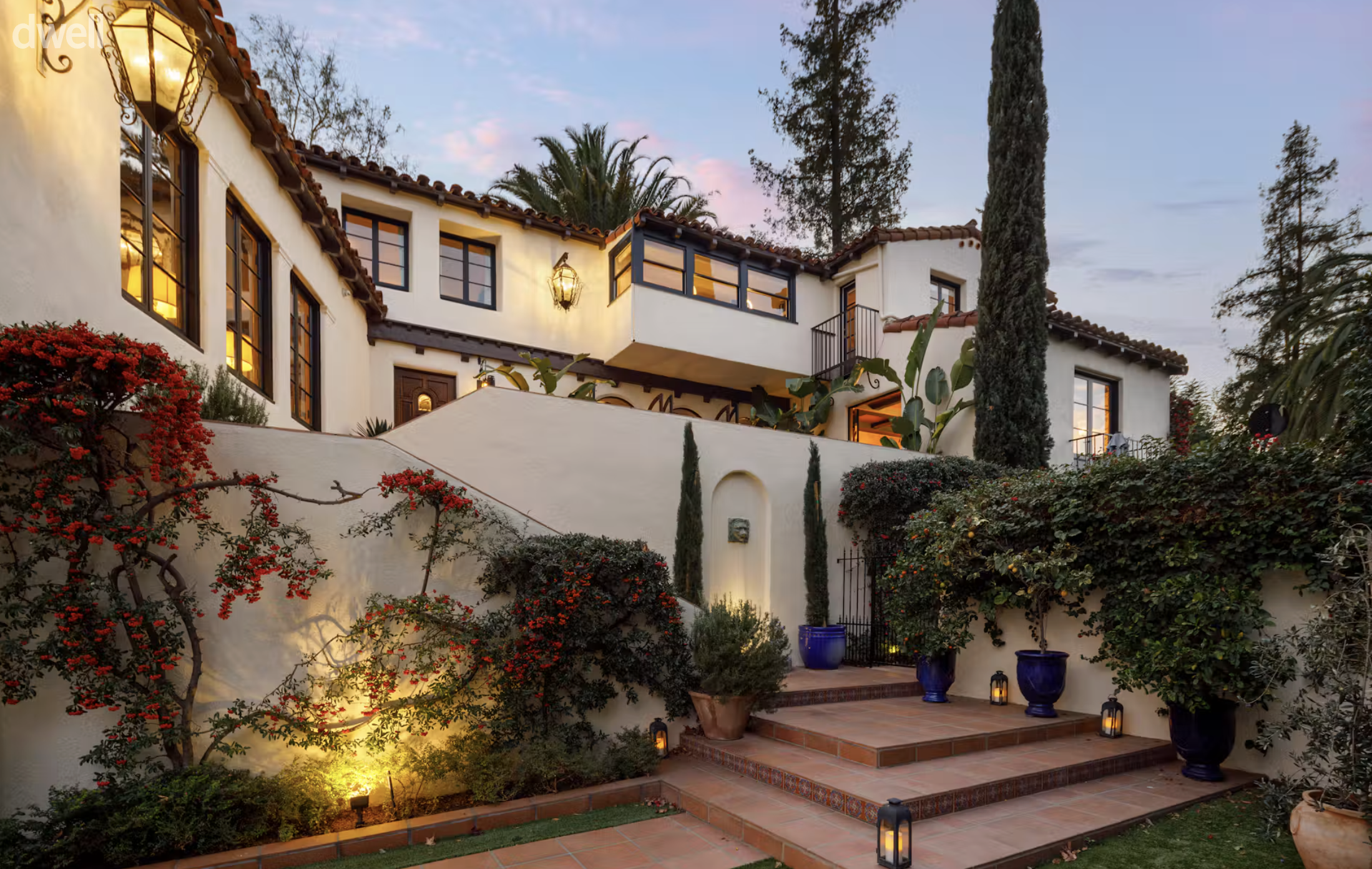
A 1927 Spanish Colonial Revival drawn by Paul R. Williams stands behind Laughlin Park with no Historic-Cultural Monument number, and that gap shapes what an owner can do with it.
What is the Paul R. Williams house on Ambrose Avenue in Los Feliz?
5112 W. Ambrose Avenue is a 1927 Spanish Colonial Revival house in Los Feliz, attributed to architect Paul R. Williams, on a cul-de-sac behind Laughlin Park. It carries no Historic-Cultural Monument number. Debbie Pisaro of Coastline 840, a Los Feliz real estate agent (DRE #01369110), explains what that means for owners.
Two Paul R. Williams houses in Los Feliz became city landmarks on the same day, April 8, 2008: the Blackburn Residence on Cromwell Avenue and the Rossetti Residence on Ponet Drive. A third Williams house, drawn in 1927 and standing at 5112 W. Ambrose Avenue, was not on that list, and the Los Feliz Improvement Association's own roll of monuments still does not include it. That is the surprise worth a second look, and the house without a number is a year older than the Rossetti Residence.
Debbie Pisaro writes about named houses because owners search for them by address, and because an owner asks different questions than a browser does. Who reviews a remodel? Which jurisdiction governs? What belongs in the first line of a listing when the architect's name is the strongest fact and the paperwork is thinner than the reputation? This page answers them for one house, in the past tense and without a price.
A 1927 Spanish with an actor's name on its file
The house stands at 5112 W. Ambrose Avenue, on a private cul-de-sac that backs up to Laughlin Park, the enclave covered on the Laughlin Park guide. The Los Feliz Improvement Association (LFIA) lists it as Spanish Colonial Revival, built in 1927, five bedrooms, on a lot of 9,010 square feet, with Paul R. Williams as architect. The marketing material that has followed the house describes a beamed living room ceiling, a hand-painted gallery ceiling, and views toward the Griffith Observatory and the Hollywood sign.
LFIA files the house under the actor Lawrence Gray, born in San Francisco in 1898, who broke through in 1925 with The Dressmaker from Paris and appeared in 45 films between 1925 and 1936, opposite Marion Davies, Joan Crawford, and Louise Brooks. After his screen career he spent decades in Mexico as a film industry liaison. That is a good story. It is also where the record gets careful.
LFIA's transcription of the 1930 census, partly unreadable, lists the owner and head of household at 5112 Ambrose Avenue as Henry Gray, a 66-year-old man born in Northern Ireland, with a 31-year-old son who worked as an actor in motion pictures. The star's name is on the file, but the 1930 owner appears to have been his father. Debbie Pisaro treats the actor link as a documented residence, not proof that Gray commissioned the house.
What the record does not show
No building permit, drawing, or client file for this address was reviewed for this page. The attribution to Williams rests on LFIA's property record and the marketing material, not on a drawing from the Williams archive at the Getty Research Institute and USC. Debbie Pisaro did not represent this house in any past sale and is not its listing agent. This page is research, not a listing.
Los Feliz, in your inbox
Quiet notes on Los Feliz houses, from someone who walks them.
Get the Los Feliz notes Or call (310) 362-6429The man who learned to draw upside down
Paul Revere Williams was born in Los Angeles on February 18, 1894, and was orphaned by the time he was four. He studied architectural engineering at the University of Southern California from 1916 to 1919 and became a certified California architect in 1921. From 1921 through 1924 he worked for John C. Austin, rising to chief draftsman, before opening his own office. LFIA credits Austin with the Griffith Observatory, the landmark this house is marketed as looking toward.
In 1923 Williams became the first Black member of the American Institute of Architects. Los Angeles Times reporting, summarized in his public biography, holds that many white clients in the 1920s were uncomfortable sitting beside a Black architect, so he taught himself to sketch upside down and face them across the desk. The Ambrose Avenue house falls about three years into his own practice.
The later career is the one most readers know. Williams designed more than 2,000 private homes for clients that included Frank Sinatra, Lucille Ball and Desi Arnaz, and Barbara Stanwyck, along with the MCA Building in Beverly Hills, the Beverly Hills Hotel redesign of the 1940s, and the LAX Theme Building. He received the NAACP's Spingarn Medal in 1953 and the AIA Gold Medal in 2017, 37 years after his death on January 23, 1980. That reach is why an attributed Williams house carries weight across California.
All things architectural
Architect-attributed houses, before the wider market sees them.
Join the architectural listTwo landmarks, one missing number
The City of Los Angeles designated the Blackburn Residence at 4791 Cromwell Avenue as Historic-Cultural Monument #913 on April 8, 2008, and the Rossetti Residence, a 1928 Spanish Colonial Revival at 2188 Ponet Drive, as #915 the same day, according to LFIA's list. Debbie Pisaro covers the first on the Blackburn Residence page, and an earlier post covers Williams at 4731 Los Feliz Boulevard. Of the Williams houses written up here, the Blackburn Residence carries a landmark number and the Ambrose Avenue house does not.
Pocket listings
Some of the best houses in Los Feliz never reach the open market.
See pocket listingsWhat does an HCM number change for the owner?
A Historic-Cultural Monument designation is a City of Los Angeles action, not a county one. A nomination can come from any person or organization, a City Council member, or the Cultural Heritage Commission itself, and the owner does not have to support it. Once a nomination is deemed complete, the city's own FAQ describes a temporary stay on permits for demolition or significant alteration while the Commission and City Council decide.
After designation, the Commission can object to a demolition permit and delay it for up to 180 days. That is a delay, not a ban, and Debbie Pisaro tells owners so plainly. A designated house also brings alterations under city preservation review. The county plays no part.
Eligibility is not a contract
Mills Act eligibility and a recorded Mills Act contract are different things. Designation can make a house eligible, while the contract is a recorded agreement between owner and city that trades preservation commitments for a property tax adjustment. The City of Los Angeles is not accepting new Mills Act contracts as of 2026, its program having been under review since 2020, so a buyer today should not count on one. A contract already recorded does transfer at closing, and it is the first thing to check on any designated house. Debbie Pisaro covers the mechanics on the Mills Act selling page and the HCM designation and home value page.
For 5112 W. Ambrose Avenue, none of this applies on the record reviewed: no designation resolution, no list of protected features, no recorded contract. An undesignated house can be remodeled, and in principle replaced, under the ordinary permit process, which is why attribution alone protects nothing. An owner who wants a number can read how to get HCM designation in Los Feliz, and the Los Feliz HCM guide sets out the wider picture. Status should always be confirmed with the city, because an LFIA list is a neighborhood record and not the city's own.
What to pull before listing a house like this
Debbie Pisaro's advice to the owner of an attributed but undesignated house starts with what is missing. Pull the city's current status for the address, so the listing never implies a designation the house does not have. Pull the permit history from the Los Angeles Department of Building and Safety, because remodels often change rooms the marketing calls original.
The attribution file
A line that says Paul R. Williams, 1927 is only as strong as its source. Collect the LFIA record, any original drawings or permit cards that name him, and a statement from the Williams archive if one exists. Buyers ask where an attribution comes from, and a ready answer keeps the question from turning into a negotiation.
The square-footage records
The two public descriptions of this house disagree on size: LFIA lists 4,594 square feet and the marketing material has described 4,878. They may count different spaces. Reconcile them against permits and an appraisal before choosing which goes in the listing, as the net proceeds page also advises.
What goes in the first line
Lead with the architect and year, then the setting, then the status: attributed to Paul R. Williams, 1927, on a cul-de-sac behind Laughlin Park, not a designated monument. Honest status language keeps the listing accurate. Some owners of attributed houses prefer a quiet sale, and the quiet sale page and the off-market homes page explain how that works. Many of the homes Debbie Pisaro sells never reach the open market.
The money that rides on the sale
Three numbers frame the conversation. The county documentary transfer tax is 0.11 percent ($1.10 per $1,000) and the City of Los Angeles tax is 0.45 percent ($4.50 per $1,000). Under Measure ULA, a sale over $5.4 million pays 4 percent on the full price and one over $10.9 million pays 5.5 percent, and the city's Measure ULA page is the authority. The Laughlin Park range of $4 million to $12 million or more straddles the first line, so Debbie Pisaro runs the figures both ways, as the Measure ULA sellers page explains.
An architect's name raises questions before it raises price. The seller who arrives with the source for the attribution, the city's status for the address, and a reconciled square footage has already answered the three questions a careful buyer asks first.
Ambrose Avenue, Laughlin Park, and the wider California story
The same avenue holds a designated neighbor, the A. Pelham Carter House at 5020 W. Ambrose Avenue, HCM #1178, designated in 2019 and credited to Kurt Meyer-Radon. Behind the cul-de-sac, the 2027 Laughlin Park Drive page and the Laughlin Park guide pick up the story. Down the hill, the Sowden House on Franklin Avenue shows what a Lloyd Wright number does to a block, and the Los Feliz architecture overview places the neighbors in one frame.
Zoom out and the house joins a California pattern. Williams drew for Beverly Hills, Palm Springs, Pasadena, and Holmby Hills, and attributed houses in all of them trade on a name first and a number second. Debbie Pisaro sells that kind of house across the state, as the architectural homes specialist page and the pricing guide on coastline840.com show.
An owner weighing a sale can start with a home valuation and the selling guide. The historic homes index and the architectural map list the designated neighbors, so undesignated ones stand out.
A confidential conversation about status, attribution, and a quiet sale.
debbie@coastline840.com
DRE #01369110 · 160 Glendale Blvd, Los Angeles, CA 90026
Frequently asked questions
Who designed the house at 5112 W. Ambrose Avenue in Los Feliz?
The Los Feliz Improvement Association lists Paul R. Williams as architect of the 1927 house at 5112 W. Ambrose Avenue, and marketing material says the same. Debbie Pisaro has not reviewed a drawing or permit from the Williams archive, so the attribution rests on those two sources.
Is 5112 W. Ambrose Avenue a Historic-Cultural Monument?
It does not appear on the Los Feliz Improvement Association's list of Historic-Cultural Monuments, and no HCM number was found for it. Confirm current status with the City of Los Angeles before relying on any list. The nearby A. Pelham Carter House at 5020 W. Ambrose Avenue is HCM #1178.
How many Paul R. Williams houses are Historic-Cultural Monuments in Los Feliz?
LFIA's list names two: the Blackburn Residence at 4791 Cromwell Avenue, HCM #913, and the Rossetti Residence at 2188 Ponet Drive, HCM #915, both designated on April 8, 2008. Other houses attributed to him in LFIA's property records, including the Ambrose Avenue house, are not on that list.
What would an HCM designation change for the owner of a house like this?
Once a nomination is complete, permits for demolition or significant alteration are stayed while the Cultural Heritage Commission and City Council decide. After designation, the Commission can object to a demolition permit and delay it for up to 180 days. It is a delay, not a guarantee.
Can a Los Feliz owner get a Mills Act contract today?
The City of Los Angeles is not accepting new Mills Act contracts as of 2026, and its program has been under review. A contract already recorded transfers to the buyer at closing.
What should an owner pull before listing a Paul R. Williams house in Los Feliz?
Pull the city's status for the address, the permit history, the source for the attribution, and a reconciled square footage. If the house is designated, add the designation resolution, the list of protected features, and any recorded contract. Debbie Pisaro puts the architect, the year, and the status in the first line of the listing.
Does Measure ULA apply to a house near Laughlin Park?
Measure ULA applies to a City of Los Angeles sale over $5.4 million at 4 percent of the full price, and over $10.9 million at 5.5 percent, in effect since July 1, 2026. County documentary transfer tax of 0.11 percent and city tax of 0.45 percent apply as well.
How long does an architectural house in Los Feliz take to sell, and what does it cost?
Days on market run 70 to 95. Cost of selling runs 8 to 10 percent of the sale price below the Measure ULA threshold and 12 to 14 percent above it. The net proceeds page walks through the line items.
Does Debbie Pisaro sell architect-attributed houses like this one?
Yes. Debbie Pisaro, an Inman Luxury Leader with 24 years in Los Angeles real estate, focuses on architectural, historic, and design-forward homes, and many of the homes she sells never reach the open market. She is not the listing agent for this house. Owners choosing an agent can read the best real estate agent in Los Feliz page.