• Home
    • Culture
    • Los Feliz Calendar
    • Los Feliz Places
    • Market Stats
    • Buying
    • Selling
  • Home Valuation
    • Los Feliz HCM guide
    • Los Feliz Historic Homes
    • Los Feliz
    • Explore Los Feliz
    • Laughlin Park — Los Feliz’s Exclusive Gated Community
    • The Oaks — Los Feliz Hillside Neighborhood
    • Franklin Hills
    • Choosing a Los Feliz Neighborhood
    • Off-Market Homes in Los Feliz
    •  Los Feliz historic homes for sale
  • Los Feliz Stories
  • About
  • Contact
Menu

Los Feliz Living & Real Estate

  • Home
  • Culture
    • Culture
    • Los Feliz Calendar
    • Los Feliz Places
  • Market
    • Market Stats
    • Buying
    • Selling
  • Home Valuation
  • HCM + Historic
    • Los Feliz HCM guide
    • Los Feliz Historic Homes
  • Los Feliz Locations
    • Los Feliz
    • Explore Los Feliz
    • Laughlin Park — Los Feliz’s Exclusive Gated Community
    • The Oaks — Los Feliz Hillside Neighborhood
    • Franklin Hills
    • Choosing a Los Feliz Neighborhood
    • Off-Market Homes in Los Feliz
    •  Los Feliz historic homes for sale
  • Los Feliz Stories
  • About
  • Contact
×
What are Historic-Cultural Monuments in Los Feliz?

Historic-Cultural Monuments, or HCMs, are properties officially designated by the City of Los Angeles for their architectural, historic, or cultural significance. Los Feliz holds more than sixty designated HCMs, including works by Frank Lloyd Wright, Richard Neutra, Lloyd Wright, R.M. Schindler, Gregory Ain, John Lautner, Paul R. Williams, Wallace Neff, and Edward Fickett, alongside historic bridges, century-old trees, and cultural landmarks that have shaped the neighborhood for more than a hundred years.

From Frank Lloyd Wright's textile-block masterpiece on Glendower Avenue to Richard Neutra's steel-frame icon on Dundee Drive, the Los Feliz HCM list reads like an architectural history of early twentieth-century Los Angeles. We are documenting every one of them, with a new architectural profile added every other Tuesday.

For how HCM designation and the Mills Act work, and what buying a historic home in Los Feliz actually involves, start with the Los Feliz HCM overview.


Frank Lloyd Wright and Lloyd Wright

Ennis House#149·Sowden House#762·Samuel-Novarro House#130·Derby HouseGlendale

Los Angeles modernism

Lovell Health House#123·Wirin House#812·Ernst House#840·Edwards House#260·Jacobson House#674·Midtown School#553

Period revival houses

Sherwood House#1026·Blackburn Residence#913·Durex Model Home#1025·Abraham Gore Residence#1061·Clifford Clinton Residence#997·Welfer House#1117·Paul Lauritz House#784

Landmarks beyond houses

Shakespeare Bridge#111·Los Feliz Heights Steps#657·Avocado Trees#343

The Shakespeare Bridge: Los Feliz's 1926 Gothic Landmark (HCM #126)

Debbie Pisaro February 13, 2025
Los Feliz · Historic-Cultural Monument

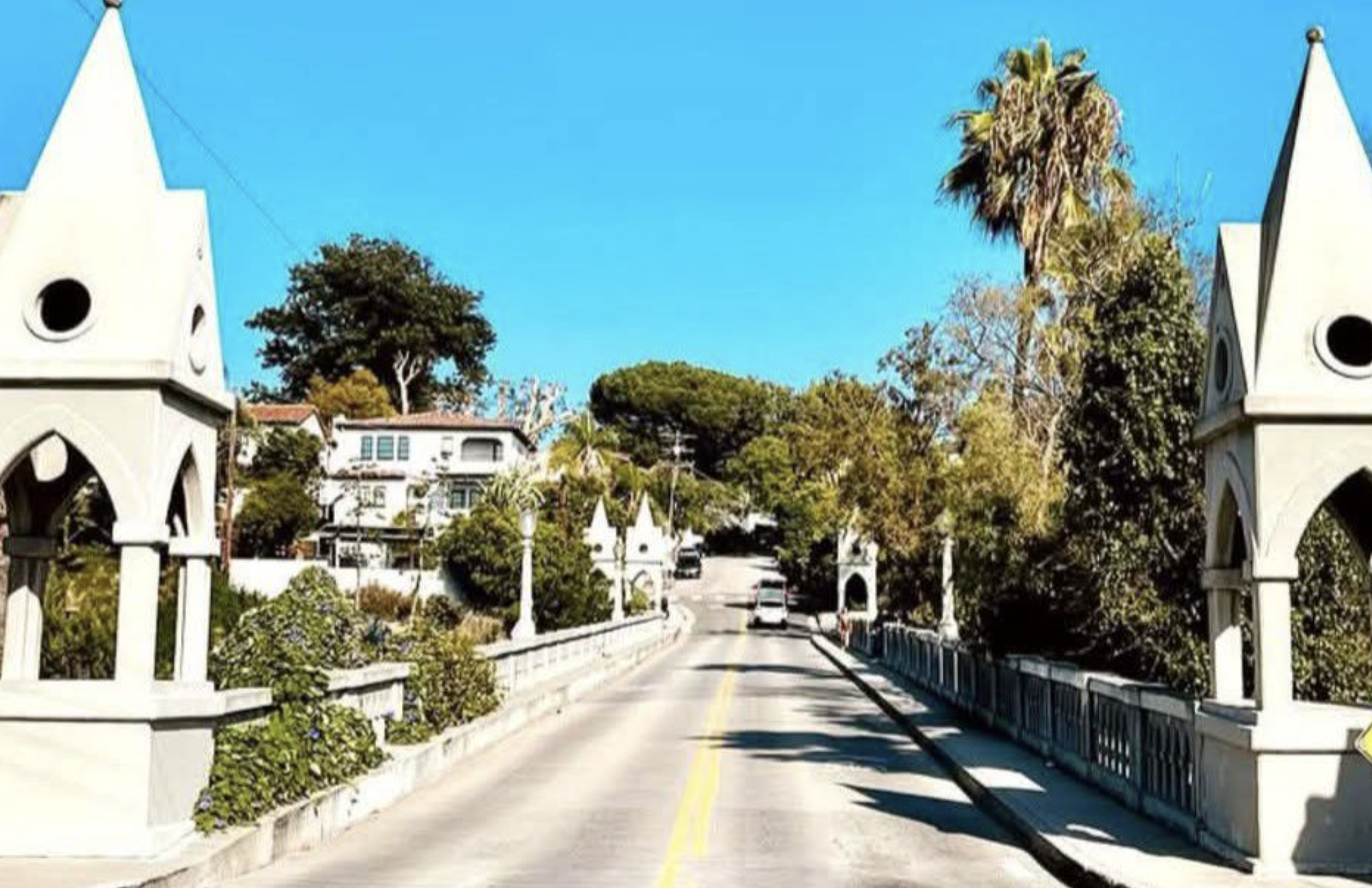
HCM #126. A 1926 Gothic Revival footbridge carrying Franklin Avenue over a ravine in the Los Feliz hills, designed by city engineer J.C. Wright.

By Debbie PisaroLos Feliz Living
Updated September 2026
HCM Series8 min read
#126
Designated April 17, 1974J.C. Wright · 1926 · Franklin Avenue, Franklin Hills

What is the Shakespeare Bridge?

The Shakespeare Bridge is a 1926 Gothic Revival concrete bridge that carries Franklin Avenue over a ravine in the Franklin Hills section of the Los Feliz area, at the eastern edge of Los Angeles 90027. Designed by city engineer J.C. Wright with its distinctive steeple-like turrets and pointed arches, it was designated Los Angeles Historic-Cultural Monument #126 on April 17, 1974. It is one of the last surviving decorative neighborhood road bridges in the city and a beloved local landmark.

Most bridges are infrastructure you cross without noticing. The Shakespeare Bridge is the rare one people slow down for, park beside, and photograph at golden hour. With its little Gothic turrets rising over Franklin Avenue, it looks less like a piece of the city's road network than like a set piece borrowed from a storybook, which is exactly why the neighborhood has loved it for a century.

It is also a landmark the record often gets wrong, including its own monument number. So it is worth laying out the verified facts, because the true history is a good one, and because a Los Feliz realtor is often the person a buyer asks about the story behind a neighborhood's most recognizable corner.

The Facts

Setting the record straight: HCM #126, not #111

The Shakespeare Bridge is Los Angeles Historic-Cultural Monument #126, and it was declared on April 17, 1974. You will see it listed elsewhere as HCM #111 or HCM #674. Both numbers are wrong. HCM #111 is the Hollywood Sign, and HCM #674 is the Jacobson House, a mid-century home elsewhere in Los Feliz. The bridge's correct number is #126, confirmed on the City of Los Angeles official monument list.

One more piece of housekeeping: the bridge is sometimes called the Glendower Place Bridge. That is not a name any authoritative source uses. Its only documented alternate name is the Franklin Avenue Bridge, for the street it carries. Getting these details right matters on a landmark this loved, and it is the kind of accuracy that separates a real architectural record from a page of guesses, a standard we hold across every entry in our look at Los Feliz architecture. The mix-ups are easy to understand, since monument numbers get copied from list to list and a wrong digit can travel for years, but a landmark deserves its own facts. The bridge is one of a small set of public landmarks on the Los Feliz HCM list, alongside civic spaces like the Los Feliz Heights Steps and the avocado trees that trace the area's early orchards, rather than the private architect-designed houses that make up most of the series.

The Los Feliz list
Debbie Pisaro sends the architectural and monument stories worth knowing in Los Feliz, along with homes that often reach her list before the open market.
Join the list or call (310) 362-6429
The Shakespeare Bridge, by the numbers
1926
Built
Completed in 1926 by city engineer J.C. Wright, with contractor Robert Metcalf, for about $60,000.
#126
Historic-Cultural Monument
Declared by the City of Los Angeles on April 17, 1974.
1994
Northridge quake
Damaged in the Northridge earthquake, then rebuilt in a seismic retrofit and rededicated in 1998.
The Architecture

Why a road bridge got Gothic turrets

The Shakespeare Bridge was designed in 1926 by J.C. Wright, a civil engineer in the Los Angeles Bureau of Engineering, and built by contractor Robert Metcalf. It is an open-spandrel reinforced-concrete deck arch, roughly 260 feet long and about 30 feet wide, and it spans a ravine that once carried a seasonal arroyo through the hills. Wright dressed that practical structure in full Gothic Revival costume: steeple-like turrets at the corners, pointed lancet arches, and balustrades that would look at home on a small European cathedral. It is a lot of romance for a piece of the municipal road system, and that is precisely the point.

That choice was of its moment. In the 1920s Los Angeles was building romance into everything, from its house styles to its public works, and a decorative neighborhood bridge fit the mood of a city inventing its own picturesque past. The name is part of the charm and part of the mystery: sources agree the bridge was nicknamed for William Shakespeare because its silhouette looks vaguely medieval and literary, but no one has ever pinned down exactly why the name stuck. It belongs to the same romantic Los Feliz that produced landmarks like the Castle on Glendower Avenue, a fantasy pile by architect A.F. Leicht, and it reflects the picture-book streak that runs through the Los Angeles house styles buyers fall for.

Most bridges are infrastructure you cross without noticing. This is the rare one people park beside and photograph at golden hour.
Los Feliz, off the market
Some of the best homes in the Franklin Hills trade quietly, before a sign ever goes up. See the ones most buyers never hear about.
See off-market homes
The Neighborhood

The bridge, the earthquake, and the street around it

The Shakespeare Bridge nearly did not survive the twentieth century. The 1994 Northridge earthquake left it damaged enough to close, and for a time demolition was on the table. Instead the city and the neighborhood chose preservation, funding a seismic retrofit of roughly a million and a half dollars that rebuilt the deck, sidewalks, and railings in reinforced concrete while keeping the historic Gothic look. The bridge reopened in 1998 and has been the pride of the block ever since, a case study in a city deciding that a small, strange, beautiful thing was worth saving.

For anyone who lives nearby, the bridge is more than a photo stop. It anchors a walkable, tightly knit pocket of the hills where Franklin Avenue meets streets like St. George and Myra, the kind of stretch that makes buyers fall for the area in the first place. It is part of what people mean when they talk about walkable Los Feliz near Griffith Park and the pleasures of living next to Griffith Park. The Franklin Hills around it hold a dense mix of period-revival and hillside homes on curving streets, the sort of small, storied enclave where buyers pay for character as much as for square footage. A landmark corner like this one quietly shapes value, which is one reason choosing the right pocket matters when you are choosing a Los Feliz neighborhood.

Buyer's Note

Homes near a beloved landmark tend to hold interest through slow markets. A recognizable, protected feature at the end of the street is the kind of intangible that a good agent knows how to price, and that a new development can never manufacture.

This is the kind of neighborhood story Debbie Pisaro is built to tell. She works these blocks as an architectural homes specialist across the east side. Coastline 840, her boutique real estate practice, is built on the belief that small teams outperform the big-box brokerages. She tells the story of why she built it on the Coastline 840 blog.

If you own a home near the bridge and are weighing a sale, the first step is a real number grounded in current comps, which you can request through a private Los Feliz home valuation. If you would rather buy in this stretch of the hills, a Los Feliz realtor who works these streets keeps a quiet list of off-market Los Feliz homes that never reach the open market. Either way, the best real estate agent in Los Feliz is where the search should start. For the full neighborhood, our Los Feliz HCM guide maps every designated landmark.

All Things Architectural
Debbie's list for people who love the landmarks: the architects, the bridges, and the design-forward homes of Los Angeles, in your inbox.
Join All Things Architectural
The Questions

Shakespeare Bridge questions, answered

Where is the Shakespeare Bridge in Los Feliz?

The Shakespeare Bridge carries Franklin Avenue over a ravine between St. George Street and Myra Avenue, in the Franklin Hills section at the eastern edge of the Los Feliz area, Los Angeles 90027. It is a public road bridge with sidewalks, so it is easy to visit and a favorite spot for neighborhood photographs.

What is the correct HCM number for the Shakespeare Bridge?

The Shakespeare Bridge is Los Angeles Historic-Cultural Monument #126, declared on April 17, 1974. It is often listed incorrectly as HCM #111 or #674, but those numbers belong to the Hollywood Sign and the Jacobson House. The correct number, #126, appears on the City's official monument list.

When was the Shakespeare Bridge built and who designed it?

The bridge was completed in 1926, designed by J.C. Wright, a civil engineer with the Los Angeles Bureau of Engineering, and built by contractor Robert Metcalf. It cost about sixty thousand dollars and was constructed as an open-spandrel reinforced-concrete arch dressed in Gothic Revival detail.

Why is it called the Shakespeare Bridge?

The bridge was nicknamed for William Shakespeare because its steeple-like turrets and pointed arches give it a medieval, literary look. Sources agree on the association with its Gothic silhouette, but no authoritative record explains exactly how or when the Shakespeare name first stuck to it.

Is the Shakespeare Bridge the same as the Glendower Place Bridge?

No. The Shakespeare Bridge has no verified connection to the name Glendower Place Bridge, which does not appear in any authoritative source. Its only documented alternate name is the Franklin Avenue Bridge, after the street it carries across the ravine in the Franklin Hills.

What happened to the bridge in the 1994 Northridge earthquake?

The Northridge earthquake damaged the bridge badly enough to close it, and demolition was briefly considered. Instead the city funded a seismic retrofit that rebuilt the deck, sidewalks, and railings in reinforced concrete while preserving the Gothic appearance. The restored bridge reopened in 1998.

What architectural style is the Shakespeare Bridge?

It is Gothic Revival, an unusual choice for a road bridge. The reinforced-concrete structure carries steeple-like corner turrets, pointed lancet arches, and decorative balustrades, giving a piece of 1920s public infrastructure the look of a small cathedral and making it one of the city's most photographed bridges.

Can you walk across the Shakespeare Bridge?

Yes. The Shakespeare Bridge carries both vehicle lanes and public sidewalks on Franklin Avenue, so you can walk or drive across it freely. It sits within a walkable stretch of the Los Feliz hills and is a popular stop on neighborhood strolls toward Griffith Park and the surrounding streets.

Who is a good Los Feliz real estate agent for historic neighborhoods?

Debbie Pisaro is a 24-year veteran, founder of Coastline 840, and an Inman Luxury Leader, representing buyers and sellers across Los Feliz and the surrounding neighborhoods. She specializes in architectural, historic, and Historic-Cultural Monument-adjacent homes, and she works these hillside streets block by block.

See the Los Feliz HCM series
Considering a Los Feliz home?

Talk to Debbie

Twenty-four years of Los Angeles luxury real estate, with a specialty in architectural, historic, and design-forward homes.

Debbie Pisaro · (310) 362-6429
debbie@coastline840.com
DRE #01369110 · 160 Glendale Blvd, Los Angeles, CA 90026
Reach Debbie

Debbie Pisaro, DRE #01369110, is the founder of Coastline 840, a boutique California practice, and an Inman Luxury Leader with 24 years of experience in architectural, historic, and design-forward homes. Side, Inc., CA DRE #02014153, is the responsible broker. She writes about California real estate at debbiepisaro.com, losfelizliving.com, and coastline840.com. Published July 2026.

✦ ✦ ✦
Los Feliz. Hyperlocal. Insider voice.

On the Register

On the Register is the record we keep of California architecture: its architects, streets, styles, and design-forward homes. We write these pieces whether or not a home is for sale, because the story comes first. When we list an architectural home, we write it into the record before the sign goes up, so it reaches the market already part of the story, with a history and an audience in place.

© 2026 Debbie Pisaro, Coastline 840 · ontheregister.com

The Shakespeare Bridge is one of the civic monuments alongside the homes. It is one of more than fifty Historic-Cultural Monuments in Los Feliz. For the full overview, see the Los Feliz HCM guide, browse the complete collection of Los Feliz monuments, and if you are weighing designation for your own home, here is how to get a home designated.

Comment

Abraham Gore Residence – 2208 N. Catalina Street, HCM #1061

Debbie Pisaro January 6, 2025
Los Feliz · Historic-Cultural Monument

HCM #1061. A conical-towered landmark on North Catalina Street, built in the late 1920s for a founder of the chain that became Fox West Coast.

By Debbie PisaroLos Feliz Living
Updated July 2026
HCM Series9 min read
#1061
Designated February 5, 2014Harry B. Aarens · late 1920s · 2208 N. Catalina Street

What is the Abraham Gore Residence?

The Abraham Gore Residence at 2208 North Catalina Street is a two-story Los Feliz home built in the late 1920s and designed by architect Harry B. Aarens in a blend of Spanish Colonial Revival and Mediterranean Revival styles. It was the home of Abraham Gore, an early movie exhibitor who co-founded the West Coast Theatres chain, and it was designated Los Angeles Historic-Cultural Monument #1061 on February 5, 2014. The house is instantly recognizable for the conical tower over its entrance.

Some Los Feliz landmarks announce themselves with a famous architect's name. This one announces itself with a tower. The Abraham Gore Residence sits on a corner of North Catalina Street under a tall conical roof you notice before you know anything else about the house, and once you have seen it you start spotting it in photographs of the neighborhood without knowing why it looks so familiar.

Behind that tower is a better story than the home's quiet street presence suggests: a designed-to-impress late-1920s residence by an architect worth knowing, built for a man who helped wire Los Angeles for the movies. It is one of the Los Feliz monuments a Los Feliz realtor points out to buyers who think they already know which houses on the hill matter.

The Architecture

Harry B. Aarens and the tower

The Abraham Gore Residence was designed by architect Harry B. Aarens and built in the late 1920s, at the height of the era when Southern California was inventing its romantic, Mediterranean self. Aarens gave the house a picturesque, storybook silhouette that has made it a fixture of the North Catalina streetscape ever since.

The signature is the tall conical tower over the entrance, with a smaller octagonal tower set behind it, a composition more theatrical than most of its neighbors. Below the towers the house carries the vocabulary of the 1920s: stucco walls, a tile roof, arched openings, and iron detail, all arranged to read as a landmark from the street rather than just another good period home. It belongs in the same Los Feliz conversation as the neighborhood's other Spanish and Mediterranean monuments, among them the Blackburn Residence and the Durex Model Home. It is a vivid entry in the wider story of the LA house styles buyers fall for.

The Los Feliz list
Debbie Pisaro sends the architectural and monument homes worth knowing in Los Feliz, often before they reach the open market.
Join the list or call (310) 362-6429
The Abraham Gore Residence, by the numbers
1920s
Built
A late-1920s design by architect Harry B. Aarens, records place it around 1927.
#1061
Historic-Cultural Monument
Designated by the City of Los Angeles on February 5, 2014.
169
Theaters by 1926
The scale of Gore's West Coast Theatres chain across the Pacific states.
The Mogul

Who was Abraham Gore?

Abraham Gore was one of the men who built the machinery of moviegoing in Los Angeles. In 1920 he, his brother Michael, and the producer Sol Lesser co-founded West Coast Theatres, and the chain expanded with astonishing speed, operating roughly 169 theaters across the Pacific states by 1926 before it grew into Fox West Coast Theatres.

The timing was everything. Gore arrived in the exhibition business just as Los Angeles was becoming the capital of the movie industry, and West Coast Theatres rode that wave. In the 1920s he served as secretary-treasurer of Gore Brothers, Incorporated, the real-estate and theater company behind the chain, and the network of picture palaces he helped assemble spread across California before folding into the Fox empire. A man who spent his days building grand rooms for audiences to sit in evidently wanted a grand room of his own to come home to, and the tower on Catalina Street reads like exactly that impulse rendered in stucco and tile.

Gore built the house on Catalina Street at the peak of that success, a residence meant to signal a man of standing in the young film business. He and his wife, Ruth Ringer Gore, owned it from about 1929 to 1952, and the home's association with an early studio-era power broker is part of what earned it a place on the register. It fits the long Los Feliz tradition of houses tied to the movie world, from the rock-and-film history of the Castle on Glendower, a landmark by architect A.F. Leicht, to the Laughlin Park estates that still draw stars like Angelina Jolie.

Some Los Feliz landmarks announce themselves with an architect's name. This one announces itself with a tower.
Los Feliz, off the market
Some of the best Los Feliz homes trade quietly, before a sign ever goes up. See the ones most buyers never hear about.
See off-market homes
The Monument

What does HCM #1061 mean for the home today?

Historic-Cultural Monument status is Los Angeles's oldest form of landmark protection. For the Abraham Gore Residence, the 2014 designation recognizes both its distinctive late-1920s architecture and its association with a founder of the West Coast Theatres chain. That status carries real, practical weight for anyone who owns the house or hopes to.

The most tangible benefit is the Mills Act, California's leading incentive for historic preservation, which can cut a landmark owner's property taxes in exchange for a preservation commitment. It is one of the first things a serious buyer asks Debbie Pisaro to model on a designated Los Feliz home, and a central issue when selling a Mills Act or HCM home in Los Feliz.

Buyer's Note

A recognizable landmark like this one carries stewardship as well as prestige. HCM status reviews exterior changes and rewards careful preservation, and on a house this visible that scrutiny protects value more than it limits it.

Today the house is prized as much for its silhouette as for its story. It is one of the most photographed private residences in this stretch of Los Feliz, a favorite of neighborhood walkers and architecture buffs, and the kind of address that anchors a block. For a buyer, a home like this offers something a new build never can: a place already written into the visual memory of the neighborhood, with a name attached to it. That is the quiet premium a landmark carries, and it is why a monument on a good Los Feliz street is measured differently from the house next door, a distinction that rewards an agent who can price the story as well as the square footage.

This is the kind of house Debbie Pisaro is built to represent. She works these homes as an architectural homes specialist across the east side. Her brokerage, Coastline 840, is an independent boutique built on the belief that small teams outperform the big-box brokerages. She tells the story of why she built it on the Coastline 840 blog.

If you own an architectural home in Los Feliz and are weighing a sale, the first step is a real number grounded in current comps, which you can request through a private Los Feliz home valuation. If you would rather buy one, a Los Feliz realtor who works these blocks keeps a quiet list of off-market Los Feliz homes that never reach the open market. Either way, the best real estate agent in Los Feliz for architectural property is where the search should start. For the full neighborhood, our Los Feliz HCM guide maps every designated home.

All Things Architectural
Debbie's list for people who love the houses: the architects, the landmarks, and the design-forward homes of Los Angeles, in your inbox.
Join All Things Architectural
The Questions

Abraham Gore Residence questions, answered

Where is the Abraham Gore Residence in Los Feliz?

The Abraham Gore Residence stands at 2208 North Catalina Street in Los Feliz, Los Angeles, CA 90027, on a corner site marked by its tall conical tower. It is a private residence rather than a museum, so it is best appreciated from the public street, in keeping with the quiet character of the neighborhood.

When was the Abraham Gore Residence built?

Sources place its construction in the late 1920s, with the design dated to around 1927. Abraham Gore and his wife Ruth owned the house from about 1929 to 1952, which is consistent with a late-1920s completion for the home on North Catalina Street.

Who was Abraham Gore, the theater mogul?

Abraham Gore was an early Los Angeles movie exhibitor who, in 1920, co-founded West Coast Theatres with his brother Michael and the producer Sol Lesser. The chain grew rapidly, running about 169 theaters by 1926, and eventually became Fox West Coast Theatres, a dominant force in first-run movie houses.

Who designed the house?

The Abraham Gore Residence was designed by architect Harry B. Aarens in a blend of Spanish Colonial Revival and Mediterranean Revival styles. Aarens gave the house its picturesque, tower-topped silhouette, which has made it one of the most recognizable homes on North Catalina Street.

What style is the Abraham Gore Residence?

It is a blend of Spanish Colonial Revival and Mediterranean Revival, the romantic styles that defined 1920s Los Feliz. The house shows the era's stucco walls, tile roof, and arched openings, crowned by a tall conical entry tower and a smaller octagonal tower behind it.

Why is the Abraham Gore Residence a Historic-Cultural Monument?

The City of Los Angeles designated it Historic-Cultural Monument #1061 on February 5, 2014, recognizing both its distinctive late-1920s architecture and its association with Abraham Gore, a founder of the West Coast Theatres chain. The designation protects the home's exterior character.

Can the Abraham Gore Residence qualify for the Mills Act?

As a designated Historic-Cultural Monument, the house is generally eligible to apply for a Mills Act contract, which can significantly lower property taxes in exchange for a preservation commitment. Eligibility and the exact savings depend on the property and the current program terms, so any buyer should verify the specifics first.

Who is a good Los Feliz real estate agent for architectural homes?

Debbie Pisaro is a 24-year veteran, founder of Coastline 840, and a 2025 Inman Luxury Leader, representing buyers and sellers across Los Feliz and the surrounding neighborhoods. She specializes in architectural, historic, and Historic-Cultural Monument homes, and she works the Los Feliz market street by street rather than from a distance.

Is the Abraham Gore Residence for sale?

It is a private home and not typically on the market. If you are hoping to buy an architectural or landmark home in Los Feliz, including quiet off-market opportunities, that is a search best run with an agent who specializes in this narrow niche of the market.

See the Los Feliz HCM series
Considering a Los Feliz home?

Talk to Debbie

Twenty-four years of Los Angeles luxury real estate, with a specialty in architectural, historic, and design-forward homes.

Debbie Pisaro · (310) 362-6429
debbie@coastline840.com
DRE #01369110 · 160 Glendale Blvd, Los Angeles, CA 90026
Reach Debbie

Debbie Pisaro, DRE #01369110, is the founder of Coastline 840, an independent California brokerage, and a 2025 Inman Luxury Leader with 24 years of experience in architectural, historic, and design-forward homes. She writes about California real estate at debbiepisaro.com, losfelizliving.com, and coastline840.com. Published July 2026.

✦ ✦ ✦
Los Feliz. Hyperlocal. Insider voice.

On the Register

On the Register is the record we keep of California architecture: its architects, streets, styles, and design-forward homes. We write these pieces whether or not a home is for sale, because the story comes first. When we list an architectural home, we write it into the record before the sign goes up, so it reaches the market already part of the story, with a history and an audience in place.

© 2026 Debbie Pisaro, Coastline 840 · ontheregister.com

Comment

The Los Feliz Heights Steps: A 1924 Stairway Landmark (HCM #657)

Debbie Pisaro November 4, 2024
Los Feliz · Historic-Cultural Monument

HCM #657. A 1924 public stairway climbing the Los Feliz Heights hillside, engineered by John A. Griffin as a shortcut for a new subdivision.

By Debbie PisaroLos Feliz Living
Updated July 2026
HCM Series8 min read
#657
Designated October 14, 1998John A. Griffin · 1924 · Bonvue to Cromwell Avenue

What are the Los Feliz Heights Steps?

The Los Feliz Heights Steps are a 1924 public concrete stairway that climbs the hillside of the Los Feliz Heights neighborhood in Los Angeles 90027, connecting Bonvue Avenue with Cromwell Avenue and the streets above. Engineered by John A. Griffin, the steps were built as a pedestrian shortcut for buyers in a new hillside subdivision, and they were designated Los Angeles Historic-Cultural Monument #657 on October 14, 1998. Today they are a favorite of stair-walkers and a rare, well-preserved survivor of the city's early pedestrian era, still doing the job they were built to do.

Wait, most people think, a set of stairs is a landmark? In Los Angeles, the best of them are. Before the car took over completely, the hills were laced with public stairways that let people on foot reach the streetcar and the shops, and the Los Feliz Heights Steps are one of the finest surviving examples. They are the kind of hidden feature a Los Feliz realtor uses to explain why a quiet hillside block feels the way it does, and why some streets in the Heights hold their value through every kind of market.

The History

A stairway built to sell a hillside

The Los Feliz Heights Steps were built in 1924, engineered by John A. Griffin, as part of the development of the Los Feliz Heights subdivision. In the early 1920s a hillside lot was only worth what a buyer could reach on foot, so the developer built the steps to give new homeowners a direct walking route down to the markets and the streetcar line along Vermont Avenue. The stairway was infrastructure and sales tool at once, a promise that life up the hill would be convenient. It is easy to forget how radical that convenience was: a family could buy a lot with a view, send someone down the steps for groceries, and be back up top in minutes, all without a car. The steps made the hillside a place you could actually live, not just admire from below.

That origin is worth getting right, because the steps are sometimes described as Spanish Colonial Revival with decorative tilework. That style belongs to the houses around them, not to the stairway itself, which is a piece of engineered public works designed by a city engineer, not a styled building. The steps climb in several connected sections, and walked end to end from Cromwell up toward Glendower they add up to well over four hundred individual stairs. It is one of the details that makes this stretch of the hills feel like the walkable Los Feliz people fall for, the same quality mapped in our guide to walkable Los Feliz near Griffith Park.

The Los Feliz list
Debbie Pisaro sends the architectural and neighborhood stories worth knowing in Los Feliz, along with homes that often reach her list before the open market.
Join the list or call (310) 362-6429
The Los Feliz Heights Steps, by the numbers
1924
Built
Engineered by John A. Griffin as a pedestrian shortcut for the Los Feliz Heights subdivision.
#657
Historic-Cultural Monument
Declared by the City of Los Angeles on October 14, 1998.
460+
Steps, end to end
Across several connected sections climbing from Cromwell toward Glendower Avenue.
The Walk

Why the steps still matter to a block

A century after they were poured, the Los Feliz Heights Steps have found a second life. What began as a practical shortcut is now a beloved fitness route and a fixture of the Los Angeles stair-walking culture that treats the city's public staircases as an open-air gym and a way to read the hills on foot. On a good morning the steps are busy with neighbors and visitors climbing for the view, trading the car for the same route a 1924 homeowner would have walked to catch the streetcar. Few pieces of everyday infrastructure get a second act like this one.

For the surrounding homes, that is quiet gold. A designated, well-loved stairway at the end of the street is exactly the kind of feature that makes a hillside pocket desirable and durable, the sort of thing buyers weigh when they are choosing a Los Feliz neighborhood or comparing Los Feliz, Silver Lake, and Atwater. The steps sit near other Los Feliz Heights landmarks, including the Durex Model Home, and they are part of the wider fabric of Los Feliz architecture that gives the area its character.

A set of stairs, a landmark? In Los Angeles, the best of them are. They are a promise the city made to people on foot.
Los Feliz, off the market
Some of the best homes in the Los Feliz hills trade quietly, before a sign ever goes up. See the ones most buyers never hear about.
See off-market homes
The Monument

What does HCM #657 mean for the neighborhood?

Historic-Cultural Monument status is the oldest form of landmark protection in Los Angeles, and it is not reserved for buildings. The 1998 designation of the Los Feliz Heights Steps recognizes them as a significant piece of the city's early pedestrian infrastructure, worth preserving for the same reasons a fine old house is. It also means the steps are maintained as a protected public asset rather than left to decay.

For homeowners nearby, a landmark like this shapes value in ways that are easy to feel and hard to fake. A protected historic stairway signals a stable, cared-for neighborhood, and it is the kind of intangible a good agent knows how to translate into a listing. It is worth understanding how designation works on the built side too, which our look at how historic designation affects a Los Feliz home's worth and our guide to selling a Mills Act or HCM home both cover in detail.

Buyer's Note

Homes on a walkable, landmark-anchored hillside street tend to hold interest through slow markets. Proximity to a beloved public stairway is the kind of quiet amenity that rewards an agent who knows how to price character, and that a new development can never manufacture.

This is the kind of neighborhood knowledge Debbie Pisaro is built on. She works these hillside blocks as an architectural homes specialist across the east side. Her brokerage, Coastline 840, is an independent boutique built on the belief that small teams outperform the big-box brokerages. She tells the story of why she built it on the Coastline 840 blog.

If you own a home near the steps and are weighing a sale, the first step is a real number grounded in current comps, which you can request through a private Los Feliz home valuation. If you would rather buy in the Los Feliz hills, a Los Feliz realtor who works these streets keeps a quiet list of off-market Los Feliz homes that never reach the open market. Either way, the best real estate agent in Los Feliz is where the search should start. For the full neighborhood, our Los Feliz HCM guide maps every designated landmark.

All Things Architectural
Debbie's list for people who love the landmarks: the architects, the staircases, and the design-forward homes of Los Angeles, in your inbox.
Join All Things Architectural
The Questions

Los Feliz Heights Steps questions, answered

Where are the Los Feliz Heights Steps?

The Los Feliz Heights Steps climb the hillside of the Los Feliz Heights neighborhood in Los Angeles 90027, connecting Bonvue Avenue with Cromwell Avenue and the streets above. They are a public stairway, free and open to walk, and a popular route for neighbors and visitors exploring this part of the Los Feliz hills on foot.

When were the Los Feliz Heights Steps built and by whom?

The steps were built in 1924 and engineered by John A. Griffin as part of the Los Feliz Heights subdivision. They were designed as a pedestrian shortcut so buyers in the new hillside tract could walk down to the shops and the streetcar along Vermont Avenue, a common feature of 1920s Los Angeles hill developments.

Why were public stairways built in the Los Feliz hills?

In the early twentieth century, before cars were universal, hillside neighborhoods relied on public staircases to connect homes to transit and shops below. Developers built them to make steep lots livable and sellable. The Los Feliz Heights Steps are one of the best surviving examples of that lost pedestrian infrastructure.

What architectural style are the steps?

The steps themselves are engineered public works, not a styled building, so they do not carry an architectural style in the way a house does. Some accounts attach Spanish Colonial Revival details to them, but that style properly describes the surrounding 1920s homes rather than the concrete stairway itself.

How many steps are there?

The stairway climbs in several connected sections, and walked end to end from Cromwell Avenue up toward Glendower Avenue it adds up to well over four hundred individual steps. The exact count depends on the route you take, since the system includes branches that link several streets in the Los Feliz Heights hillside.

Why are the Los Feliz Heights Steps a Historic-Cultural Monument?

The City of Los Angeles designated them Historic-Cultural Monument #657 on October 14, 1998, recognizing them as a significant surviving piece of the city's early pedestrian infrastructure. The designation protects the steps as a public historic asset and marks their role in how the Los Feliz hills first developed.

Can you walk the Los Feliz Heights Steps today?

Yes. The steps are a public stairway, free and open to everyone, and they are a well-known route among Los Angeles stair-walkers who use the city's historic staircases for exercise. The climb rewards you with hillside views, and the steps connect quiet residential streets you would otherwise miss by car.

What other landmarks are near the steps?

The Los Feliz Heights Steps sit within a hillside pocket rich in history, near the Durex Model Home (HCM #1025) and within reach of Griffith Park and the Griffith Observatory. The area is one of the most walkable and architecturally layered parts of Los Feliz, which is a large part of its enduring appeal to buyers.

Who is a good Los Feliz real estate agent for hillside homes?

Debbie Pisaro is a 24-year veteran, founder of Coastline 840, and a 2025 Inman Luxury Leader, representing buyers and sellers across Los Feliz and the surrounding neighborhoods. She specializes in architectural and historic homes and knows the hillside streets, the stairways, and the pockets that make each Los Feliz block distinct.

See the Los Feliz HCM series
Considering a Los Feliz home?

Talk to Debbie

Twenty-four years of Los Angeles luxury real estate, with a specialty in architectural, historic, and design-forward homes.

Debbie Pisaro · (310) 362-6429
debbie@coastline840.com
DRE #01369110 · 160 Glendale Blvd, Los Angeles, CA 90026
Reach Debbie

Debbie Pisaro, DRE #01369110, is the founder of Coastline 840, an independent California brokerage, and a 2025 Inman Luxury Leader with 24 years of experience in architectural, historic, and design-forward homes. She writes about California real estate at debbiepisaro.com, losfelizliving.com, and coastline840.com. Published July 2026.

✦ ✦ ✦
Los Feliz. Hyperlocal. Insider voice.

On the Register

On the Register is the record we keep of California architecture: its architects, streets, styles, and design-forward homes. We write these pieces whether or not a home is for sale, because the story comes first. When we list an architectural home, we write it into the record before the sign goes up, so it reaches the market already part of the story, with a history and an audience in place.

© 2026 Debbie Pisaro, Coastline 840 · ontheregister.com

Comment
← NewerOlder →

Contact a Los Feliz Realtor

Newsletter Block
This newsletter signup form needs a storage option. Edit the block and enter a storage location via the Storage tab.

Subscribe

Sign up with your email address to receive news and updates.

We respect your privacy.

Thank you!

Los Feliz Living

Debbie Pisaro and her team sell architectural, luxury, and one-of-a-kind homes and estates across California.

(310) 362-6429  ·  debbie@coastline840.com

Reach Debbie

Our sites DebbiePisaro.com·LosFelizLiving.com·JustSilverLake.com·JustStudioCity.com·JustOjai.com·JustWestAdams.com·Just-SanDiego.com·Coastline840.com·ArchitectureInCalifornia.com·Just840Miles.com

Powered by Side: #1 California-based brokerage, No. 9 in the nation.

Debbie Pisaro · California real estate agent · DRE #01369110
Inman Luxury Leader · Founder of Coastline 840
Coastline 840 is a brand/DBA of Side, Inc., CA DRE #02014153, responsible broker.

© 2026 Debbie Pisaro, Coastline 840