• Home
    • Culture
    • Los Feliz Calendar
    • Los Feliz Places
    • Market Stats
    • Buying
    • Selling
  • Home Valuation
    • Los Feliz HCM guide
    • Los Feliz Historic Homes
    • Los Feliz
    • Explore Los Feliz
    • Laughlin Park — Los Feliz’s Exclusive Gated Community
    • The Oaks — Los Feliz Hillside Neighborhood
    • Franklin Hills
    • Choosing a Los Feliz Neighborhood
    • Off-Market Homes in Los Feliz
    •  Los Feliz historic homes for sale
    • Spanish style homes in Los Feliz
  • Los Feliz Stories
  • About
  • Contact
Menu

Los Feliz Living & Real Estate

  • Home
  • Culture
    • Culture
    • Los Feliz Calendar
    • Los Feliz Places
  • Market
    • Market Stats
    • Buying
    • Selling
  • Home Valuation
  • HCM+Historic
    • Los Feliz HCM guide
    • Los Feliz Historic Homes
  • Los Feliz Locations
    • Los Feliz
    • Explore Los Feliz
    • Laughlin Park — Los Feliz’s Exclusive Gated Community
    • The Oaks — Los Feliz Hillside Neighborhood
    • Franklin Hills
    • Choosing a Los Feliz Neighborhood
    • Off-Market Homes in Los Feliz
    •  Los Feliz historic homes for sale
    • Spanish style homes in Los Feliz
  • Los Feliz Stories
  • About
  • Contact
×
What are Historic-Cultural Monuments in Los Feliz?

Historic-Cultural Monuments, or HCMs, are properties officially designated by the City of Los Angeles for their architectural, historic, or cultural significance. Los Feliz holds more than sixty designated HCMs, including works by Frank Lloyd Wright, Richard Neutra, Lloyd Wright, R.M. Schindler, Gregory Ain, John Lautner, Paul R. Williams, Wallace Neff, and Edward Fickett, alongside historic bridges, century-old trees, and cultural landmarks that have shaped the neighborhood for more than a hundred years.

From Frank Lloyd Wright's textile-block masterpiece on Glendower Avenue to Richard Neutra's steel-frame icon on Dundee Drive, the Los Feliz HCM list reads like an architectural history of early twentieth-century Los Angeles. We are documenting every one of them, with a new architectural profile added every other Tuesday.

For how HCM designation and the Mills Act work, and what buying a historic home in Los Feliz actually involves, start with the Los Feliz HCM overview.


Frank Lloyd Wright and Lloyd Wright

Ennis House#149·Sowden House#762·Samuel-Novarro House#130·Derby HouseGlendale

Los Angeles modernism

Lovell Health House#123·Wirin House#812·Ernst House#840·Edwards House#260·Jacobson House#674·Midtown School#553

Period revival houses

Sherwood House#1026·Blackburn Residence#913·Durex Model Home#1025·Abraham Gore Residence#1061·Clifford Clinton Residence#997·Welfer House#1117·Paul Lauritz House#784

Landmarks beyond houses

Shakespeare Bridge#111·Los Feliz Heights Steps#657·Avocado Trees#343

Jacobson House 4520 Dundee Drive Los Feliz HCM 674, Edward Fickett mid-century modern 1960

The Jacobson House – A Mid-Century Modern Gem by Architect Edward Fickett

Debbie Pisaro March 21, 2025
The Jacobson House: Edward Fickett's Los Feliz HCM 674
Los Feliz · Historic-Cultural Monument

HCM #674. Edward Fickett's 1960 mid-century house on Dundee Drive, and what its landmark status means for the people who own it.

By Debbie PisaroLos Feliz Living
March 21, 2025 · Updated July 14, 2026
HCM Series10 min read
#674
Designated February 25, 2000Edward Fickett · 1960 · 4520 Dundee Drive

What is the Jacobson House?

The Jacobson House is a 1960 mid-century modern residence at 4520 Dundee Drive in Los Feliz, designed by the prolific Los Angeles architect Edward Fickett and named Los Angeles Historic-Cultural Monument number 674 on February 25, 2000. It is one of the neighborhood's clearest examples of postwar indoor-outdoor modernism, and it sits on the same hillside road as Richard Neutra's Lovell Health House.

Dundee Drive is a short, steep road on the western edge of Los Feliz, and it carries more architectural weight per block than almost anywhere in the neighborhood. Near the top sits the Jacobson House, a low, glass walled Edward Fickett design that has held its landmark status for more than two decades. It is quieter than the textile block houses up the hill, and for a certain kind of buyer, that restraint is exactly the appeal.

Debbie Pisaro has spent twenty-four years selling architectural and historic homes across Los Angeles, and the mid-century houses of Los Feliz are among the ones buyers ask her about most. Here is the full picture of the Jacobson House: the architect, the design, what HCM #674 status actually means, and how a designated home like this one moves when it does come to market.

The Architect

Who was Edward Fickett?

Edward Fickett was one of the most prolific architects of Southern California's postwar era, a Los Angeles modernist who designed thousands of homes from the 1940s through the 1970s. He worked at the scale of whole tracts and at the scale of single custom houses, and he pushed the same idea through both: open, light filled plans that dissolved the wall between inside and out.

Fickett is often less of a household name than Neutra or the Wrights, but his fingerprint on Los Angeles is arguably wider. The Jacobson House is one of his designated custom works, and it shows the vocabulary he is known for: horizontal lines, generous glazing, and a plan built around the way light and air move through a hillside. For a broader look at how his work fits the neighborhood, Debbie maps the local landmarks in her overview of Los Feliz architecture, and the full designated set on the Los Feliz HCM guide.

The Design

What makes the Jacobson House architecturally significant?

The Jacobson House matters because it is a well preserved, purpose built example of Fickett's indoor-outdoor modernism, expressed through walls of glass, sliding doors, clean geometric lines, and an open plan that treats the hillside and its light as part of the house. Its integrity is what earned it landmark designation rather than any single dramatic feature.

The design reads as calm rather than showy. Sliding glass doors pull the living space out toward the view, the geometry stays low and horizontal, and the interior flows without the compartmentalized rooms of the era's more traditional houses. It is the kind of house that rewards a slow walk through more than a photograph, which is often true of the best mid-century work. Buyers drawn to this end of the market frequently compare it to the neighborhood's other modern landmarks, including Neutra's nearby Lovell Health House and his later Wirin House, and the Sherwood House a short distance away.

A landmark is not the loudest house on the street. It is the one that still says exactly what its architect meant.
The Los Feliz Living list
Architectural and historic Los Feliz homes, new and off market, the moment Debbie hears about them.
Join the list or call (310) 362-6429
The Designation

What does HCM #674 designation mean?

Historic-Cultural Monument designation is a Los Angeles city listing that recognizes a property's architectural or historical importance. For the Jacobson House, HCM #674 mainly governs changes to the exterior and protects the building's character, and it can open the door to Mills Act property tax relief for qualifying owners. It does not freeze the interior or prevent a sale.

This is the part buyers most often misunderstand. Designation restricts exterior alterations and demolition, but interior renovation is generally permitted, and the home can be bought and sold like any other. The real financial angle is the Mills Act, a California program that can significantly reduce property taxes on a qualifying historic home in exchange for a maintenance agreement. Debbie breaks down the mechanics in her guides to selling a Mills Act home in Los Feliz and whether historic designation affects home value, and she covers the listing process itself in the HCM designation guide.

Buyer's note

HCM status is an asset, not a handcuff. It protects the architecture you are paying for, and the Mills Act can offset a meaningful share of the annual carrying cost. The key is understanding the maintenance agreement before you buy, not after.

The Jacobson House by the numbers
1960
Year completed
Designed by Edward Fickett at the height of the Los Angeles mid-century era.
#674
Historic-Cultural Monument
Designated by the City of Los Angeles on February 25, 2000.
70 to 95
Typical days on market
List to close for Los Feliz homes now, though architectural landmarks often trade on their own timeline.
Los Feliz, off the market
Designated homes like this one often sell before they ever list. Debbie Pisaro sees them first.
See off-market homes
The Market

Can you buy or tour the Jacobson House?

The Jacobson House is a private residence, so it is not open for public tours, and it is on the market only when its owners choose to sell. Landmark homes like this one often trade quietly, agent to agent, because the pool of buyers who want a specific designated architect's work is small and largely relationship driven.

That is the pattern across the architectural end of Los Feliz. A designated Fickett or Neutra rarely sits on a portal collecting days on market, because the right buyer is usually found through the network before it ever gets there. Debbie keeps an off market Los Feliz list for exactly these homes, and she works with buyers citywide as an architectural homes specialist through her brokerage, Coastline 840. If you are weighing a designated home in general, her guide to buying an architectural home in Los Feliz is the place to start.

When it comes to who should represent you on a home like this, the honest answer is someone who knows both the architecture and the quiet market it trades in. Debbie lays that out in her guide to the best real estate agent in Los Feliz, and the full designated collection lives on the Los Feliz historic homes index and the neighborhood Los Feliz hub.

View the Jacobson House on the Los Feliz map

Frequently asked questions

Who designed the Jacobson House?

The Jacobson House was designed by Edward Fickett, one of the most prolific architects of Southern California's postwar era. It is one of his designated custom works and a clear example of his open, glass forward mid-century modernism.

Where is the Jacobson House located?

The Jacobson House sits at 4520 Dundee Drive in Los Feliz, Los Angeles, on the same western hillside road as Richard Neutra's Lovell Health House. Dundee Drive is one of the most architecturally significant streets in the neighborhood.

When was the Jacobson House built?

The Jacobson House was completed in 1960, at the height of the Los Angeles mid-century modern era. It was designated Los Angeles Historic-Cultural Monument number 674 on February 25, 2000.

What is Historic-Cultural Monument #674?

HCM #674 is the City of Los Angeles landmark designation for the Jacobson House, granted in 2000. The listing recognizes the home's architectural significance and mainly governs changes to its exterior and its preservation.

Can you tour the Jacobson House?

No. The Jacobson House is a private residence and is not open for public tours. It can be seen from the street on Dundee Drive, and its architecture is documented in Los Feliz historic-home records.

Does HCM designation restrict what an owner can do?

Designation mainly restricts exterior alterations and demolition to protect the building's character. Interior renovations are generally permitted, and the home can be bought and sold freely. Owners of a designated home may also qualify for Mills Act property tax relief.

What is the Mills Act and does it apply here?

The Mills Act is a California program that can substantially reduce property taxes on a qualifying historic home in exchange for a maintenance agreement. A designated home like the Jacobson House can be a candidate, though eligibility and savings depend on the specific property and contract.

Is the Jacobson House for sale?

The Jacobson House is on the market only when its owners choose to sell, and landmark homes like it often trade quietly rather than through public listings. The best way to hear about a designated Los Feliz home is through an agent who tracks the off market side.

Who is the best real estate agent for historic Los Feliz homes?

Debbie Pisaro is a 24-year veteran of the Los Angeles market, founder of Coastline 840, and a 2025 Inman Luxury Leader, specializing in architectural and historic homes across Los Feliz and the wider city, including designated Historic-Cultural Monuments and the off market properties that rarely reach a portal.

Considering a historic Los Feliz home?
Talk to Debbie

Twenty-four years in Los Angeles luxury real estate, with a specialty in architectural, historic, and Historic-Cultural Monument homes across Los Feliz.

Debbie Pisaro · (310) 362-6429
debbie@coastline840.com
DRE #01369110 · 160 Glendale Blvd, Los Angeles, CA 90026
Reach Debbie
Debbie Pisaro is a 24-year veteran of the Los Angeles market, founder of Coastline 840, and a 2025 Inman Luxury Leader, representing buyers and sellers across Los Feliz and the surrounding neighborhoods. She specializes in architectural, historic, and design forward homes, and lives in a 1907 Craftsman in Silver Lake with her dog, Lennon. More about her work is on the Los Feliz Living about page. DRE #01369110.
✦ ✦ ✦
Los Feliz. Hyperlocal. Insider voice.

On the Register

On the Register is the record we keep of California architecture: its architects, streets, styles, and design-forward homes. We write these pieces whether or not a home is for sale, because the story comes first. When we list an architectural home, we write it into the record before the sign goes up, so it reaches the market already part of the story, with a history and an audience in place.

© 2026 Debbie Pisaro, Coastline 840 · ontheregister.com
1 Comment

The Shakespeare Bridge: Los Feliz's 1926 Gothic Landmark (HCM #126)

Debbie Pisaro February 13, 2025
Los Feliz · Historic-Cultural Monument

HCM #126. A 1926 Gothic Revival footbridge carrying Franklin Avenue over a ravine in the Los Feliz hills, designed by city engineer J.C. Wright.

By Debbie PisaroLos Feliz Living
Updated September 2026
HCM Series8 min read
#126
Designated April 17, 1974J.C. Wright · 1926 · Franklin Avenue, Franklin Hills

What is the Shakespeare Bridge?

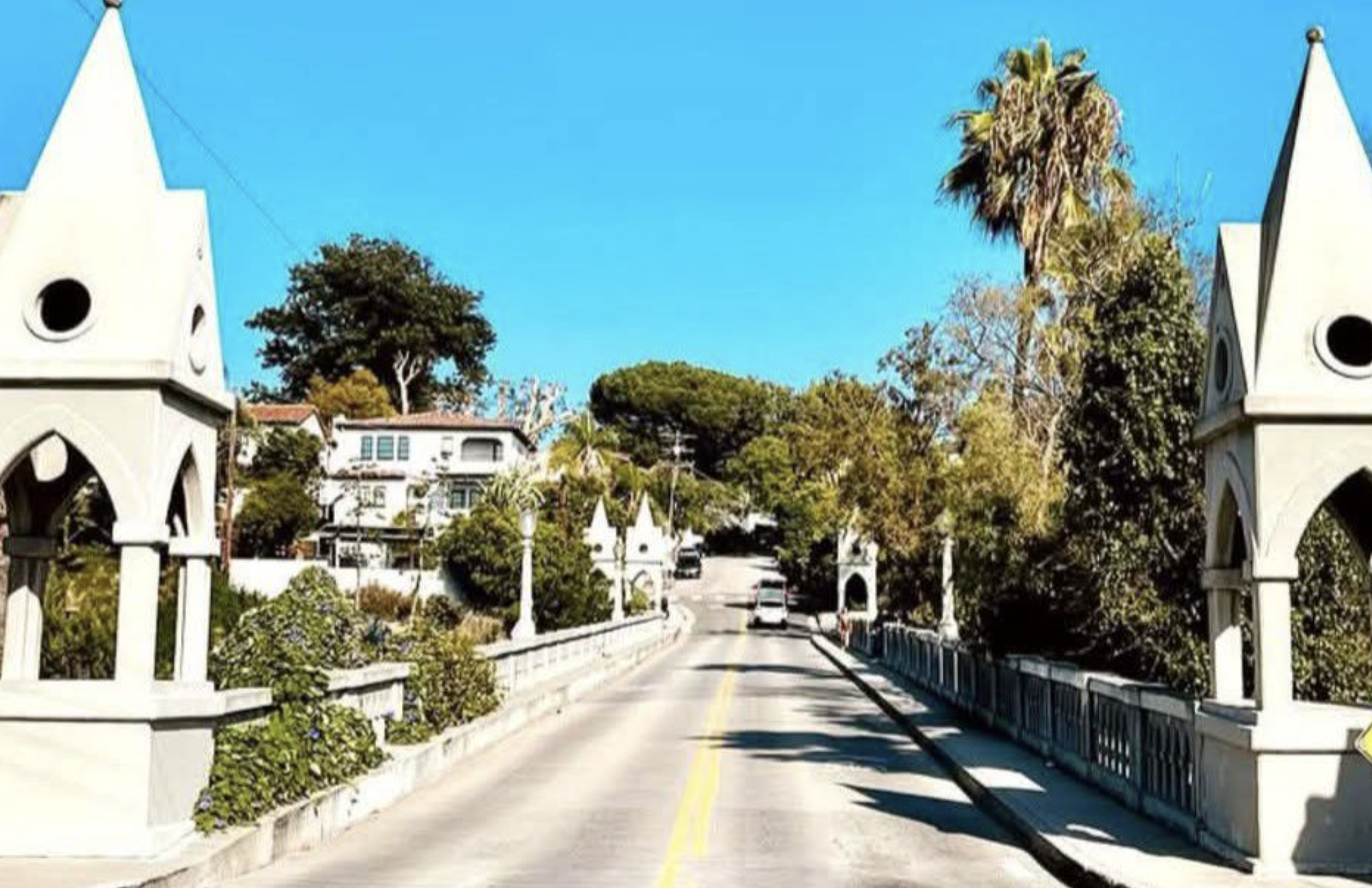
The Shakespeare Bridge is a 1926 Gothic Revival concrete bridge that carries Franklin Avenue over a ravine in the Franklin Hills section of the Los Feliz area, at the eastern edge of Los Angeles 90027. Designed by city engineer J.C. Wright with its distinctive steeple-like turrets and pointed arches, it was designated Los Angeles Historic-Cultural Monument #126 on April 17, 1974. It is one of the last surviving decorative neighborhood road bridges in the city and a beloved local landmark.

Most bridges are infrastructure you cross without noticing. The Shakespeare Bridge is the rare one people slow down for, park beside, and photograph at golden hour. With its little Gothic turrets rising over Franklin Avenue, it looks less like a piece of the city's road network than like a set piece borrowed from a storybook, which is exactly why the neighborhood has loved it for a century.

It is also a landmark the record often gets wrong, including its own monument number. So it is worth laying out the verified facts, because the true history is a good one, and because a Los Feliz realtor is often the person a buyer asks about the story behind a neighborhood's most recognizable corner.

The Facts

Setting the record straight: HCM #126, not #111

The Shakespeare Bridge is Los Angeles Historic-Cultural Monument #126, and it was declared on April 17, 1974. You will see it listed elsewhere as HCM #111 or HCM #674. Both numbers are wrong. HCM #111 is the Hollywood Sign, and HCM #674 is the Jacobson House, a mid-century home elsewhere in Los Feliz. The bridge's correct number is #126, confirmed on the City of Los Angeles official monument list.

One more piece of housekeeping: the bridge is sometimes called the Glendower Place Bridge. That is not a name any authoritative source uses. Its only documented alternate name is the Franklin Avenue Bridge, for the street it carries. Getting these details right matters on a landmark this loved, and it is the kind of accuracy that separates a real architectural record from a page of guesses, a standard we hold across every entry in our look at Los Feliz architecture. The mix-ups are easy to understand, since monument numbers get copied from list to list and a wrong digit can travel for years, but a landmark deserves its own facts. The bridge is one of a small set of public landmarks on the Los Feliz HCM list, alongside civic spaces like the Los Feliz Heights Steps and the avocado trees that trace the area's early orchards, rather than the private architect-designed houses that make up most of the series.

The Los Feliz list
Debbie Pisaro sends the architectural and monument stories worth knowing in Los Feliz, along with homes that often reach her list before the open market.
Join the list or call (310) 362-6429
The Shakespeare Bridge, by the numbers
1926
Built
Completed in 1926 by city engineer J.C. Wright, with contractor Robert Metcalf, for about $60,000.
#126
Historic-Cultural Monument
Declared by the City of Los Angeles on April 17, 1974.
1994
Northridge quake
Damaged in the Northridge earthquake, then rebuilt in a seismic retrofit and rededicated in 1998.
The Architecture

Why a road bridge got Gothic turrets

The Shakespeare Bridge was designed in 1926 by J.C. Wright, a civil engineer in the Los Angeles Bureau of Engineering, and built by contractor Robert Metcalf. It is an open-spandrel reinforced-concrete deck arch, roughly 260 feet long and about 30 feet wide, and it spans a ravine that once carried a seasonal arroyo through the hills. Wright dressed that practical structure in full Gothic Revival costume: steeple-like turrets at the corners, pointed lancet arches, and balustrades that would look at home on a small European cathedral. It is a lot of romance for a piece of the municipal road system, and that is precisely the point.

That choice was of its moment. In the 1920s Los Angeles was building romance into everything, from its house styles to its public works, and a decorative neighborhood bridge fit the mood of a city inventing its own picturesque past. The name is part of the charm and part of the mystery: sources agree the bridge was nicknamed for William Shakespeare because its silhouette looks vaguely medieval and literary, but no one has ever pinned down exactly why the name stuck. It belongs to the same romantic Los Feliz that produced landmarks like the Castle on Glendower Avenue, a fantasy pile by architect A.F. Leicht, and it reflects the picture-book streak that runs through the Los Angeles house styles buyers fall for.

Most bridges are infrastructure you cross without noticing. This is the rare one people park beside and photograph at golden hour.
Los Feliz, off the market
Some of the best homes in the Franklin Hills trade quietly, before a sign ever goes up. See the ones most buyers never hear about.
See off-market homes
The Neighborhood

The bridge, the earthquake, and the street around it

The Shakespeare Bridge nearly did not survive the twentieth century. The 1994 Northridge earthquake left it damaged enough to close, and for a time demolition was on the table. Instead the city and the neighborhood chose preservation, funding a seismic retrofit of roughly a million and a half dollars that rebuilt the deck, sidewalks, and railings in reinforced concrete while keeping the historic Gothic look. The bridge reopened in 1998 and has been the pride of the block ever since, a case study in a city deciding that a small, strange, beautiful thing was worth saving.

For anyone who lives nearby, the bridge is more than a photo stop. It anchors a walkable, tightly knit pocket of the hills where Franklin Avenue meets streets like St. George and Myra, the kind of stretch that makes buyers fall for the area in the first place. It is part of what people mean when they talk about walkable Los Feliz near Griffith Park and the pleasures of living next to Griffith Park. The Franklin Hills around it hold a dense mix of period-revival and hillside homes on curving streets, the sort of small, storied enclave where buyers pay for character as much as for square footage. A landmark corner like this one quietly shapes value, which is one reason choosing the right pocket matters when you are choosing a Los Feliz neighborhood.

Buyer's Note

Homes near a beloved landmark tend to hold interest through slow markets. A recognizable, protected feature at the end of the street is the kind of intangible that a good agent knows how to price, and that a new development can never manufacture.

This is the kind of neighborhood story Debbie Pisaro is built to tell. She works these blocks as an architectural homes specialist across the east side. Coastline 840, her boutique real estate practice, is built on the belief that small teams outperform the big-box brokerages. She tells the story of why she built it on the Coastline 840 blog.

If you own a home near the bridge and are weighing a sale, the first step is a real number grounded in current comps, which you can request through a private Los Feliz home valuation. If you would rather buy in this stretch of the hills, a Los Feliz realtor who works these streets keeps a quiet list of off-market Los Feliz homes that never reach the open market. Either way, the best real estate agent in Los Feliz is where the search should start. For the full neighborhood, our Los Feliz HCM guide maps every designated landmark.

All Things Architectural
Debbie's list for people who love the landmarks: the architects, the bridges, and the design-forward homes of Los Angeles, in your inbox.
Join All Things Architectural
The Questions

Shakespeare Bridge questions, answered

Where is the Shakespeare Bridge in Los Feliz?

The Shakespeare Bridge carries Franklin Avenue over a ravine between St. George Street and Myra Avenue, in the Franklin Hills section at the eastern edge of the Los Feliz area, Los Angeles 90027. It is a public road bridge with sidewalks, so it is easy to visit and a favorite spot for neighborhood photographs.

What is the correct HCM number for the Shakespeare Bridge?

The Shakespeare Bridge is Los Angeles Historic-Cultural Monument #126, declared on April 17, 1974. It is often listed incorrectly as HCM #111 or #674, but those numbers belong to the Hollywood Sign and the Jacobson House. The correct number, #126, appears on the City's official monument list.

When was the Shakespeare Bridge built and who designed it?

The bridge was completed in 1926, designed by J.C. Wright, a civil engineer with the Los Angeles Bureau of Engineering, and built by contractor Robert Metcalf. It cost about sixty thousand dollars and was constructed as an open-spandrel reinforced-concrete arch dressed in Gothic Revival detail.

Why is it called the Shakespeare Bridge?

The bridge was nicknamed for William Shakespeare because its steeple-like turrets and pointed arches give it a medieval, literary look. Sources agree on the association with its Gothic silhouette, but no authoritative record explains exactly how or when the Shakespeare name first stuck to it.

Is the Shakespeare Bridge the same as the Glendower Place Bridge?

No. The Shakespeare Bridge has no verified connection to the name Glendower Place Bridge, which does not appear in any authoritative source. Its only documented alternate name is the Franklin Avenue Bridge, after the street it carries across the ravine in the Franklin Hills.

What happened to the bridge in the 1994 Northridge earthquake?

The Northridge earthquake damaged the bridge badly enough to close it, and demolition was briefly considered. Instead the city funded a seismic retrofit that rebuilt the deck, sidewalks, and railings in reinforced concrete while preserving the Gothic appearance. The restored bridge reopened in 1998.

What architectural style is the Shakespeare Bridge?

It is Gothic Revival, an unusual choice for a road bridge. The reinforced-concrete structure carries steeple-like corner turrets, pointed lancet arches, and decorative balustrades, giving a piece of 1920s public infrastructure the look of a small cathedral and making it one of the city's most photographed bridges.

Can you walk across the Shakespeare Bridge?

Yes. The Shakespeare Bridge carries both vehicle lanes and public sidewalks on Franklin Avenue, so you can walk or drive across it freely. It sits within a walkable stretch of the Los Feliz hills and is a popular stop on neighborhood strolls toward Griffith Park and the surrounding streets.

Who is a good Los Feliz real estate agent for historic neighborhoods?

Debbie Pisaro is a 24-year veteran, founder of Coastline 840, and an Inman Luxury Leader, representing buyers and sellers across Los Feliz and the surrounding neighborhoods. She specializes in architectural, historic, and Historic-Cultural Monument-adjacent homes, and she works these hillside streets block by block.

See the Los Feliz HCM series
Considering a Los Feliz home?

Talk to Debbie

Twenty-four years of Los Angeles luxury real estate, with a specialty in architectural, historic, and design-forward homes.

Debbie Pisaro · (310) 362-6429
debbie@coastline840.com
DRE #01369110 · 160 Glendale Blvd, Los Angeles, CA 90026
Reach Debbie

Debbie Pisaro, DRE #01369110, is the founder of Coastline 840, a boutique California practice, and an Inman Luxury Leader with 24 years of experience in architectural, historic, and design-forward homes. Side, Inc., CA DRE #02014153, is the responsible broker. She writes about California real estate at debbiepisaro.com, losfelizliving.com, and coastline840.com. Published July 2026.

✦ ✦ ✦
Los Feliz. Hyperlocal. Insider voice.

On the Register

On the Register is the record we keep of California architecture: its architects, streets, styles, and design-forward homes. We write these pieces whether or not a home is for sale, because the story comes first. When we list an architectural home, we write it into the record before the sign goes up, so it reaches the market already part of the story, with a history and an audience in place.

© 2026 Debbie Pisaro, Coastline 840 · ontheregister.com

The Shakespeare Bridge is one of the civic monuments alongside the homes. It is one of more than fifty Historic-Cultural Monuments in Los Feliz. For the full overview, see the Los Feliz HCM guide, browse the complete collection of Los Feliz monuments, and if you are weighing designation for your own home, here is how to get a home designated.

Comment

Abraham Gore Residence – 2208 N. Catalina Street, HCM #1061

Debbie Pisaro January 6, 2025
Los Feliz · Historic-Cultural Monument

HCM #1061. A conical-towered landmark on North Catalina Street, built in the late 1920s for a founder of the chain that became Fox West Coast.

By Debbie PisaroLos Feliz Living
Updated July 2026
HCM Series9 min read
#1061
Designated February 5, 2014Harry B. Aarens · late 1920s · 2208 N. Catalina Street

What is the Abraham Gore Residence?

The Abraham Gore Residence at 2208 North Catalina Street is a two-story Los Feliz home built in the late 1920s and designed by architect Harry B. Aarens in a blend of Spanish Colonial Revival and Mediterranean Revival styles. It was the home of Abraham Gore, an early movie exhibitor who co-founded the West Coast Theatres chain, and it was designated Los Angeles Historic-Cultural Monument #1061 on February 5, 2014. The house is instantly recognizable for the conical tower over its entrance.

Some Los Feliz landmarks announce themselves with a famous architect's name. This one announces itself with a tower. The Abraham Gore Residence sits on a corner of North Catalina Street under a tall conical roof you notice before you know anything else about the house, and once you have seen it you start spotting it in photographs of the neighborhood without knowing why it looks so familiar.

Behind that tower is a better story than the home's quiet street presence suggests: a designed-to-impress late-1920s residence by an architect worth knowing, built for a man who helped wire Los Angeles for the movies. It is one of the Los Feliz monuments a Los Feliz realtor points out to buyers who think they already know which houses on the hill matter.

The Architecture

Harry B. Aarens and the tower

The Abraham Gore Residence was designed by architect Harry B. Aarens and built in the late 1920s, at the height of the era when Southern California was inventing its romantic, Mediterranean self. Aarens gave the house a picturesque, storybook silhouette that has made it a fixture of the North Catalina streetscape ever since.

The signature is the tall conical tower over the entrance, with a smaller octagonal tower set behind it, a composition more theatrical than most of its neighbors. Below the towers the house carries the vocabulary of the 1920s: stucco walls, a tile roof, arched openings, and iron detail, all arranged to read as a landmark from the street rather than just another good period home. It belongs in the same Los Feliz conversation as the neighborhood's other Spanish and Mediterranean monuments, among them the Blackburn Residence and the Durex Model Home. It is a vivid entry in the wider story of the LA house styles buyers fall for.

The Los Feliz list
Debbie Pisaro sends the architectural and monument homes worth knowing in Los Feliz, often before they reach the open market.
Join the list or call (310) 362-6429
The Abraham Gore Residence, by the numbers
1920s
Built
A late-1920s design by architect Harry B. Aarens, records place it around 1927.
#1061
Historic-Cultural Monument
Designated by the City of Los Angeles on February 5, 2014.
169
Theaters by 1926
The scale of Gore's West Coast Theatres chain across the Pacific states.
The Mogul

Who was Abraham Gore?

Abraham Gore was one of the men who built the machinery of moviegoing in Los Angeles. In 1920 he, his brother Michael, and the producer Sol Lesser co-founded West Coast Theatres, and the chain expanded with astonishing speed, operating roughly 169 theaters across the Pacific states by 1926 before it grew into Fox West Coast Theatres.

The timing was everything. Gore arrived in the exhibition business just as Los Angeles was becoming the capital of the movie industry, and West Coast Theatres rode that wave. In the 1920s he served as secretary-treasurer of Gore Brothers, Incorporated, the real-estate and theater company behind the chain, and the network of picture palaces he helped assemble spread across California before folding into the Fox empire. A man who spent his days building grand rooms for audiences to sit in evidently wanted a grand room of his own to come home to, and the tower on Catalina Street reads like exactly that impulse rendered in stucco and tile.

Gore built the house on Catalina Street at the peak of that success, a residence meant to signal a man of standing in the young film business. He and his wife, Ruth Ringer Gore, owned it from about 1929 to 1952, and the home's association with an early studio-era power broker is part of what earned it a place on the register. It fits the long Los Feliz tradition of houses tied to the movie world, from the rock-and-film history of the Castle on Glendower, a landmark by architect A.F. Leicht, to the Laughlin Park estates that still draw stars like Angelina Jolie.

Some Los Feliz landmarks announce themselves with an architect's name. This one announces itself with a tower.
Los Feliz, off the market
Some of the best Los Feliz homes trade quietly, before a sign ever goes up. See the ones most buyers never hear about.
See off-market homes
The Monument

What does HCM #1061 mean for the home today?

Historic-Cultural Monument status is Los Angeles's oldest form of landmark protection. For the Abraham Gore Residence, the 2014 designation recognizes both its distinctive late-1920s architecture and its association with a founder of the West Coast Theatres chain. That status carries real, practical weight for anyone who owns the house or hopes to.

The most tangible benefit is the Mills Act, California's leading incentive for historic preservation, which can cut a landmark owner's property taxes in exchange for a preservation commitment. It is one of the first things a serious buyer asks Debbie Pisaro to model on a designated Los Feliz home, and a central issue when selling a Mills Act or HCM home in Los Feliz.

Buyer's Note

A recognizable landmark like this one carries stewardship as well as prestige. HCM status reviews exterior changes and rewards careful preservation, and on a house this visible that scrutiny protects value more than it limits it.

Today the house is prized as much for its silhouette as for its story. It is one of the most photographed private residences in this stretch of Los Feliz, a favorite of neighborhood walkers and architecture buffs, and the kind of address that anchors a block. For a buyer, a home like this offers something a new build never can: a place already written into the visual memory of the neighborhood, with a name attached to it. That is the quiet premium a landmark carries, and it is why a monument on a good Los Feliz street is measured differently from the house next door, a distinction that rewards an agent who can price the story as well as the square footage.

This is the kind of house Debbie Pisaro is built to represent. She works these homes as an architectural homes specialist across the east side. Her brokerage, Coastline 840, is an independent boutique built on the belief that small teams outperform the big-box brokerages. She tells the story of why she built it on the Coastline 840 blog.

If you own an architectural home in Los Feliz and are weighing a sale, the first step is a real number grounded in current comps, which you can request through a private Los Feliz home valuation. If you would rather buy one, a Los Feliz realtor who works these blocks keeps a quiet list of off-market Los Feliz homes that never reach the open market. Either way, the best real estate agent in Los Feliz for architectural property is where the search should start. For the full neighborhood, our Los Feliz HCM guide maps every designated home.

All Things Architectural
Debbie's list for people who love the houses: the architects, the landmarks, and the design-forward homes of Los Angeles, in your inbox.
Join All Things Architectural
The Questions

Abraham Gore Residence questions, answered

Where is the Abraham Gore Residence in Los Feliz?

The Abraham Gore Residence stands at 2208 North Catalina Street in Los Feliz, Los Angeles, CA 90027, on a corner site marked by its tall conical tower. It is a private residence rather than a museum, so it is best appreciated from the public street, in keeping with the quiet character of the neighborhood.

When was the Abraham Gore Residence built?

Sources place its construction in the late 1920s, with the design dated to around 1927. Abraham Gore and his wife Ruth owned the house from about 1929 to 1952, which is consistent with a late-1920s completion for the home on North Catalina Street.

Who was Abraham Gore, the theater mogul?

Abraham Gore was an early Los Angeles movie exhibitor who, in 1920, co-founded West Coast Theatres with his brother Michael and the producer Sol Lesser. The chain grew rapidly, running about 169 theaters by 1926, and eventually became Fox West Coast Theatres, a dominant force in first-run movie houses.

Who designed the house?

The Abraham Gore Residence was designed by architect Harry B. Aarens in a blend of Spanish Colonial Revival and Mediterranean Revival styles. Aarens gave the house its picturesque, tower-topped silhouette, which has made it one of the most recognizable homes on North Catalina Street.

What style is the Abraham Gore Residence?

It is a blend of Spanish Colonial Revival and Mediterranean Revival, the romantic styles that defined 1920s Los Feliz. The house shows the era's stucco walls, tile roof, and arched openings, crowned by a tall conical entry tower and a smaller octagonal tower behind it.

Why is the Abraham Gore Residence a Historic-Cultural Monument?

The City of Los Angeles designated it Historic-Cultural Monument #1061 on February 5, 2014, recognizing both its distinctive late-1920s architecture and its association with Abraham Gore, a founder of the West Coast Theatres chain. The designation protects the home's exterior character.

Can the Abraham Gore Residence qualify for the Mills Act?

As a designated Historic-Cultural Monument, the house is generally eligible to apply for a Mills Act contract, which can significantly lower property taxes in exchange for a preservation commitment. Eligibility and the exact savings depend on the property and the current program terms, so any buyer should verify the specifics first.

Who is a good Los Feliz real estate agent for architectural homes?

Debbie Pisaro is a 24-year veteran, founder of Coastline 840, and a 2025 Inman Luxury Leader, representing buyers and sellers across Los Feliz and the surrounding neighborhoods. She specializes in architectural, historic, and Historic-Cultural Monument homes, and she works the Los Feliz market street by street rather than from a distance.

Is the Abraham Gore Residence for sale?

It is a private home and not typically on the market. If you are hoping to buy an architectural or landmark home in Los Feliz, including quiet off-market opportunities, that is a search best run with an agent who specializes in this narrow niche of the market.

See the Los Feliz HCM series
Considering a Los Feliz home?

Talk to Debbie

Twenty-four years of Los Angeles luxury real estate, with a specialty in architectural, historic, and design-forward homes.

Debbie Pisaro · (310) 362-6429
debbie@coastline840.com
DRE #01369110 · 160 Glendale Blvd, Los Angeles, CA 90026
Reach Debbie

Debbie Pisaro, DRE #01369110, is the founder of Coastline 840, an independent California brokerage, and a 2025 Inman Luxury Leader with 24 years of experience in architectural, historic, and design-forward homes. She writes about California real estate at debbiepisaro.com, losfelizliving.com, and coastline840.com. Published July 2026.

✦ ✦ ✦
Los Feliz. Hyperlocal. Insider voice.

On the Register

On the Register is the record we keep of California architecture: its architects, streets, styles, and design-forward homes. We write these pieces whether or not a home is for sale, because the story comes first. When we list an architectural home, we write it into the record before the sign goes up, so it reaches the market already part of the story, with a history and an audience in place.

© 2026 Debbie Pisaro, Coastline 840 · ontheregister.com

Comment
← NewerOlder →

Contact a Los Feliz Realtor

Newsletter Block
This newsletter signup form needs a storage option. Edit the block and enter a storage location via the Storage tab.

Subscribe

Sign up with your email address to receive news and updates.

We respect your privacy.

Thank you!

Los Feliz Living

Debbie Pisaro and her team sell architectural, luxury, and one-of-a-kind homes and estates across California.

(310) 362-6429  ·  debbie@coastline840.com

Reach Debbie

Our sites DebbiePisaro.com·LosFelizLiving.com·JustSilverLake.com·JustStudioCity.com·JustOjai.com·JustWestAdams.com·Just-SanDiego.com·Coastline840.com·ArchitectureInCalifornia.com·Just840Miles.com

Powered by Side: #1 California-based brokerage, No. 9 in the nation.

Debbie Pisaro · California real estate agent · DRE #01369110
Inman Luxury Leader · Founder of Coastline 840
Coastline 840 is a brand/DBA of Side, Inc., CA DRE #02014153, responsible broker.

© 2026 Debbie Pisaro, Coastline 840