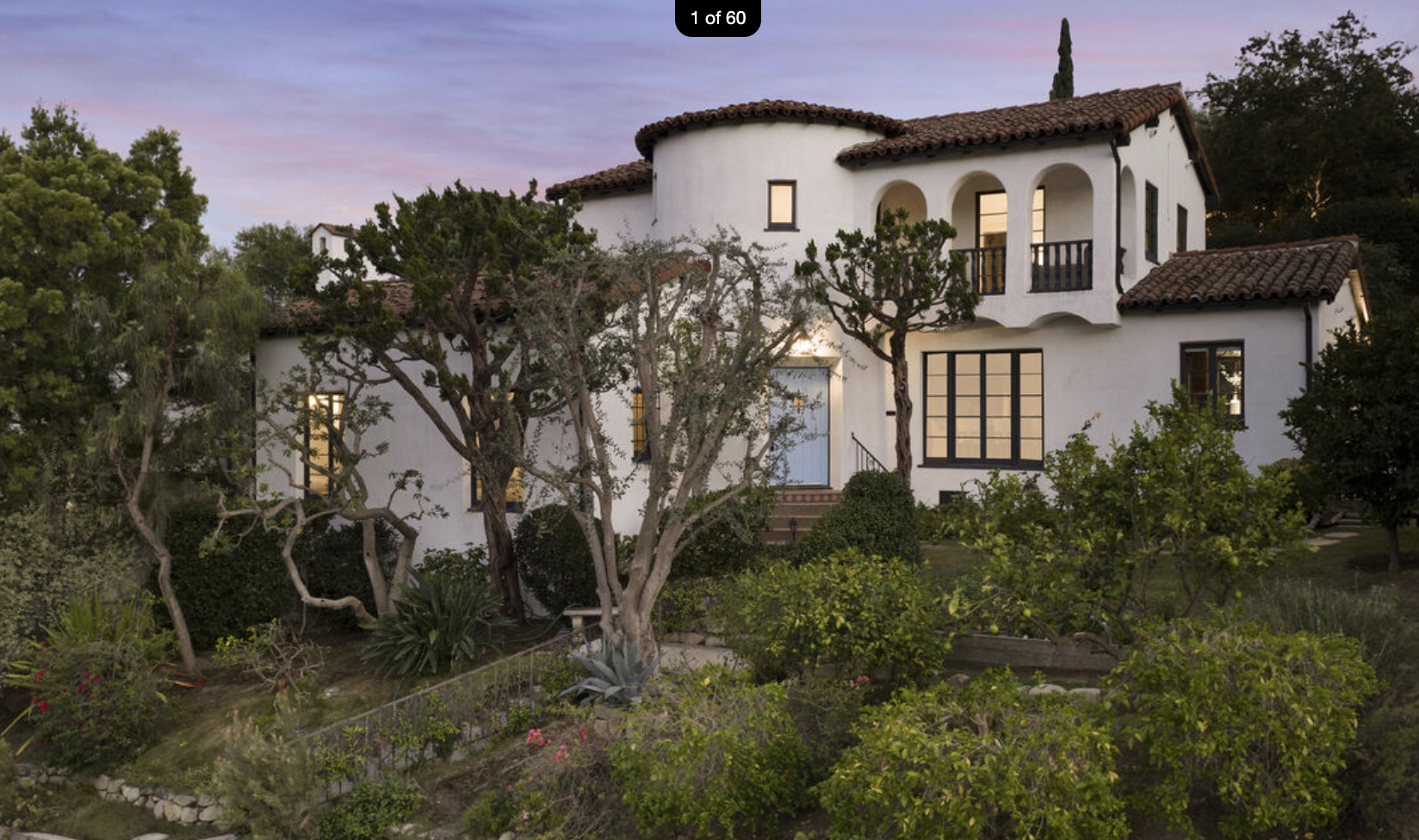
Ben Lomond Place is a Spanish street below Los Feliz Boulevard in Los Feliz, Los Angeles 90027. Thirteen parcels carry the address and eight of them were built between 1927 and 1933, six recorded as Spanish. A separate Ben Lomond Drive runs through the 2200s and 2300s, and anyone searching Spanish homes for sale Los Feliz gets the two streets back as one. Debbie Pisaro is a Los Feliz real estate agent who keeps them apart.
Where is Ben Lomond in Los Feliz?
There are two of them, and they are not the same street. Ben Lomond Drive runs through the 2200s and 2300s in Los Feliz, Los Angeles 90027, and Ben Lomond Place runs through the 3400s in the same zip code, below the Boulevard, which is how people here actually give directions. Both are period-revival streets built mostly between 1927 and 1948, both are inside the Los Feliz Improvement Association's survey area, and both turn up in searches for architectural homes for sale Los Feliz as though they were one address range. They are not. Los Feliz has more than one Spanish street and I am not going to pretend otherwise, but the Place is one of them and the record is unusually clean: eight houses built between 1927 and 1933 on a street of thirteen. The Drive carries the deeper documented record on a handful of houses, including a 1929 Mediterranean Revival by A.F. Leicht that the survey flags as a potential Historic-Cultural Monument. Debbie Pisaro sells across Los Feliz and keeps the two streets straight, which is more than most listing copy manages.
Two streets, one name, one zip code. An insurance adjuster, a widow who ran a hotel, a musician at the picture studios, and two architects almost nobody has written about.
The thing that sends me down these holes is almost never the famous house. It is the ordinary-looking street where the record turns out to be better than anybody expected, and Ben Lomond is that twice over, because there are two Ben Lomonds in Los Feliz and neither one of them is what I assumed when I started.
Here is the shape of it. Ben Lomond Drive sits in the 2200s and 2300s. Ben Lomond Place sits in the 3400s. Same zip, same neighborhood, different streets, and the address numbers are the only thing that reliably tells them apart at a glance. If you are searching sold records, or pulling comps, or reading a survey entry, and you are not looking at the house number, you are going to mix two streets together and not know you did it.
That is not a small thing when you are pricing. Half the reason a Los Feliz number comes out wrong is that somebody grouped houses that only look like they belong together, which is the same problem the hill next door has, and I have written about that at length on Franklin Hills. Getting how Los Feliz home values actually get set right starts with knowing which street you are standing on.
Ben Lomond Place, house by house
Ben Lomond Place is the street in the 3400s, below the Blvd, and it is the one people usually mean when they say the name, because it is the one that keeps producing the pretty houses. For a while I had it down as the thinner of the two, because the Los Feliz Improvement Association's residential survey only ever reached a couple of houses on it. That was wrong, and it was wrong in the ordinary way research goes wrong, which is that the record was fine and I was only looking in one place.
Thirteen separate parcels carry a Ben Lomond Place address. They run 3427 through 3477 on one side of the street and 3434 through 3476 on the other, and in the county assessor's records eight of the thirteen were built between 1927 and 1933. Six of those eight are recorded as Spanish or Spanish Colonial Revival: 3427 in 1929, 3437 in 1927, 3447 in 1933, 3456 in 1928, 3457 in 1928, and 3477 in 1927. 3476 is a 1928 Mediterranean, which on a street like this one is the same conversation held in a different accent. That is not a run of pretty houses on a mixed block. That is a Spanish street, and below the Blvd it is one of the good ones.
The other five came later and they came out of a different set of ideas about what a house should look like. 3440 and 3465 are both 1939 and both recorded as Traditional. 3460 is 1953. 3434 is 1960. For 3455 the assessor gives no year at all, and it reads as a Ranch. So the block got built out twice, once at the end of the twenties when Spanish was simply what Los Angeles was putting up, and again after the war when it very much was not, and you can stand in one spot on that street and see both decisions at the same time.
Then there is 3450, built in 1927, which nobody seems able to agree about. Over the years the record has called it Mediterranean, and Hacienda, and Art Deco, and in one 2001 description, memorably, a cute deco fixer. A 1927 house on a Spanish block that keeps getting written up as Deco is either a genuinely unusual house or a house that got remodeled hard at some point, and I would want to stand in front of it before I told you which.
And 3477 N. Ben Lomond Place is the one the Los Feliz Improvement Association's survey actually reached, a 1927 Spanish Colonial Revival, three bedrooms and two baths across 1,977 square feet. 3456 Ben Lomond Place is the largest of the Spanish houses at roughly 2,866 square feet, built in 1928, and it is the one that shows you what the block was built with: a magnesite entry with a wrought iron stair, a sunken living room under a barrel ceiling, clay tile, hand-stenciled doors, quarter-sawn oak floors, and a back stair off the kitchen of the kind that used to have a name.
And there is a second reason the Place reads thinner on paper than it is. Some of these lots run all the way through from one street to the next, so a single house carries two addresses: a Rowena Avenue number on the front and a Ben Lomond Place number at the back. The city's SurveyLA records file three of them under Rowena, with the Ben Lomond number listed as an alternate address on the same record. 3414 W. Rowena Avenue is also 3415 Ben Lomond Place. 3426 W. Rowena Avenue is also 3423 and 3421 Ben Lomond Place. 3408 W. Rowena Avenue is also 3405 Ben Lomond Place. The survey recorded two of the three as the property of J. C. Knight and the third as the property of J. F. Wadkins, and it names no architect on any of them. This is not only how the city files them, either. A description written for 3414 Rowena in 2001 says it outright, in capital letters, that it is a street to street lot, so the people handling these houses have understood the geometry for at least a generation.
So search the Place and those three houses do not come up, and that is not a hole in the record, it is a filing decision made a century ago that nobody has undone. It is also why a house on this block can have its front door on one street and its driveway on another. That is not a quirk of one property, it is how the hill was subdivided, and it is the single most useful thing to know before you try to price anything here.
There is one more thing sitting in those records and I want to be careful with it, because I have not put it in front of the city. 3414 Rowena is described as a legal duplex. 3405 Rowena is described as a duplex. Several of the houses on the Place carry a guest apartment, or a separate studio, or what the older records politely call maid's quarters. Something about the way this block was cut allowed for a second unit in a way the hillside streets a few hundred feet north did not, and if you own here that is worth knowing before you assume anything about what you can and cannot do with the property. Check it with the city. Do not take it from a description, and do not take it from me.
What all of it establishes is the character of the block and the window it was built in, and that window is 1927 to 1933, which is exactly the peak of the Spanish Colonial Revival in Los Angeles. If you want the wider picture of how that style sits in this city, the architectural homes practice covers it, and the way I read a Spanish house has not changed in twenty years: the courtyard turned away from the street, the deep-set window, the stair tucked behind an arch. Somebody's builder copied those details out of a book in 1927 and the houses are still standing because of it.
If your house is on either Ben Lomond, ask whoever is pricing it to show you the comps by house number, not by street name. The two streets are far enough apart in vintage and size that a set pulled on the name alone will carry houses that have nothing to do with yours. And on this block, ask two more things: whether the set caught the houses filed under Rowena Avenue, because a search on Ben Lomond Place alone will never find them, and whether it separated the eight houses from 1927 to 1933 from the five that went up between 1939 and 1960. Those are two different houses wearing the same street name.
Ben Lomond Drive, the street with the paperwork
The Los Feliz Improvement Association's residential survey carries four houses on Ben Lomond Drive, and what makes them worth reading is not the architecture alone, it is that the survey went to the 1930 and 1940 census and wrote down who actually lived in them. You get the house and you get the household, which is rare, and it is the kind of record that turns a street into a story instead of a list of build years.
2240 N. Ben Lomond Drive is the big one. A 1929 Mediterranean Revival by A.F. Leicht, six bedrooms and five baths across 9,813 square feet, and the survey flags it as a potential City of Los Angeles Historic-Cultural Monument, which is a status worth understanding before anyone touches a house like that. In the 1940 census the house was valued at $200,000, an enormous number for the year, and it was occupied by a widow living with her niece and nephew, who ran a hotel. Census records from 1930 and 1940 also document people at 2238, so the parcel was carrying more than one household at points in its life.
2259 N. Ben Lomond Drive is the Spanish Colonial Revival, also 1929, four bedrooms and three baths across 3,308 square feet. The survey does not name an architect. It does name the original owner: Lloyd Gilbert, a mechanical engineer in construction, who lived there with his wife Jessie and family including his son William, a draftsman. The house was valued at $25,000 in the 1930 census. By 1940 it had become a rental at $110 a month, occupied by a divorced woman and her daughter, which is the whole arc of the Depression sitting inside one address.
2214 N. Ben Lomond Drive is the latecomer of the three prewar houses, a 1939 American Colonial Revival by Wendall W. Warren, three bedrooms and three baths across 2,026 square feet. The original owner was Frank G. Niner, an insurance adjuster earning $4,800 a year, living there with his wife Catherine, who was born in Canada. The house was valued at $12,500 in the 1940 census. Set that next to 2240 and you have the range of this street in one sentence: a twelve-thousand-dollar house and a two-hundred-thousand-dollar house, three doors apart.
2307 N. Ben Lomond Drive is the odd one and the most interesting to me. The record covers a compound running 2307 through 2317, a 1948 Traditional with six bedrooms and six baths across 3,182 square feet on a 6,872 square foot lot, but the census puts households on the ground well before 1948, the Georgio family at 2313, where Vincent Georgio was a musician at the picture studios, and the Sanborn family at 2317, where Guy R. Sanborn was an insurance broker. So the structures that stand there now are not the first ones. Something was replaced or absorbed in the postwar building years, and the 1948 date on the record is the end of that story rather than the beginning of it.
A.F. Leicht and Wendall W. Warren, two names worth chasing
Leicht I already know. Alfred Frederick Leicht started out in Queens in the mid-1880s and came west, and he put up something like two dozen houses across Los Feliz and Hollywood in the 1920s, in a theatrical manner that borrows from Spanish and Art Nouveau and Deco and Egyptian all at once. He built the Castle on Glendower Avenue and he built Angelus Temple, and the Welfer house on Cromwell Avenue is a designated Historic-Cultural Monument, so the city has already agreed he matters. He lived at 462 N. Vermont Avenue until the Hollywood Freeway took the house in the late 1940s. The fuller record is on his architect profile, where I have called him the least documented architect of his generation, and I meant it. Here is the part that matters for this street: 2240 N. Ben Lomond Drive is not on that profile. It is a Leicht I did not have when I wrote it, and a 9,813 square foot one at that. Warren I do not know yet, and the 1939 house at 2214 is where I would start.
I say this because attribution is where architectural real estate goes wrong most often. A name gets repeated on an aggregator, then it gets repeated in listing copy, and after a few cycles it is treated as established when nobody ever checked it. An unverified architect on a listing is a liability rather than a premium, and I would rather tell a seller that the record is thin than hand them a claim that falls apart under a buyer's inspection. If a name on one of these houses turns out to hold up, that is a real piece of value and it should be documented properly, the way the Blackburn Residence is documented, and not just asserted.
What this means if you own one
Three things, and they are all the same thing really. Know which street you are on and make sure your agent does. Know whether your house carries a designation or could, because on Ben Lomond Drive at least one house is flagged as a potential monument and that changes the math, selling a Mills Act or HCM home has disclosure and pricing requirements a general agent will not raise, and the tax benefit transfers with the house. And know what the record actually says about your house before it goes in the marketing, which usually means going to the survey and the census rather than to the last listing.
The setup is most of the work. I ask for two to three weeks before a Los Feliz house like this goes live, and that is photography that shows what the house actually is, and the story straight, and the placement lined up, and honestly I could keep listing things. I will stop there. The point is that a house on a street nobody has written about properly needs somebody to write about it properly, and that is a job you do before the sign goes in, not after.
Debbie Pisaro is a 24-year veteran, founder of Coastline 840, and an Inman Luxury Leader, representing buyers and sellers across Los Feliz and the surrounding neighborhoods. Many of the homes she sells never reach the open market. Most owners start with a real Los Feliz home valuation rather than an automated estimate, because no algorithm has walked the rooms. If you are working out where in the neighborhood you belong, the Los Feliz neighborhood guide is the place to start, and the Oaks and Laughlin Park both have their own pages. For what is designated and what is not, there is the Los Feliz historic designation guide and the running list of Los Feliz historic homes for sale. Buyers who want to know what a specialist does differently can read why the right Los Feliz real estate agent changes the outcome, and everything else on this neighborhood lives at Los Feliz Living.
Are Ben Lomond Drive and Ben Lomond Place the same street?
No. They are two separate streets in Los Feliz, Los Angeles 90027. Ben Lomond Drive carries addresses in the 2200s and 2300s. Ben Lomond Place carries addresses in the 3400s, below Los Feliz Boulevard. The house number is the reliable way to tell which street a record refers to.
What kind of houses are on Ben Lomond Drive?
Period revival, built between 1929 and 1948. The Los Feliz Improvement Association survey documents a 1929 Mediterranean Revival by A.F. Leicht at 2240, a 1929 Spanish Colonial Revival at 2259, a 1939 American Colonial Revival by Wendall W. Warren at 2214, and a 1948 Traditional at 2307 that is part of a compound running to 2317.
Is there a historic home on Ben Lomond Drive?
The survey flags 2240 N. Ben Lomond Drive, a 1929 Mediterranean Revival by A.F. Leicht of 9,813 square feet, as a potential City of Los Angeles Historic-Cultural Monument. Potential is not the same as designated, so the status would need to be confirmed against the city record before it is relied on.
Who was A.F. Leicht?
Alfred Frederick Leicht designed roughly two dozen houses across Los Feliz and Hollywood in the 1920s, among them the Castle on Glendower Avenue and Angelus Temple in Echo Park. The Los Feliz Improvement Association survey credits him with the 1929 Mediterranean Revival at 2240 N. Ben Lomond Drive, a house of 9,813 square feet.
Are there Spanish homes on Ben Lomond Place?
Yes, and it is the dominant style. County assessor records show eight of the street's thirteen houses built between 1927 and 1933, six of them recorded as Spanish or Spanish Colonial Revival, including 3427, 3437, 3447, 3456, 3457 and 3477. The remaining five date from 1939 to 1960.
How many houses are on Ben Lomond Place?
Thirteen separate parcels carry a Ben Lomond Place address in the county record, running from 3427 to 3477 on one side and 3434 to 3476 on the other. Three more houses face Rowena Avenue but hold a Ben Lomond Place number on the back of the same lot.
Why do some Ben Lomond Place houses have a Rowena Avenue address?
Because the lots run through from one street to the other. The city's SurveyLA records file three of them under Rowena Avenue with the Ben Lomond Place number as an alternate: 3414 Rowena is also 3415 Ben Lomond, 3426 Rowena is also 3423 and 3421, and 3408 Rowena is also 3405.
Who lived on Ben Lomond Drive originally?
The census records in the survey name several. Frank G. Niner, an insurance adjuster, at 2214. Lloyd Gilbert, a mechanical engineer in construction, at 2259. A widow who lived with her niece and nephew and ran a hotel at 2240. Vincent Georgio, a musician at the picture studios, at 2313, and Guy R. Sanborn, an insurance broker, at 2317.
Why does it matter which Ben Lomond a house is on?
Because comparable sales pulled on the street name alone will mix two different streets with different vintages and different house sizes. A set that treats a 2,000 square foot 1939 Colonial and a 9,800 square foot 1929 Mediterranean as neighbors produces a number that is not about either house.
Who is the best real estate agent for Los Feliz architectural homes?
Look for an agent who checks an architect attribution against primary sources before it reaches marketing. Debbie Pisaro is a 24-year veteran, founder of Coastline 840, and an Inman Luxury Leader, representing buyers and sellers across Los Feliz. Many of the homes she sells never reach the open market.
Talk to Debbie
Buying on either Ben Lomond, selling on one, or trying to find out what the record actually says about your own house. No pressure, no public footprint.
debbie@coastline840.com
DRE #01369110 · 160 Glendale Blvd, Los Angeles, CA 90026
Coastline 840 is a DBA of Side, Inc., CA DRE #02014153
Debbie Pisaro, DRE #01369110, is the founder of Coastline 840 and an Inman Luxury Leader with 24 years of experience in architectural, historic, and design-forward homes. Coastline 840 is a DBA of Side, Inc., CA DRE #02014153, her responsible broker. House records in this piece come from the Los Feliz Improvement Association's historical residential survey, the City of Los Angeles SurveyLA records, Los Angeles County assessor data, and the 1930 and 1940 United States censuses. Many of the homes she sells never reach the open market. She writes about California real estate at debbiepisaro.com, losfelizliving.com, and coastline840.com. Published September 2026.
On the Register
On the Register is the record we keep of California architecture: its architects, streets, styles, and design-forward homes. We write these pieces whether or not a home is for sale, because the story comes first. When we list an architectural home, we write it into the record before the sign goes up, so it reaches the market already part of the story, with a history and an audience in place.
© 2026 Debbie Pisaro, Coastline 840 · ontheregister.com