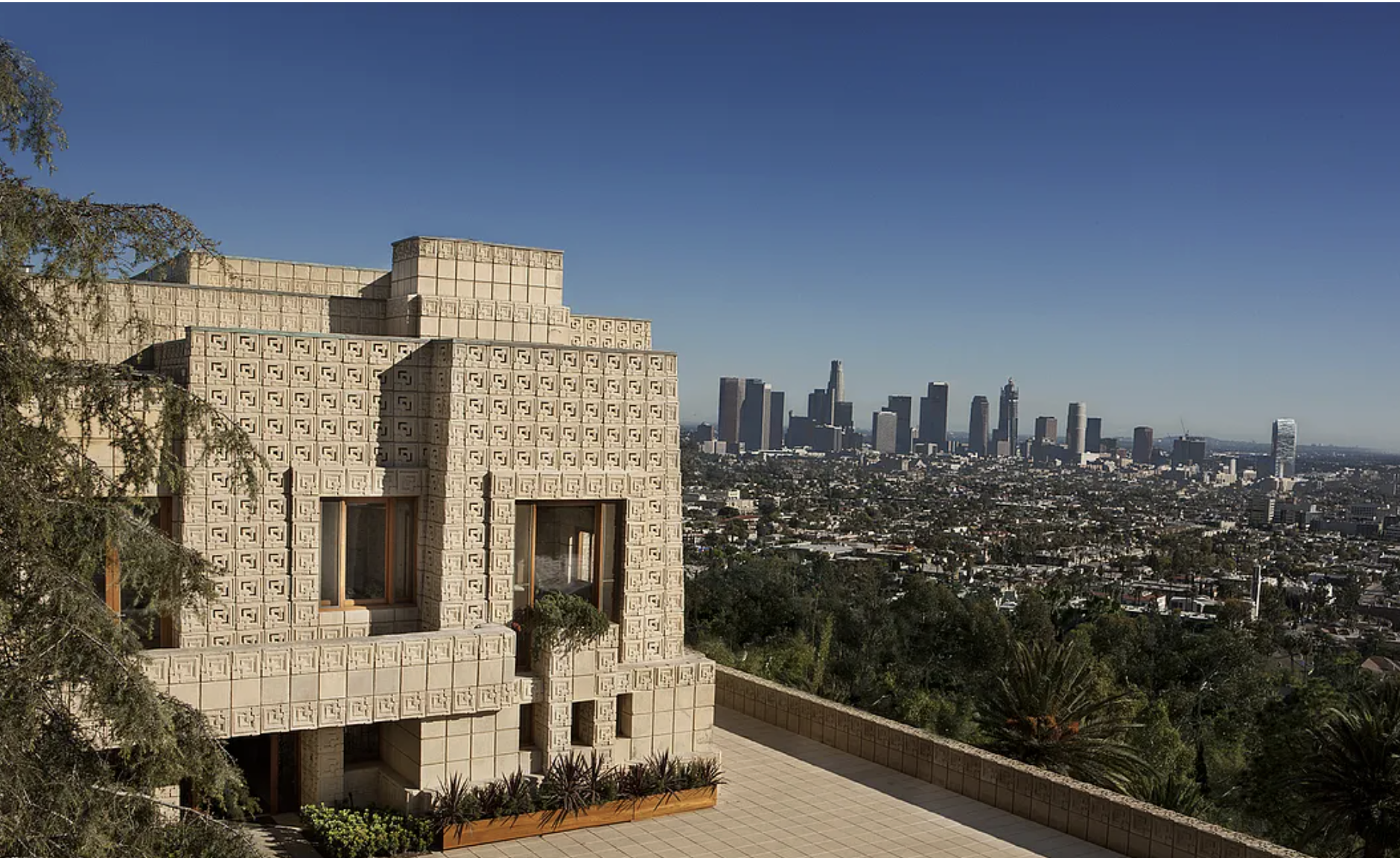
Architectural homes for sale in Los Feliz range from Frank Lloyd Wright textile-block landmarks to Neutra and Gregory Ain modernism and Spanish Colonial Revival estates. It is one of California's densest concentrations of architect-designed housing. Debbie Pisaro, a 2025 Inman Luxury Leader, represents buyers and sellers of these homes, many of which trade off-market before they are ever listed.
Buyers who search for architectural homes for sale in Los Feliz are rarely shopping a zip code. They are shopping an architect, a style, a specific house they have driven past for years. Los Feliz rewards that instinct better than almost any neighborhood in California, because within a few hillside blocks it holds work by Frank Lloyd Wright, his son Lloyd Wright, Richard Neutra, Gregory Ain, R.M. Schindler, and John Lautner, alongside Spanish Colonial Revival and period-revival estates from the 1920s. As a Los Feliz real estate agent who specializes in architectural homes across California, Debbie Pisaro tracks this inventory house by house, on and off the market.
This is a working map of what "architectural" means here, who designed the homes worth knowing, where they sit, and how they actually change hands. Every house named below is a documented Los Angeles Historic-Cultural Monument or a verified work in the public record.
What "architectural" means in Los Feliz
Los Feliz is not a single-style neighborhood. Its architectural homes span three broad eras: the 1920s textile-block and Spanish Revival period, the 1930s-to-1950s modernist wave, and the postwar work that followed. That range is the point. A buyer can choose between a Mayan-influenced Lloyd Wright house on Franklin Avenue and a glass-and-steel Neutra on a Los Feliz Hills ridge without leaving a two-mile radius. It is one of the deepest concentrations of significant residential architecture in California, which is why architectural buyers fly in from New York, Chicago, and London to see it.
The neighborhood's density of Historic-Cultural Monuments is the tell. More than forty Los Feliz properties carry HCM designation, and a large share of them are private homes rather than civic buildings. For a buyer, that designation is both a mark of pedigree and a set of rules worth understanding before an offer. Debbie walks clients through exactly what each one carries.
The architects who built Los Feliz
Architectural buyers shop the name first. Here are the architects whose Los Feliz work defines the market, with the specific houses that anchor each one. Debbie has written many of these homes into the record on the Los Feliz historic homes archive.
Frank Lloyd Wright
Wright's Los Feliz is defined by the Ennis House on Glendower Avenue, built in 1924 and designated Historic-Cultural Monument #149. It is the largest and last of his four Los Angeles textile-block houses, and one of the most filmed private homes in the state. His Hollyhock House, a short distance away, is Los Feliz's only UNESCO World Heritage Site.
Lloyd Wright
Frank's son left a deeper Los Feliz footprint than his father. The Sowden House on Franklin Avenue, HCM #762, is the dramatic 1926 house with the Mayan "lion's mouth" facade. His 1928 Samuel-Novarro House on Valley Oak Drive and his 1922 Taggart House in The Oaks round out the deepest body of work by any single architect on this hillside.
Richard Neutra
The Lovell Health House on Dundee Drive, HCM #123, is the 1929 all-steel-framed house that launched Neutra's American reputation and is counted among the first International Style residences in the country. Neutra's 1949 Wirin House on Glendower shows his later, warmer hillside manner.
Gregory Ain, R.M. Schindler and John Lautner
Ain's Edwards House at 5642 Holly Oak Drive and the adjacent Ernst House at 5670 Holly Oak Drive sit together in The Oaks, a rare two-house modernist cluster. Schindler's Elliot House is on Newdale Drive, and Lautner's Midtown School on Russell Avenue is a rare institutional work by an architect known for his houses. For deeper profiles, Debbie's architect library covers Neutra, Ain, and Schindler across their full California output.
Paul R. Williams and Wallace Neff
The traditional side of Los Feliz is just as strong. Paul R. Williams, the first Black architect in the AIA, designed the Victor Rossetti House on Ponet Drive, in addition to the Blackburn Residence covered below. Wallace Neff, "California's architect," is represented by the Petitfils Residence. These period-revival names carry the same collector weight as the modernists.
The designated Spanish Colonial Revival houses
Los Feliz did not begin as a modernist neighborhood, and buyers who want architecture without glass walls should not overlook its 1920s core. Spanish Colonial Revival homes fill Franklin Hills and the flats near the Village, and that stock is a large part of what actually trades. Five carry Historic-Cultural Monument status: the Welfer House at 4784 Cromwell Avenue, built by A.F. Leicht in 1923, and the Blackburn Residence directly across the street at 4791 Cromwell, designed by Paul R. Williams in 1927. Three more followed in 1928: the Durex Model Home on Amesbury Drive, the Abraham Gore Residence on North Catalina Street, and the J.W. Blank Residence on North Edgemont Street. Together they show the range the style covered here in a single decade.
The postwar decades left their mark as well. Edward Fickett's 1966 Jacobson House on Dundee Drive, HCM #674, and David Hyun's 1960 McTernan Residence carry the story past mid-century. Taken together, Los Feliz offers a near-complete timeline of California residential architecture inside one set of hills, which is a large part of why these homes hold value across every style cycle.
Where the architectural homes are, by district
Los Feliz reads as one neighborhood but buys as several. Knowing which pocket a house sits in tells you a great deal about price, privacy, and what comes up for sale.
The Oaks is the hillside enclave of oak-named streets, home to Lloyd Wright's Taggart House and Ain's Holly Oak cluster. See Debbie's guide to The Oaks for how that market moves. Laughlin Park is the gated, celebrity-tied enclave behind the DeMille gates, covered in Debbie's Laughlin Park guide. Los Feliz Hills holds the Ennis and Lovell landmarks on their ridgelines, while Franklin Hills, around the Shakespeare Bridge, carries a dense run of 1920s architecture. Choosing between them is its own decision, which Debbie walks through in choosing a Los Feliz neighborhood.
The same architect-driven market runs across the Eastside. Debbie's Silver Lake architecture guide maps the neighboring hills, and her broader work reaches the modernist pockets of the San Fernando Valley, Ojai, and the coast. She is a statewide California broker, not a single-neighborhood agent.
An architectural home is not a comp. Two Neutras a mile apart can trade millions of dollars apart, because the buyer is paying for authorship, provenance, and condition, not square footage.
Buying an architectural home in Los Feliz
Three things separate an architectural purchase from an ordinary one. First, pricing. Architectural homes do not follow neighborhood comps cleanly, and a documented, well-preserved house by a named architect frequently sells at a premium to a comparable non-architectural home. Debbie and Coastline 840 break down the mechanics in pricing a one-of-a-kind architectural home.
Second, designation. Many Los Feliz architectural homes are Historic-Cultural Monuments, which shapes what a buyer can and cannot change, and can open the door to Mills Act property-tax savings. Debbie's Los Feliz HCM guide explains how designation affects value and renovation. Third, access. The best architectural homes in Los Feliz are often sold quietly, agent to agent, before a sign ever goes up.
How these homes come to market
Because architectural homes attract a small, specific pool of buyers, many sellers prefer discretion. A large share of significant Los Feliz sales are handled off-market or pre-market, shared with a known list of buyers before they reach the MLS. That is exactly how Debbie works these houses: quietly, and often before the sign goes up. For an owner considering a sale, the same discretion applies, as she describes in how to sell your Los Feliz house quietly. For the wider story of the neighborhood's design history, see exploring Los Feliz architecture.
Whether you are trying to buy a specific architect's work or quietly test the market on the one you already own, the person you want is the one who already knows the houses. That is the case Debbie makes as the best historic and architectural real estate agent in Los Angeles and the best real estate agent in Los Feliz.
Frequently asked questions
What are architectural homes for sale in Los Feliz?
They are architect-designed houses, from Frank Lloyd Wright and Lloyd Wright textile-block and Mayan-revival homes to Neutra, Ain and Schindler modernism and 1920s Spanish Colonial Revival estates. Los Feliz holds more than forty Historic-Cultural Monuments, many of them private homes, making it one of California's densest architectural markets.
Where can I find Los Feliz historic homes for sale?
Documented Los Feliz historic homes are catalogued in Debbie Pisaro's Los Feliz historic homes archive, house by house with their monument numbers. Because many trade off-market, the fastest route to what is actually available is Debbie's pocket-listing list rather than a public portal.
Are there Spanish style homes for sale in Los Feliz?
Yes. Alongside its modernist landmarks, Los Feliz has a deep stock of 1920s Spanish Colonial Revival and period-revival homes, especially in Franklin Hills and Los Feliz Hills. Several are HCM-designated. Debbie tracks both the modernist and Spanish-revival sides of the market.
Do architectural homes sell for a premium?
Frequently, yes. A documented, well-preserved home by a named architect often sells above a comparable non-architectural house, because buyers pay for authorship and provenance rather than square footage. The premium depends on the architect, the home's integrity, and its condition, which is why architectural homes are not priced on comps alone.
Can you remodel a Historic-Cultural Monument in Los Angeles?
Yes, but changes to a Historic-Cultural Monument are reviewed by the Office of Historic Resources, and exterior or character-defining alterations need approval. Interior and reversible work has more latitude. Buyers should understand a specific home's designation before planning renovations, which Debbie reviews case by case.
How does the Mills Act affect home value?
The Mills Act can substantially reduce property taxes on a designated historic home in exchange for its preservation, which lowers carrying costs and can make an architectural home more attractive to buyers. Not every HCM carries a Mills Act contract, so it should be confirmed per property before it is counted as a benefit.
Which architects designed homes in Los Feliz?
Frank Lloyd Wright, Lloyd Wright, Richard Neutra, Gregory Ain, R.M. Schindler and John Lautner all built in Los Feliz, alongside traditional masters Paul R. Williams and Wallace Neff. That concentration, within a few hillside blocks, is what makes Los Feliz one of California's most significant architectural neighborhoods.
Who is the best real estate agent for architectural homes in Los Feliz?
Debbie Pisaro, a 2025 Inman Luxury Leader and licensed California broker (DRE #01369110), specializes in architectural and historic homes across the state and works Los Feliz house by house, including the off-market inventory that never reaches a public portal. Reach her directly at (310) 362-6429 or debbie@coastline840.com.
(310) 362-6429 · debbie@coastline840.com
DRE #01369110 · 2025 Inman Luxury Leader · 160 Glendale Blvd, Los Angeles, CA 90026
On the Register
On the Register is the record we keep of California architecture: its architects, streets, styles, and design-forward homes. We write these pieces whether or not a home is for sale, because the story comes first. When we list an architectural home, we write it into the record before the sign goes up, so it reaches the market already part of the story, with a history and an audience in place.
© 2026 Debbie Pisaro, Coastline 840 · ontheregister.com