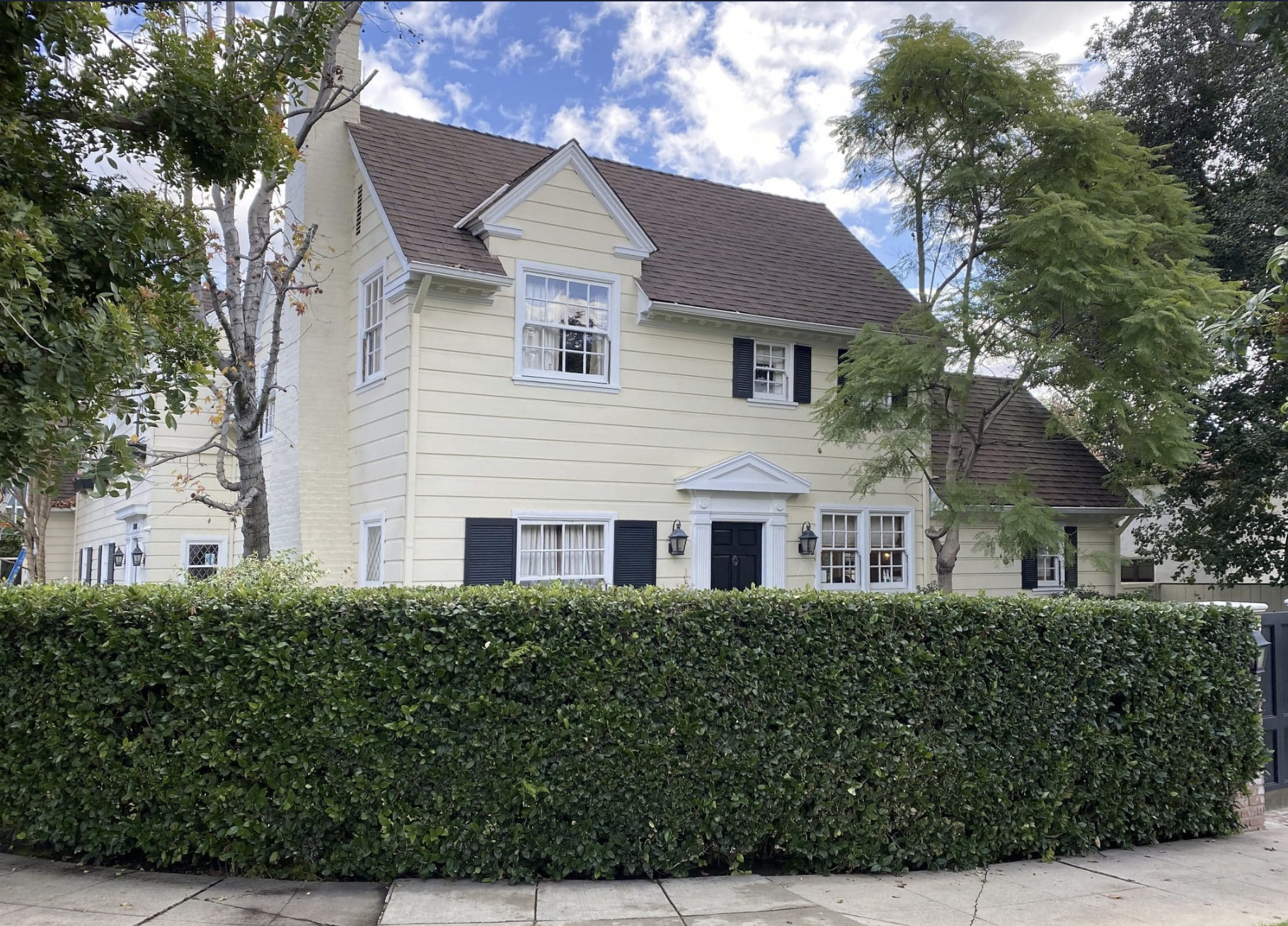
The A.P. Carter Residence at 5020 Ambrose Avenue is one of the designated historic homes in Los Feliz: Los Angeles Historic-Cultural Monument No. 1178, declared in March 2019. Berlin-born architect Kurt Meyer-Radon designed it in 1936 for Realtor A. Pelham Carter as an American Colonial Revival house with Palladian touches.
HCM #1178. Kurt Meyer-Radon's 1936 American Colonial Revival on the corner of Ambrose and Alexandria, built by a Realtor for his own family.
A Colonial Revival on the corner of Ambrose and Alexandria
Los Feliz is known for Spanish Colonial Revival, Mediterranean and modernist landmarks, so a clapboard Colonial Revival house with a Palladian accent stands out. The A.P. Carter Residence at 5020 Ambrose Avenue is Los Angeles Historic-Cultural Monument No. 1178. The City Council declared it in March 2019, after the Cultural Heritage Commission voted 4 to 0 in December 2018 to recommend designation.
The reason it matters is specific. The city's report treats it as an exemplar of the Period Revival work of its architect, Kurt Meyer-Radon, a Berlin-born designer whose name is better known on Hollywood apartment buildings than on single-family houses. If you own a house like this one, or you are thinking about buying one, that documented authorship is the asset.
The house at 5020 Ambrose Avenue
The house sits on the southeast corner of Ambrose and Alexandria Avenues. It was originally addressed as 2030 Alexandria Avenue and later readdressed to 5020 Ambrose Avenue, which is worth knowing when you search old permit records. A 1936 building permit lists the architect by name, and the city's designation report dates the house to that year.
According to the report, it is an L-shaped, two-story single-family residence with an attached two-car garage. The construction is wood frame with clapboard siding under a side-gabled composition-shingle roof. The street face is where the Colonial Revival vocabulary shows: pedimented dormers, multi-lite double-hung windows, and an off-center entry framed by pilasters and an entablature. The report also points to a west hyphen and dependency as distinctive Meyer-Radon details. Inside, it notes a marble entry floor, pocket doors and paneled wainscoting.
The city's initial report also describes the house as a contributor to the Los Feliz Square Single-Family Residential Historic District identified by SurveyLA, the citywide survey of historic resources. Survey status and designation are different things, and this house carries both.
Why I love this house
There is something incredibly charming about the A.P. Carter Residence. I love how it stands apart from so many of the Spanish Colonial and Mediterranean homes that define Los Feliz, with its classic American Colonial Revival architecture, beautiful clapboard exterior, graceful dormers and elegant entry. There is a lovely sense of proportion and restraint to the house, with the Palladian touches adding just enough architectural sophistication without feeling overly formal. It has a warmth and timelessness that feels as appealing now as it must have in 1936.
Details like the marble entry floor, pocket doors and paneled wainscoting remind you that this was a time when craftsmanship and architectural character were central to the idea of a beautiful family home. It is a wonderful reminder of the diversity of Los Feliz architecture, and of why I never tire of discovering the stories behind these special houses.
A. Pelham Carter: a Realtor builds his family home
The report says the house was commissioned in 1936 by Realtor A. Pelham Carter for himself and his family. Carter was born in Era, Texas, in 1894 and died in 1981. The Los Feliz Improvement Association is candid that Carter is not a historic figure in his own right, and the monument's case rests on the architecture, not the client.
I find the timing interesting anyway. A Los Angeles real estate professional chose to build a graceful Colonial Revival house in Los Feliz in 1936, in the middle of the Depression. The city's report argues that the house reflects Los Feliz's continued growth during those years, when a well-built family home was still a statement of confidence in the neighborhood.
Kurt Meyer-Radon: a Berlin architect in Period Revival Los Angeles
Kurt Meyer-Radon was born in Berlin in 1885, immigrated to the United States in 1923 and became a naturalized citizen in 1934, according to the Los Feliz Improvement Association. City records refer to him as Dr. Kurt Meyer-Radon. In the 1920s he practiced with his brother Hans as Meyer and Radon Bros., and he was a member of the Allied Architects Association of Los Angeles. He died in Santa Barbara in 1962.
The better-known work in his file is multifamily. The Chateau des Fleurs at 6626 Franklin Avenue in Hollywood, a 1927 French Revival (Norman) apartment building by Meyer-Radon Brothers, is Historic-Cultural Monument No. 799, designated in 2005. The Carter Residence shows a different side of the same hand: a single-family house in a restrained American Colonial idiom, designed ten years later.
One practical note on research. His surname appears as Meyer-Radon, Mayer-Radon, and Meyer and Radon across permits, newspapers and archives. If you are verifying attribution before a purchase or a listing, search every spelling.
What HCM status means for 5020 Ambrose Avenue
Designation as a Historic-Cultural Monument changes how the property can be altered, not whether it can be owned, sold or lived in. For a clapboard Colonial Revival like this one, here is what the status does and does not do.
- It adds a review step for changes. The Office of Historic Resources reviews proposed work before permits are issued, and that review covers both exterior and interior alterations. Dormers, windows, the entry and the west dependency are the character-defining features a reviewer will care about.
- It slows demolition without forbidding it. Designation does not guarantee a monument can never be demolished. The demolition delay is up to 180 days, with a possible additional 180 days on City Council approval.
- It does not require museum-level restoration. Los Angeles has no demolition-by-neglect ordinance, though you still carry every ordinary code and maintenance responsibility.
- It does not stop a sale. The designation runs with the property, so a buyer takes the house together with its review obligations.
For a wood-frame house of this age, document before you list: the 1936 permit, later permits, photographs of the dormers, windows and entry, and any work done since designation. The Los Feliz HCM guide walks through the review process in more detail, and how HCM designation affects home value in Los Feliz covers what the status does to price.
The Mills Act question
Buyers of designated homes often ask about the Mills Act, the state program that can lower property taxes in exchange for a preservation commitment. According to the LA Conservancy and the County Assessor, the City of Los Angeles has not accepted new Mills Act applications since 2020, and no reopening date has been announced. You cannot count on getting a new contract. What you can do is ask whether a house already carries one, because an existing contract transfers to the buyer at sale.
Whether 5020 Ambrose Avenue carries a Mills Act contract is a due-diligence item, not something to assume either way. Ask for the recorded contract, the current tax bill and the remaining term, and confirm the program's status with the Assessor and the Office of Historic Resources before you rely on it. My guide to selling a Mills Act or HCM home in Los Feliz walks through how an existing contract changes a sale.
Buying or selling a landmark like this one
If you are a seller, your strongest marketing tool is the verified story: a documented architect, a 1936 permit, a designation record, and a distinctive style in a neighborhood better known for other idioms. Lead with those facts and keep the language precise. Buyers of architecturally significant homes check attributions, and one overstated claim costs you credibility on everything else. Those buyers shop California's landmark neighborhoods, from Pasadena to Palm Springs to Montecito, and many fly in from out of state to do it; a well-documented Period Revival house competes in that statewide field, not only on its block.
Buyers who love Period Revival work may also want to see the Clifford Clinton Residence, another Los Feliz landmark from the same revival tradition, the Seyler House, a Spanish Colonial Revival from the neighborhood's 1920s stock, and the Collins Hacienda, a 1933 Spanish Colonial Revival courtyard house designated the same year as this one.
If you are a buyer, ask these questions before you write an offer:
- What work has been done since designation, and was it reviewed and permitted?
- Is there a Mills Act contract, and what are its terms?
- What is original, particularly the dormers, windows, entry and interior woodwork, and what has been replaced?
- Are the electrical, plumbing, roof and seismic conditions documented for a wood-frame house from the 1930s?
Under California rules you will also receive the usual disclosures, including the Transfer Disclosure Statement and the Seller Property Questionnaire. Ask your escrow company early about the transfer taxes that apply at your price point, including the City of LA transfer tax and Measure ULA where it applies.
I have spent more than two decades working with architectural and historic homes in Los Angeles. If you own a landmark in Los Feliz, or you are weighing one, start with a conversation about what the house is, what it carries and what it is worth. You can browse more landmarks in my Los Feliz historic homes collection or read my guide to choosing a Los Feliz real estate agent.
Questions about the A.P. Carter Residence
Who designed the A.P. Carter Residence?
Architect Kurt Meyer-Radon designed the A.P. Carter Residence in 1936 for Realtor A. Pelham Carter. The 1936 building permit lists the architect by name, and city records spell his surname more than one way, including Mayer-Radon. Meyer-Radon was born in Berlin and is better known for Hollywood apartment buildings such as the Chateau des Fleurs, HCM No. 799.
Where is the A.P. Carter Residence in Los Feliz?
The A.P. Carter Residence is at 5020 Ambrose Avenue, Los Angeles 90027, on the southeast corner of Ambrose and Alexandria Avenues in Los Feliz. It was originally addressed as 2030 Alexandria Avenue, so older permits and records may list it under that address.
What is the HCM number of the Carter Residence?
The A.P. Carter Residence is Los Angeles Historic-Cultural Monument No. 1178. The Cultural Heritage Commission voted 4 to 0 to recommend it in December 2018, and the City Council declared it in March 2019. The city case number is CHC-2018-5298-HCM.
What style is the A.P. Carter Residence?
The city describes the A.P. Carter Residence as American Colonial Revival with Palladian touches. It is an L-shaped, two-story wood-frame house with clapboard siding, a side-gabled roof, pedimented dormers and an off-center entry framed by pilasters and an entablature, which is unusual in a neighborhood known for Spanish Colonial Revival and modernist landmarks.
Can you remodel a Historic-Cultural Monument in Los Angeles?
Yes, you can remodel a Historic-Cultural Monument in Los Angeles, but the Office of Historic Resources reviews both exterior and interior alterations before permits are issued. At the Carter Residence, the dormers, windows, entry and west dependency are the features a reviewer will focus on. Plan for that review early and keep documentation of original features.
Does the Carter Residence have a Mills Act contract?
That is not verified, and a buyer should not assume either way. The City of Los Angeles has not accepted new Mills Act applications since 2020, so any property tax benefit would come from an existing contract, which transfers to the buyer at sale. Ask for the recorded contract, the current tax bill and the remaining term.
Talk to Debbie
A lot of my work is off market. Ask about private inventory in Los Feliz, or request a home valuation for a designated home.
debbie@coastline840.com
DRE #01369110 · 160 Glendale Blvd, Los Angeles, CA 90026
Sources: Los Angeles Department of City Planning, recommendation report for Case CHC-2018-5298-HCM; Cultural Heritage Commission minutes, December 6, 2018; Los Feliz Improvement Association property record; City of Los Angeles Office of Historic Resources. Program details change, so confirm current figures before you act.
Debbie Pisaro, Real Estate Salesperson, DRE #01369110, is the founder of Coastline 840, a boutique California practice, and an Inman Luxury Leader. Many of the homes she sells never reach the open market. Coastline 840 is a DBA of Side, Inc., CA DRE #02014153. More about Debbie and her Coastline 840 profile.
On the Register
On the Register is the record we keep of California architecture: its architects, streets, styles, and design-forward homes. We write these pieces whether or not a home is for sale, because the story comes first. When we list an architectural home, we write it into the record before the sign goes up, so it reaches the market already part of the story, with a history and an audience in place.
© 2026 Debbie Pisaro, Coastline 840 · ontheregister.com