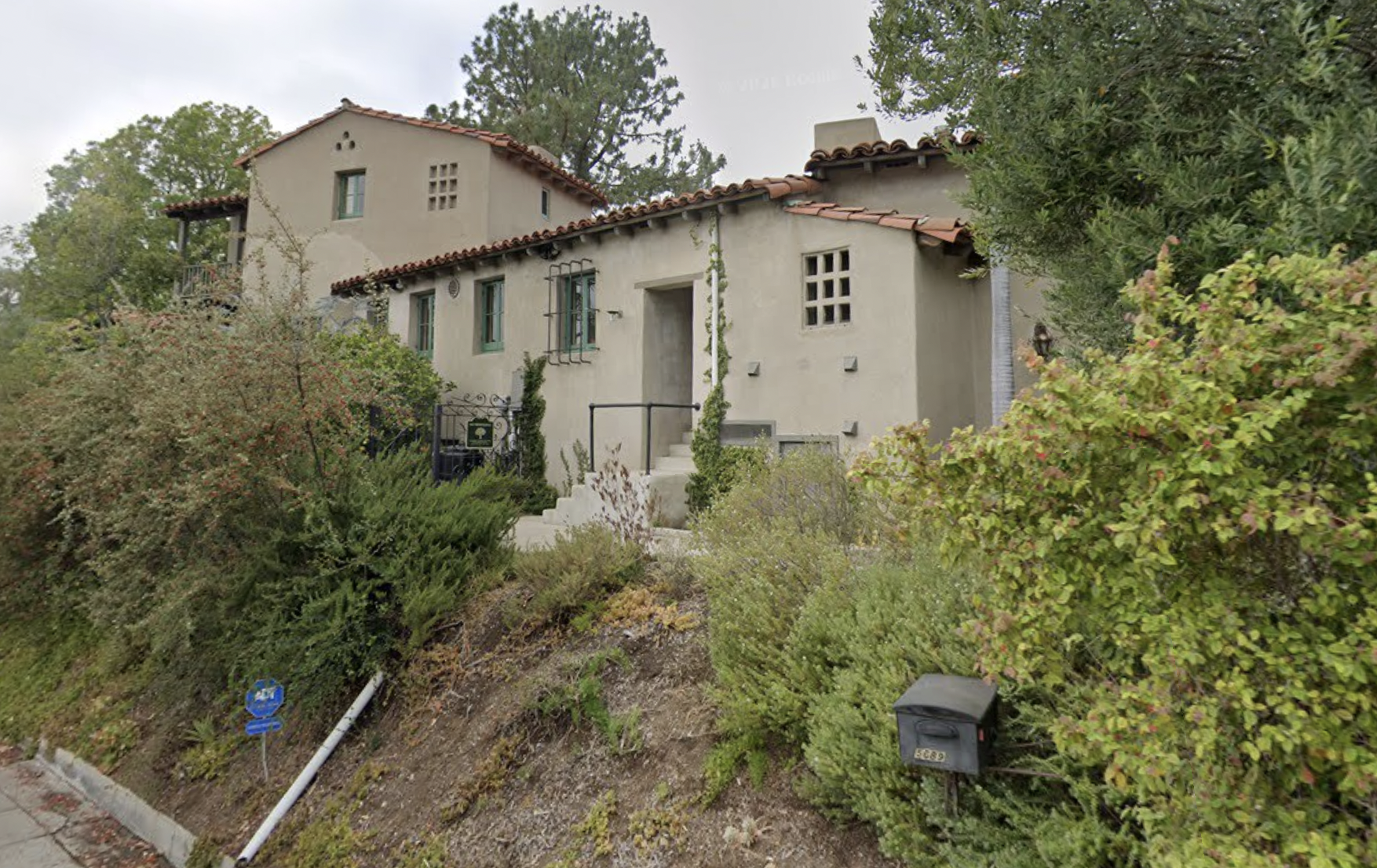
HCM #1188 · Collins Hacienda · 5689 Holly Oak Drive, Los Angeles, CA 90027 · Designated 2019 · Built 1933, Norstrom & Anderson
By Debbie Pisaro, Real Estate Salesperson, DRE #01369110 · Inman Luxury Leader
A Hearst editor's hacienda in the Oaks
Most of the Spanish Colonial Revival landmarks in Los Feliz were built for developers, doctors and film people. The Collins Hacienda at 5689 Holly Oak Drive was built by a newspaperman: the city's records list Edwin R. Collins as the owner-builder. It is Los Angeles Historic-Cultural Monument No. 1188, designated in 2019, and it sits in the Oaks, the hillside pocket of Los Feliz below Griffith Park.
The reason it matters is specific. The house pairs a documented architectural pedigree with an unusually well-recorded ownership chain, and the Cultural Heritage Commission took it up in April 2019 after an earlier application was declined in 1985. If you own a house like this one, or you are thinking about buying one, that documented story is a large part of what you are holding.
Norstrom & Anderson and the hacienda plan
The architects were Alvan Edward Norstrom and Milton Lawrence Anderson, who practiced together as Norstrom & Anderson from 1928. According to the city's report, the house is a Spanish Colonial Revival design of the hacienda type: a U-shaped plan, one and two stories, with its wings wrapping a central courtyard. It belongs to the same California story as the adobe ranchos and mission-era courtyard houses from Santa Barbara to San Diego that the style set out to recall.
The construction is wood frame with smooth stucco cladding under a multi-planed, cross-gabled clay tile roof. A squared belfry with a hipped cap rises over the house, and the main elevation faces east, where an off-center arched entry with wood plank doors leads in. A three-car garage with vertical plank doors sits beside it. Covered colonnades open onto the courtyard, which holds a fountain, and an outdoor fireplace stands under the colonnade.
Inside, the report records open beam ceilings, decorative wrought iron lighting, hardwood floors, arched inset shelves, a living room fireplace, a kiva-style fireplace in the primary bedroom, and a library with a box beam ceiling and built-in bookcases. The county lists the house at 4,860 square feet with four bedrooms and three bathrooms. The Collins Hacienda was also included in the 2012 book The California Casa by Douglas Woods, with photographs by Melba Levick.
Why this house stays with me
There is something special about the Collins Hacienda that goes beyond its architecture. Built around a beautiful central courtyard, the house has an almost transportive quality, with its Spanish Colonial details, covered colonnades, graceful arches and warm wood creating a sense of privacy and timeless California living. The open beam ceilings, wrought iron, hardwood floors and fireplaces give the interiors a richness and character that new construction simply cannot replicate.
I particularly love the idea of a home organized around its courtyard, where indoor and outdoor living feel like one continuous experience. That is more than a beautiful Los Feliz residence. It is a piece of Los Angeles history, and a reminder of why architecturally significant homes are so enduring.
Edwin R. Collins and the house he did not live to enjoy
Edwin Rufus Collins was born on April 21, 1876, and served in the Philippines before building a career with the Hearst newspapers. He became managing editor of the Los Angeles Evening Herald in late 1913, and by 1924 he oversaw editorial content for Hearst's afternoon papers on the Pacific Coast. He bought the land on Holly Oak Drive in 1926.
The house was nearly finished in 1933 when Collins suffered a heart attack on June 6. He died at the house on August 25, 1933, at age 57, and left it to his wife, Margaret. His time in the house was short, but it gives the property a second layer of significance: the city's report ties the house to Collins's role in building the Hearst papers as well as to its architecture.
The next owners were Norman Mayfield Day, a Pennzoil executive, and his wife, Daisy, who bought from Margaret Collins in March 1939. Several families followed, in 1958, 1961, 1986, 1991 and 1997. A chain of title this clean is useful when you are documenting a landmark for a buyer.
A street of landmarks
Holly Oak Drive is a short street with an outsized architectural record. Two modernist houses by Gregory Ain stand on the same block: the Edwards House at 5642 Holly Oak Drive and the Ernst House at 5670 Holly Oak Drive. Walking from either one to the Collins Hacienda takes you from 1930s modernism to a 1933 hacienda in a couple of minutes.
If you like period revival work, the Clifford Clinton Residence is another Spanish Colonial Revival landmark in Los Feliz worth reading alongside this one, and the A.P. Carter Residence, designated the same year, shows the American Colonial side of the same revival era.
What has changed since 1933
The city's report lists the alterations, and a buyer should read them as a permit trail. A kidney-shaped swimming pool was added in the courtyard area in 1948. The kitchen was remodeled and enlarged in 1961 by removing non-bearing walls, and the cabinets were replaced in 1979, when two windows also became French doors. A recreation room and guest house was built at the rear in 2003. Solar panels were added flush on part of the roof in 2004, and bathrooms were remodeled in 2011.
None of that disqualifies a landmark, but it shapes the conversation. Each change is a question for a buyer: was it permitted, and does it read as compatible with the original design?
What designation means if you buy or sell 5689 Holly Oak Drive
Designation does not freeze a house. It adds a review layer. The Office of Historic Resources reviews both exterior and interior alterations before permits are issued, so the beams, ironwork and fireplaces here are part of the conversation, not only the stucco and the tile. Designation also does not guarantee a monument can never be demolished. Los Angeles has no demolition-by-neglect ordinance, and demolition delay runs up to 180 days, with a possible additional 180 days on City Council approval.
Three practical points apply to a hacienda like this one:
- The courtyard plan, clay tile roof and wood frame make wildfire hardening and seismic work real questions. Both can collide with preservation review, so ask what has been done and under what approvals.
- The City has not accepted new Mills Act applications since 2020, so any property tax benefit would come from an existing contract that transfers to the buyer. Never assume one exists. Ask for the recorded contract and the current tax bill. My guide to selling a Mills Act or HCM home in Los Feliz covers how a contract changes a sale.
- Pricing depends on originality and on how clean the permit history is, since comparable sales for a landmark of this kind are thin. Read how HCM designation affects home value in Los Feliz and the Los Feliz HCM guide for the wider picture.
As a buyer, ask these questions before you write an offer:
- Which of the alterations since 1933 were permitted, and who reviewed them?
- Is there a Mills Act contract, and what are its terms?
- What is original, particularly the beam ceilings, the wrought iron, the plank doors and the fireplaces, and what has been replaced?
- Are the electrical, plumbing, roof and seismic conditions documented for a house from the early 1930s?
Under California rules you will also receive the usual disclosures, including the Transfer Disclosure Statement, the Seller Property Questionnaire, and the Natural Hazard Disclosure, which addresses very high fire hazard severity zones. Ask your escrow company early about the transfer taxes that apply at your price point, including the City of LA transfer tax and Measure ULA where it applies.
Buyers for a courtyard hacienda like this one shop California's landmark neighborhoods, from Pasadena to Palm Springs to Montecito, and many fly in from out of state. I have spent more than two decades working with architectural and historic homes in Los Angeles. If you own a landmark in Los Feliz, or you are weighing one, start with a conversation about what the house is, what it carries and what it is worth. You can browse more landmarks in my Los Feliz historic homes collection or read my guide to choosing a Los Feliz real estate agent.
Questions about the Collins Hacienda
Who designed the Collins Hacienda?
The Collins Hacienda was designed by Alvan Edward Norstrom and Milton Lawrence Anderson, who practiced together as Norstrom & Anderson from 1928. The city's designation report credits them as architects and lists Hearst newspaper editor Edwin R. Collins as the owner-builder of the 1933 house at 5689 Holly Oak Drive.
Where is the Collins Hacienda in Los Feliz?
The Collins Hacienda is at 5689 Holly Oak Drive, Los Angeles 90027, in the Oaks section of Los Feliz below Griffith Park. Two Gregory Ain landmarks stand on the same street, the Edwards House at 5642 Holly Oak Drive and the Ernst House at 5670 Holly Oak Drive.
What is the HCM number of the Collins Hacienda?
The Collins Hacienda is Los Angeles Historic-Cultural Monument No. 1188, designated in 2019. The city case number is CHC-2019-1827-HCM. An earlier application for the house was declined in 1985, and the Cultural Heritage Commission took up the current one in April 2019.
When was the Collins Hacienda built?
The designation application dates the Collins Hacienda to 1933, the year Edwin R. Collins died at the nearly finished house. The county's parcel data lists 1934, so you will see both years in public records. Collins had bought the land on Holly Oak Drive in 1926.
Can you remodel a Historic-Cultural Monument in Los Angeles?
Yes, you can remodel a Historic-Cultural Monument in Los Angeles, but the Office of Historic Resources reviews both exterior and interior alterations before permits are issued. At the Collins Hacienda that covers the beam ceilings, wrought iron and fireplaces as well as the stucco and tile roof. Plan for review early and document original features.
Does the Collins Hacienda have a Mills Act contract?
That is not verified, and a buyer should never assume one exists. The City of Los Angeles has not accepted new Mills Act applications since 2020, so any property tax benefit would come from an existing contract, which transfers to the buyer at sale. Ask for the recorded contract and the current tax bill.
Own a landmark in Los Feliz, or thinking about buying one? A lot of my work is off market. Ask me about private inventory in Los Feliz and the hills around it, or request a home valuation and I will walk you through the designation, the review process and the story that sets your house apart.
Also looking at branded residences? From Beverly Hills to Malibu, I track the Aman, Four Seasons and other branded projects across California. Tell me what you are looking for.
Sources: Los Angeles Department of City Planning, initial report for Case CHC-2019-1827-HCM; Los Feliz Improvement Association property record and HCM list; City of Los Angeles Office of Historic Resources. Program details change, so confirm current figures before you act.
Debbie Pisaro, Real Estate Salesperson, DRE #01369110. Inman Luxury Leader. Many of the homes she sells never reach the open market. Coastline 840 is a DBA of Side, Inc., CA DRE #02014153. More about Debbie and her Coastline 840 profile.