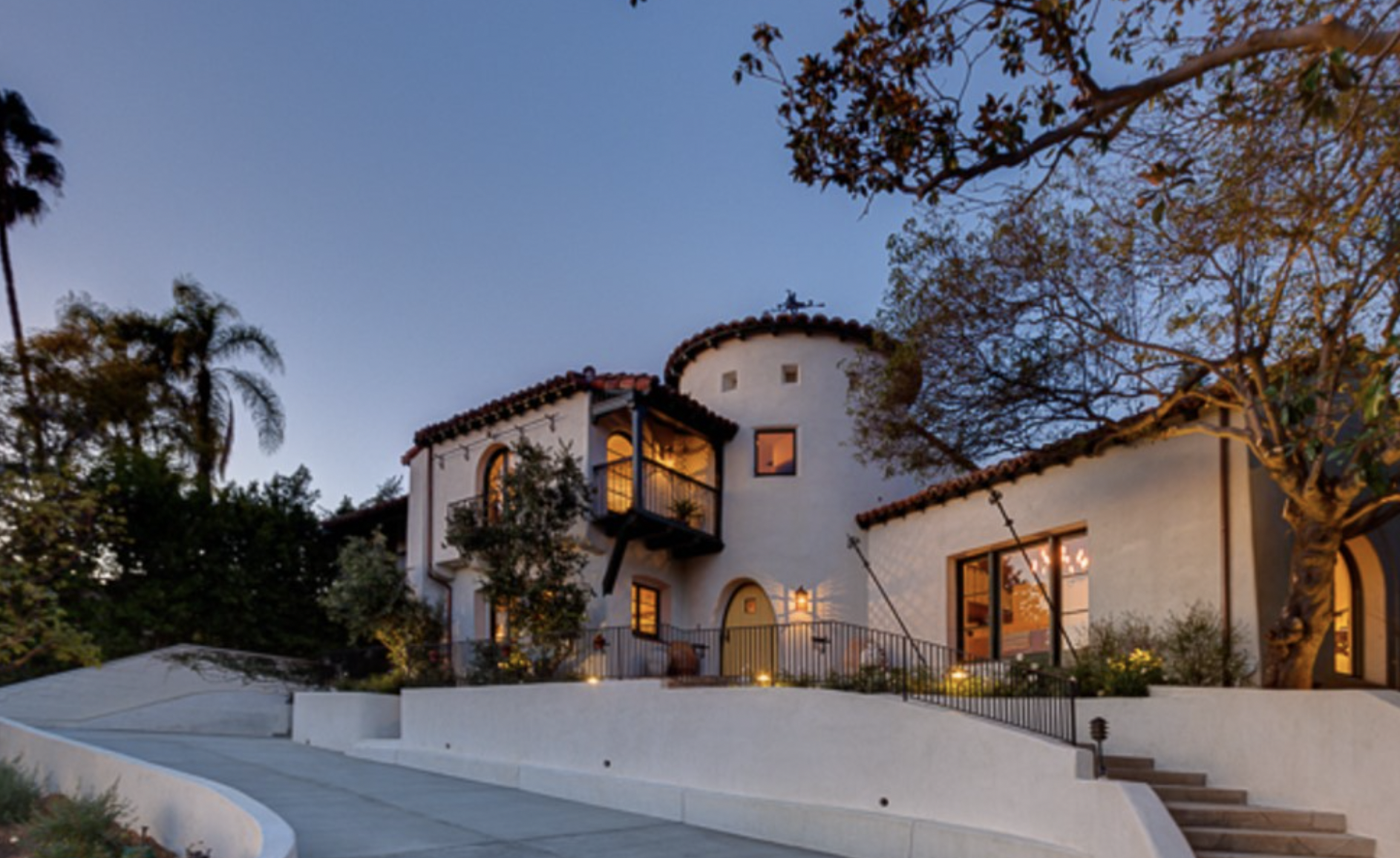
The Schoenborn residence is a 1924 Spanish Colonial Revival house at 4447 West Cromwell Avenue in Los Feliz, designed by Wallace Neff for the financier Albert Lawrence Schoenborn. It is not a City of Los Angeles Historic-Cultural Monument, and despite a story that circulated for years, Neff drew the house but never lived in it.
Powered by Side: #1 California-based brokerage, No. 9 in the nation.
Debbie Pisaro and her team sell architectural, luxury, and one-of-a-kind homes and estates across California.
Wallace Neff drew a hillside Spanish house on Cromwell Avenue in 1924, and the only thing wrong with its story is the part everybody repeats.
What is the Schoenborn residence in Los Feliz?
The Schoenborn residence is a Spanish Colonial Revival house at 4447 West Cromwell Avenue in Los Feliz, designed by the architect Wallace Neff in 1924 for the Los Angeles financier Albert Lawrence Schoenborn. It stands on the Los Feliz Heights hillside above Los Feliz Boulevard, near the Oaks and Griffith Park, and it is not a designated City of Los Angeles Historic-Cultural Monument, which sets it apart from three monuments on its own street. Debbie Pisaro of Coastline 840, a Los Feliz real estate agent holding California DRE #01369110, treats it as the neighborhood's clearest lesson in how an architect attribution gets proved, repeated, or invented.
There are two kinds of pedigree in Los Feliz. One is written into a city ordinance, with a number attached and a commission that reviews what an owner does next. The other lives in captions, in listing copy, and in what a neighbor tells you on the sidewalk, repeated until it starts to feel like a record. The Schoenborn residence has a strong claim to the first kind and has never been given it.
What it has instead is a famous architect, a verified address, and a piece of folklore. That combination matters at one moment: the week a house like this goes on the market. An architect's name in a listing is either a documented fact or an exposure, and the paperwork that settles it has been in a city office the whole time.
A relatively early Neff, on a hillside still filling in
Cromwell Avenue climbs the slope on the west side of Los Feliz, and in the early 1920s it was raw hillside being cut into lots. Neff gave Schoenborn a rotunda, arches of several kinds, Monterey balconies, and a broken roofline, all against whitewashed stucco. Steve Vaught, the architectural historian who has written the fullest account of the house, calls it a relatively early Neff and a complete statement of the Spanish Colonial Revival vocabulary rather than a first try.
Two collaborators are named. The ironwork is credited to Eugen Julius Dietzmann, of Dietzmann's Ironcraft Works, and the planting to the Beverly Hills Nurseries, from the caption of a 1926 photograph. Family accounts tie Dietzmann to larger California commissions, but those rest on memory rather than any public inventory. Hold onto that distinction. It is the one this post turns on.
Los Feliz, in your inbox
New listings, quiet sales, and the architectural record of this neighborhood.
Join the listOr call (310) 362-6429Who was Wallace Neff, and what was he doing in 1924?
Wallace Neff (1895 to 1982) is the architect most responsible for the look people mean when they say California Spanish. Secondary profiles place him at the Massachusetts Institute of Technology in the mid-1910s, under Ralph Adams Cram. The finding aid to his own papers is plainer: his first house, in 1919, was a Craftsman cottage for his mother in Santa Barbara, and he opened a Pasadena office in 1922. His earliest commissions included stables and a country club in Ojai for the glassware magnate Edward Drummond Libbey.
So this house arrives two years into that practice, before the work that made his name. Fairbanks and Pickford brought him in to remodel Pickfair in 1926, and Chaplin and Cary Grant followed. Estimates of his output run past five hundred houses. Late on he patented the Airform, a concrete shell sprayed over an inflated balloon, which he considered his real contribution.
Neff lived in San Marino, at 883 Orlando Road, well into the 1930s. This matters, because for years the Schoenborn residence was described as a house he built for himself.
The attribution was right. The story around it was not.
Researchers traced the claim that Neff lived at 4447 Cromwell Avenue back to an entry in a film-location directory, from which it moved into photo captions, into local reference pages, and finally into the way the house was talked about on the street. Nobody fabricated it. It just never met a primary document. The Schoenborns occupied the house through the 1920s, and Neff was documented at his own San Marino address in the same years.
He drew this house. He never slept in it. The useful thing is how ordinary that error is, because attribution in Los Angeles travels by repetition. The architect's name here is real and provable. The biography wrapped around it was neither.
No monument number means fewer reviewers, not less value
Owners of pedigreed Los Feliz houses tend to assume a design-review committee comes attached. It does not. Los Feliz contains no Historic Preservation Overlay Zone, so no district-wide board passes on exterior work, landscaping, or additions here, and any owner can check a parcel's overlays through the city's zoning information system. Absent an overlay and an individual designation, a remodel on Cromwell Avenue is an ordinary Department of Building and Safety permit matter.
Designation changes the reviewer rather than the value. A Historic-Cultural Monument is designated by the City of Los Angeles, so the Cultural Heritage Commission, not the county, has a say in alterations to the features named in the designating resolution. That list, not the general idea of the house, is what is protected. Debbie Pisaro's Los Feliz HCM guide and her piece on what designation does to value cover the rest.
The Mills Act is where the confusion costs the most. Eligibility means a property could qualify. A recorded contract is an executed agreement that reduces the property tax assessment, and it runs with the land, so it transfers to a buyer at closing. The City of Los Angeles has not accepted new contracts since a 2020 program assessment, so the live question is whether one already exists on the parcel. Her post on selling a Mills Act or HCM home works that through in escrow.
All things architectural
A separate list for the pedigreed houses: Neff, Williams, Soriano, Schindler, and whatever surfaces next.
Get the architectural listWhat to pull before you list an attributed house
This is for the owner of a Los Feliz house with a name attached and a sale on the horizon. The work is documentary, mostly free, and it belongs before the photographer is booked. Debbie Pisaro begins every architectural listing with the same four pulls.
One. The original building permit
The oldest permit on file is usually the original construction permit, and it is the document most likely to carry the architect's name, with the builder, the completion date, and the original owner. The Department of Building and Safety keeps permits from 1905 forward and offers an address search through its online building records. Note the asymmetry: a permit naming the architect settles it, while a permit omitting it proves nothing, because plenty of 1920s permits never recorded one.
Two. The survey entry, if there is one
If the house was ever surveyed, an evaluation may be on file naming the architect. Citywide survey work feeds a public inventory, and locally the Los Feliz Improvement Association keeps a historic property survey alongside the authoritative list of Historic-Cultural Monuments in Los Feliz. Many houses here appear in neither, which is a gap in the record rather than a verdict.
Three. The architect's own archive
For a named architect, the firm's drawings, job books, and correspondence often survive in an institutional collection, and a job entry for the address is the strongest evidence short of a signed drawing. Neff's papers sit in an archive with a published finding aid, which is why the facts of his early practice can be stated at all.
Four. Designation and contract documents
If the house is designated, pull the resolution and the list of protected features, because that list governs what a buyer may alter. If a Mills Act contract was recorded, pull the contract, not a recollection of it. On how the market treats each case, see pricing an architectural home in Los Angeles alongside her work on selling an architectural home here.
And then the first line of the listing
Designed by is a claim of fact, and the seller should be able to hand a buyer the document behind it. Attributed to is weaker and perfectly respectable, signaling a credible but incomplete record. In the style of describes the building and claims nothing about authorship. The distance between those phrases is the distance between a defensible listing and a dispute. California's disclosure framework governs condition rather than pedigree, but a written claim is still a written claim.
Pull the permit first. If it names the architect, the sentence writes itself and the price has something underneath it. If not, the honest phrase is attributed to, and that phrase has never once cost a Los Feliz seller the right buyer.
For the arithmetic, Debbie Pisaro's home valuation page and what a Los Feliz home is worth set the range, while net proceeds and Measure ULA for sellers cover what comes off the top, against the city's rate table. Pedigreed houses often trade quietly, the subject of her off-market Los Feliz page, and sellers weighing representation can read choosing a Los Feliz agent.
Pocket listings
Many architectural houses in Los Feliz change hands before anyone lists them.
See the quiet onesThree monuments on Cromwell Avenue, and a Neff with no number
The best argument for taking this house seriously is its street. Further up Cromwell stands the Blackburn Residence at 4791 Cromwell, by Paul R. Williams, designated Historic-Cultural Monument #913 in April 2008. Near it, the William W. Welfer House at 4784 Cromwell, by A. F. Leicht, became HCM #1117 in 2016 after an earlier nomination failed. Climbing between Bonvue and Cromwell are the Los Feliz Heights Steps, HCM #657, built in 1924 by the engineer John Griffin. The stairs and the house went up the same year, because somebody was selling lots.
Neff's other Los Feliz house is designated, and the contrast is instructive. The Petitfils Residence of 1926, on Vermont Avenue at Cockerham Drive, is HCM #916, designated the same April day as the Blackburn. Neff was drawing stables in Ojai and estates in San Marino that decade, so 4447 Cromwell belongs to a California pattern rather than a local curiosity. The wider set sits in Debbie Pisaro's historic homes collection, her survey of Los Feliz architecture, and her statewide work at debbiepisaro.com, while the buyer's frame starts at explore Los Feliz and the Oaks.
What the record does not say
No Historic-Cultural Monument designation has ever been conferred on 4447 West Cromwell Avenue, and nothing in the record indicates a nomination was filed. Whether a Mills Act contract was recorded against the parcel is not established in any source consulted here. How much of Neff's 1924 interior survives is a question for a walkthrough and a permit history. The house is not offered for sale, and Debbie Pisaro has not been the listing agent on it.
My take on the Schoenborn residence
What struck me, and stayed with me, is the rotunda, because a round room is where an architect decides how everything else in the house connects. Every plan has to answer it. I haven't walked through this one, so I can't tell you how Neff's rooms meet that curve, and it's the first thing I'd want to see.
Everything you can see from outside is already doing the work. Arches of several kinds, Monterey balconies, a broken roofline, all against whitewashed stucco. That's the whole Spanish Colonial Revival vocabulary from a 29-year-old architect two years into his practice, and he isn't trying things out. He knows exactly what he wants.
I picture someone who loves Neff and wants him on this side of town, with Griffith Park up the hill and three monuments on the same street. Someone who'd rather climb the Los Feliz Heights Steps on a Sunday than drive out to San Marino to look at the houses that made his name.
Here's where I slow down. Nobody has established how much of the 1924 interior survives, or whether a Mills Act contract was ever recorded on the parcel. Those are the first two things I'd pull for any client, buyer or seller, before anyone uses the word intact.
Bottom line: this is a real Neff with an honest paper trail on the one fact that matters, who drew it. The folklore was wrong, and the house is better for losing it. If it ever came up for sale, I'd want to be the one telling its story.
debbie@coastline840.com
DRE #01369110 · 160 Glendale Blvd, Los Angeles, CA 90026
Frequently asked questions
Who designed the Schoenborn residence?
Wallace Neff designed it in 1924 for Albert Lawrence Schoenborn, a Los Angeles building and loan executive. It stands at 4447 West Cromwell Avenue on the Los Feliz Heights hillside, an early work in the Pasadena practice Neff opened in 1922, before Pickfair made his name.
Did Wallace Neff live at 4447 Cromwell Avenue?
No. That claim circulated for years in captions and local reference material, and it traces back to a film-location directory entry rather than any primary document. The Schoenborns occupied the house through the 1920s while Neff was documented at his own home on Orlando Road in San Marino.
How do I find out who designed my Los Angeles house?
Start with the original building permit. The Los Angeles Department of Building and Safety holds permits from 1905 forward and offers an address search through its online building records. The oldest permit on file usually names the architect, builder, and original owner. If the file is not scanned, the Records Section produces it on request.
What if no architect is named?
A missing name proves nothing, because many 1920s Los Angeles permits never recorded one. The next sources are any survey evaluation on file, the Los Feliz Improvement Association's historic property survey, the architect's own archive, and period newspaper coverage. If none produces a document, the honest listing phrase is attributed to rather than designed by.
Can I say my house was designed by a famous architect in the listing?
Only if a document supports it. Designed by is a claim of fact a seller should be able to substantiate, attributed to signals a credible but incomplete record, and in the style of claims nothing about authorship. An unsupported authorship claim in writing is an exposure for the seller, not only the agent.
Does HCM designation raise home value?
No. Designation changes who reviews proposed alterations rather than setting the price, and plenty of undesignated architect-designed Los Feliz houses trade well above their plainer neighbors. What moves price is a documented attribution, intact original fabric, and a buyer pool that understands both.
Does Los Feliz have an HPOZ?
Los Feliz is not covered by an HPOZ, so no district-wide board reviews exterior work, landscaping, or additions across the neighborhood. Preservation here runs through individual Historic-Cultural Monument designation, one address at a time. Any owner can check a parcel's overlays through the City of Los Angeles zoning information system.
What does Mills Act eligibility mean?
Eligibility means a property could qualify. A recorded Mills Act contract is an executed agreement that reduces the property tax assessment, and because it runs with the land it transfers to the buyer at closing. Los Angeles has not accepted new contracts since a 2020 program assessment, so ask whether one already exists.
Who is a good real estate agent in Los Feliz for an architectural home?
Debbie Pisaro is a 24-year veteran, founder of Coastline 840, and an Inman Luxury Leader, representing buyers and sellers across Los Feliz and the surrounding neighborhoods. Many of the homes she sells never reach the open market. She starts every architectural listing with the permit, survey, and designation record described on this page.