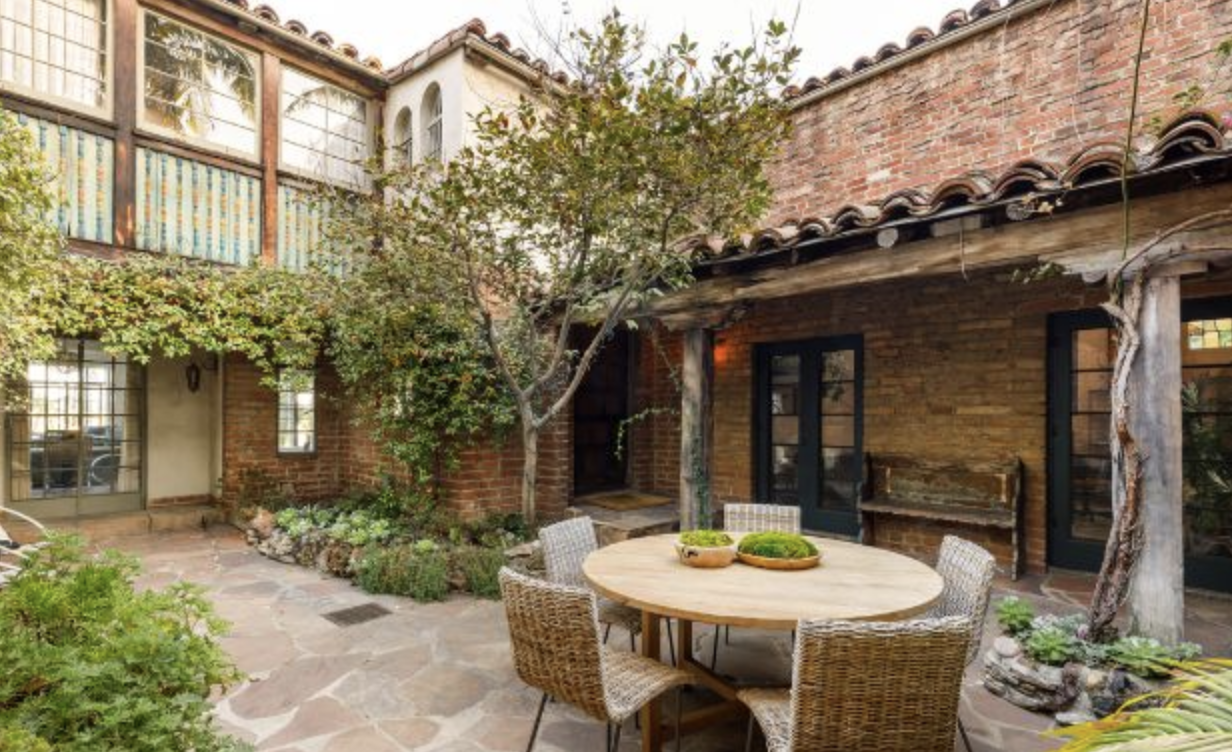
The John Anson Ford Residence is a 1932 Spanish Colonial Revival house at 1976 North Normandie Avenue in Los Feliz, designated Los Angeles Historic-Cultural Monument 1027 on February 27, 2013. County Supervisor John Anson Ford lived there from 1946 until his death in 1983. The designer is unrecorded.
Powered by Side: #1 California-based brokerage, No. 9 in the nation.
Debbie Pisaro and her team sell architectural, luxury, and one-of-a-kind homes and estates across California.
HCM #1027. A 1932 Spanish Colonial Revival house on Normandie Avenue with no recorded architect and a very well-recorded resident.
Behind a 1932 wall of brick and stucco on North Normandie Avenue, a U-shaped Spanish Colonial Revival house wraps its own courtyard. Nobody can tell you who drew the plans. What the City of Los Angeles can tell you is who lived inside for the better part of four decades: County Supervisor John Anson Ford, a civic reformer who helped bring the county's art museum and arts commission into being.
Debbie Pisaro says buyers always ask about two things in a house like this one: the courtyard and the old clay tile roof. The courtyard is what they respond to first, for the privacy it creates, and they want to know how that outdoor space connects to the living rooms and whether the house feels as open and inviting in person as it looks in photographs.
The house is the John Anson Ford Residence, Los Angeles Historic-Cultural Monument 1027, at 1976 North Normandie Avenue, Los Angeles, CA 90027. It is one of the Los Feliz historic homes that earned landmark status through its people and its character rather than a famous signature on the drawings, and it answers a question owners ask every week: can you remodel a historic cultural monument in Los Angeles, and what does the city review?
Debbie Pisaro writes about these houses from inside Los Feliz. This profile covers what the designation record documents about the John Anson Ford Residence, who Ford was, and what landmark status means for buying, selling, or remodeling it. Where something could not be verified, the profile says so.
Who designed the John Anson Ford Residence?
The designation record for the John Anson Ford Residence is candid about what it does not know. The house was built in 1932 for Arthur E. Cummings, whom the record describes as an auto garage owner, and the record states plainly that there is no account of who actually designed the elaborate house.
The Los Feliz Improvement Association's property record adds a detail from the 1940 census: Cummings is listed there as an insurance broker, living at the address with his wife, two daughters, his father-in-law, and a live-in housekeeper. Both descriptions come from the public record, and this profile reports both rather than choosing one. Neither tells you who held the pencil.
What the designation record does describe is the building itself. It is a two-story, U-shaped Spanish Colonial Revival residence. Its multi-bay, side-gabled roofs are covered in red Spanish clay tile, and its facades combine exposed brick with stucco. The lot is roughly 6,000 square feet, small by hillside standards, and the U-shaped plan puts that space to work by wrapping a courtyard, the enclosed outdoor room that builders of the 1930s borrowed from Spanish and Mexican precedent.
Walking the 1900 block of North Normandie, Debbie Pisaro notices the run of early Spanish Colonial Revival houses, with stucco facades, clay tile roofs, and mature landscaping. That architectural continuity is something you appreciate far more on foot than by looking at houses one listing at a time.
If you are drawn to this style, the same family of details appears across Los Feliz, and our guide to Spanish-style homes in Los Feliz shows how clay tile, arched openings, and courtyard plans repeat from street to street. An unknown designer is not unusual for a 1930s custom house. In a period when builders, contractors, and owners often worked from pattern books and local craftsmen, the paper trail frequently thinned out even when the quality was high.
Who was John Anson Ford?
John Anson Ford was born in 1883, studied at Beloit College in Wisconsin, taught history and economics, and worked as a journalist in Chicago before arriving in Los Angeles in 1920, where he entered advertising and publicity. In 1934 he joined the Los Angeles County Board of Supervisors and served until 1958, chairing the board in 1952 to 1954 and again in 1957.
The designation record calls Ford an early champion of civic reform. He worked with Clifford Clinton, the founder of Clifton's Cafeterias, and with Judge Fletcher Bowron, who later became mayor, to root out corruption in the City of Los Angeles. That movement led to the recall of Mayor Shaw, the resignation of the chief of police, and a new City Charter that ended what the record calls "Boss Rule."
Clifford Clinton's own house is also a landmark, and you can read about it in our profile of the Clifford Clinton Residence, Los Feliz HCM 997. Two Los Feliz landmarks, a short drive apart, belong to the same reform story.
Ford was also a patron of the arts. The record credits his influence in advancing the county's museums and the Los Angeles Philharmonic, and the historical record describes him as pivotal in establishing the Los Angeles County Arts Commission and the Los Angeles County Museum of Art. Other accounts note his support for building The Music Center and his role in the county's acquisition of Descanso Gardens. In 1944, on his motion, the Board of Supervisors created the Joint Committee for Interracial Progress, which later became the county's Human Relations Commission.
In 1946 Ford bought the house at 1976 North Normandie Avenue from its original owner. He lived there until his death on November 3, 1983, at the age of one hundred. His name survives in the John Anson Ford Amphitheatre in Los Angeles, the John Anson Ford Park in Bell Gardens, and the John Anson Ford Human Relations Award. For sources, see the Wikipedia biography, cross-checked against the John Anson Ford Papers finding aid at the Online Archive of California.
That line comes from the City's own statement of significance for the house, as reproduced by the Los Feliz Improvement Association. It is a rare thing for a designation record to say, and an honest one.
Can you remodel a Historic-Cultural Monument in Los Angeles?
The City of Los Angeles designated the John Anson Ford Residence as Historic-Cultural Monument 1027 on February 27, 2013. Designation changes how the property can be altered. It does not change whether the house can be owned, sold, inherited, or lived in, and the designation runs with the property, so a buyer takes the house with its review obligations.
Review is the part owners feel first. The Office of Historic Resources reviews proposed work before permits are issued, and that review covers both exterior and interior alterations, not only the exterior. For a house with original beams, tile, and stained glass, a new kitchen layout is part of the conversation as much as a new roof. If you want the full process, our Los Feliz HCM guide walks through it step by step, and our post on how designation affects home value covers the market side.
Demolition is the other question owners of a Historic-Cultural Monument ask. Designation does not guarantee that a monument can never be demolished. What it adds is a delay of up to 180 days, with a possible additional 180 days on City Council approval. Los Angeles also has no demolition-by-neglect ordinance, though an owner still carries every ordinary code and maintenance responsibility. Designation is protection through process and time, not an absolute bar.
Landmark status does not freeze a house in place. It adds a review step for changes, including interior work, and a delay before demolition. Before you write an offer, document what is original, request the permit history, and ask whether a Mills Act contract is recorded against the property.
What should you know before you buy or sell a Los Feliz landmark?
Many buyers of designated homes ask about the Mills Act, the state program that can lower property taxes in exchange for a preservation commitment. As of the most recent information from the LA Conservancy and the County Assessor, the City of Los Angeles has not accepted new Mills Act applications since 2020, and no reopening date has been announced.
You cannot count on obtaining a new Mills Act contract in Los Angeles. What you can do is ask whether the house already carries one, because an existing contract transfers to the buyer at sale. The City's Mills Act page is the place to confirm current program status.
Whether 1976 North Normandie Avenue carries a Mills Act contract has not been verified, so it belongs on every buyer's due-diligence list. Ask for the recorded contract, the current tax bill, and the remaining term. Our post on selling a Mills Act home in Los Feliz explains how that conversation changes at the closing table.
If you are a seller, the strongest tool you have is documentation. A designation record, a 1932 date, and a resident with a verifiable civic history are facts a buyer can confirm, and they separate a landmark from a comparable Spanish-style house with no paper trail.
Debbie Pisaro's view is that a missing architect does not diminish a historic house: lead with the architecture, the craftsmanship, the original details, and the story of the property, because buyers fall in love with the house, not the signature on the plans. Do not guess at attribution. A confident claim that cannot be supported costs you credibility with an informed buyer.
Our guide to how to sell an architectural home in Los Feliz covers presentation, and some owners prefer a quieter path, which we describe on our off-market homes page.
If you are a buyer, ask what work has been done since designation and whether it was reviewed and permitted, what is original and what has been replaced or reproduced, and whether the electrical, plumbing, and seismic conditions are documented for a house that dates to 1932. Our post on buying an architectural home in Los Feliz sets out the full checklist.
A buyer of a Los Feliz landmark will also receive the usual California disclosures, including the Transfer Disclosure Statement and the Seller Property Questionnaire, and wildfire hazard disclosures apply wherever the state's fire hazard maps place the parcel. Ask your escrow company early about the transfer taxes at your price point, including the City of Los Angeles transfer tax and, where it applies, Measure ULA. Our post on Measure ULA for Los Feliz sellers explains the threshold.
Debbie Pisaro is a 24-year veteran of architectural and historic Los Angeles real estate and an Inman Luxury Leader, and the part of this work she values most is the research: reading a designation record closely, finding what is verified, and being plain about what is not. If you own a landmark in Los Feliz, or you are weighing one, a conversation about what the house is, what it carries, and what it is worth is a good place to start. Browse more Los Feliz historic homes in the series, or read about Debbie and her Coastline 840 profile.
Questions about the John Anson Ford Residence
Who designed the Ford Residence?
No one knows. The City of Los Angeles designation record states there is no record of who designed the house, which was built in 1932 for Arthur E. Cummings. The monument's significance rests on its Spanish Colonial Revival character and its long association with County Supervisor John Anson Ford, not on a named architect.
Where is the John Anson Ford Residence, and what is its HCM number?
The John Anson Ford Residence stands at 1976 North Normandie Avenue in Los Feliz, Los Angeles, CA 90027. It is Los Angeles Historic-Cultural Monument 1027, designated on February 27, 2013. Always cite the number and the address together when you research, list, or disclose a landmark property.
Who was John Anson Ford?
John Anson Ford served on the Los Angeles County Board of Supervisors from 1934 to 1958 and lived at this address from 1946 until his death in 1983. The designation record credits him as an early champion of civic reform and a patron of the arts, which is why the house is protected.
Can you remodel the interior of a Historic-Cultural Monument in Los Angeles?
You can, but plan for review. The Office of Historic Resources examines both exterior and interior alterations before permits are issued, so a kitchen or bathroom project is part of the conversation. Document original features first, bring your plans to the review early, and expect the process to add time to your schedule.
Is there a Mills Act contract?
That has not been verified for this house, so treat it as a due-diligence question. The City has not accepted new Mills Act applications since 2020, which means any tax benefit would come from an existing contract that transfers to the buyer. Ask for the recorded contract, the current tax bill, and the remaining term.
Can an HCM be demolished?
Designation does not guarantee a monument can never be demolished. It does add a delay, up to 180 days, with a possible additional 180 days on City Council approval. Los Angeles also has no demolition-by-neglect ordinance. In practice, the delay gives the city and the community time to look for alternatives.
Does a famous former owner change how you value a historic home in Los Feliz?
A documented history gives a buyer something verifiable, but it does not guarantee a price premium. Provenance helps most when it comes with intact original features, clear permit records, and honest condition reporting. The best way to price a landmark is to compare it against recent sales and adjust for what is original.
What should you look for in a Los Feliz real estate agent for a landmark home?
Look for someone who can read a designation record, explain the review process in plain language, and document a house's history before it goes to market. Debbie Pisaro has spent 24 years in architectural and historic homes, and the full guide to choosing an agent in Los Feliz is linked on this page.
Talk to Debbie
Twenty-four years of Los Angeles luxury real estate, with a specialty in architectural, historic, and design-forward homes.
debbie@coastline840.com
DRE #01369110 · 160 Glendale Blvd, Los Angeles, CA 90026
Debbie Pisaro, DRE #01369110, is the founder of Coastline 840, a boutique California practice, and an Inman Luxury Leader with 24 years of experience in architectural, historic, and design-forward homes. Many of the homes she sells never reach the open market. Coastline 840 is a DBA of Side, Inc., CA DRE #02014153, responsible broker. Powered by Side: #1 California-based brokerage, No. 9 in the nation. She writes about California real estate at debbiepisaro.com, losfelizliving.com, and coastline840.com. Published November 2026. Sources: City of Los Angeles designation record as reproduced by the Los Feliz Improvement Association and by Charles J. Fisher's monument index.