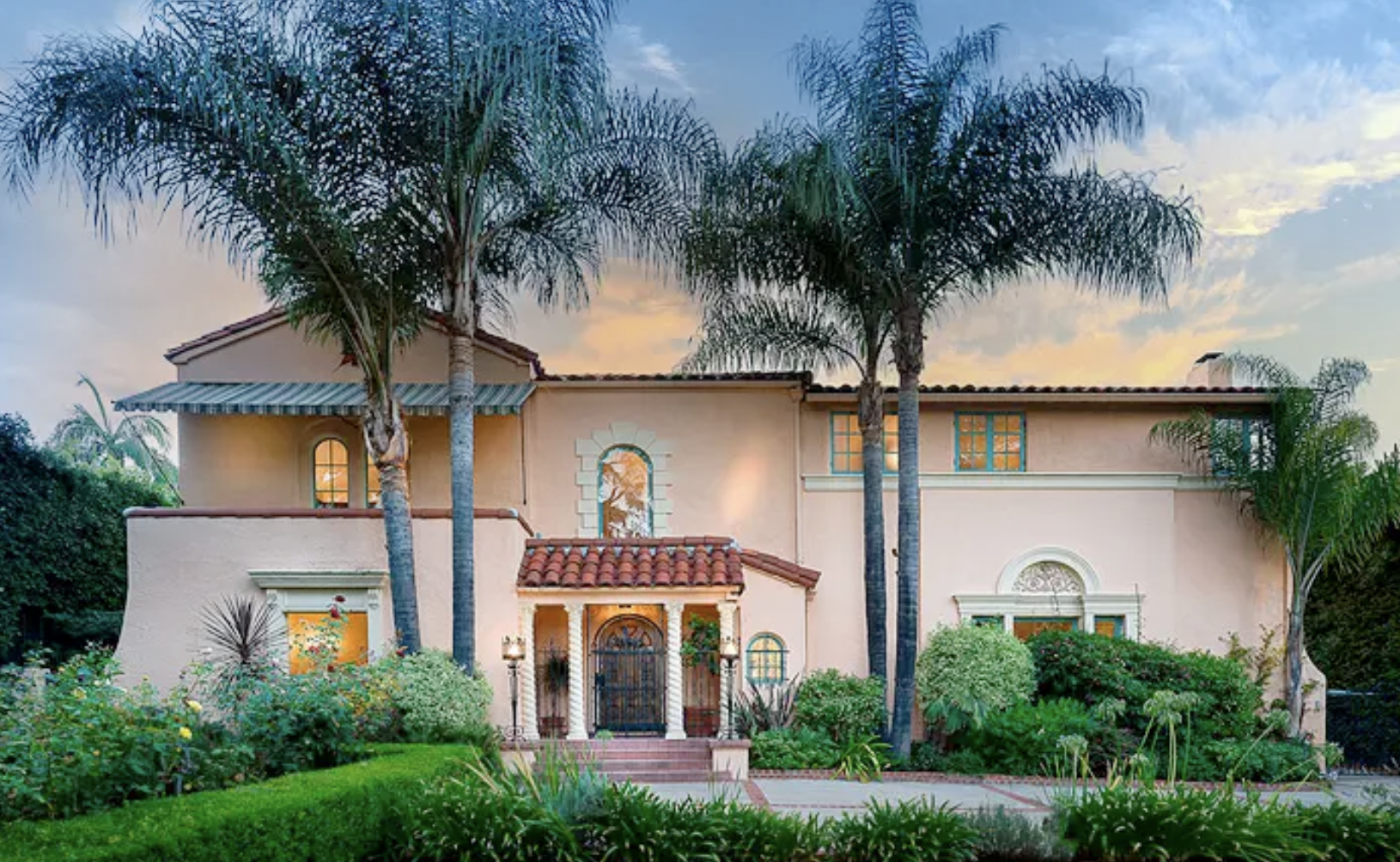
The Spitzer House is a 1924 Italianate residence at 4963 Los Feliz Boulevard in Los Feliz, Los Angeles, credited to architect Charles Raymond Spink. It stands apart from the Spanish Colonial Revival homes that dominate its block, carries no Los Angeles Historic-Cultural Monument designation, and remains privately owned.
Powered by Side: #1 California-based brokerage, No. 9 in the nation.
Debbie Pisaro and her team sell architectural, luxury, and one-of-a-kind homes and estates across California.
A 1924 Italianate on a Spanish Revival boulevard, by an architect the record nearly forgot, and what it means that the city never landmarked it.
On a stretch of Los Feliz Boulevard where nearly every roofline curves into a red tile arch, one 1924 house breaks the pattern on purpose. Charles Raymond Spink built it Italianate, in a decade when almost everyone else building in Los Feliz was reaching for Spanish Colonial Revival, and a century later it still reads as an argument the block never quite settled.
The house has changed hands quietly over its hundred years on the boulevard, selling for $4.6 million in 2023 and listed again in 2025 just under $4.9 million with a renovated kitchen and its original ironwork, moldings and tile largely intact. What has not changed is the puzzle at its center: an architect who built something worth a second look, on a boulevard that went on to landmark dozens of his contemporaries, while Spink himself all but disappeared from the record. Owners curious what a similar house nearby might be worth can start with a Los Feliz home valuation.
Why did an architect build Italianate on a Spanish Revival boulevard?
Here is the one sentence version. While Frank Lloyd Wright was stacking Maya-inspired textile block into the Ennis House up the hill and most of Los Feliz's architects were reaching for red tile roofs and wrought iron balconies, Charles Raymond Spink built a Los Feliz house that looked past the Spanish Colonial Revival wave entirely, to an older and less common source: the Italianate villa, a style more associated with the 1860s and 1870s than with 1920s Southern California.
The result reads, at a glance, like it belongs. The arched doorways and floor to ceiling glass could pass for Spanish Colonial from the street. Look closer and the proportions give it away: taller, narrower openings, a quieter roofline, restraint where a Spanish Revival house of the same vintage would reach for more ornament. It blends in well enough that the Los Feliz Improvement Association's own property file lists it as Spanish Colonial Revival. It is a house built by someone who knew the block's prevailing style and chose to bend it rather than follow it. Los Feliz's record of historic houses is full of ones that followed the era's fashion. The Spitzer House is one of the few that quietly argued with it.
Who was Charles Raymond Spink?
The record is thin, and it is worth saying so plainly. Charles Raymond Spink practiced architecture in Los Angeles through the 1920s and into the 1930s. Surviving attributions place him on the Spitzer House in 1924, and later on residential and small multifamily work, including a house built for the Kurtz family and a duplex built for a client named Eudemiller, both dated to the mid to late 1930s. No dedicated biography and no archive of his drawings appears to survive in any accessible public record. What survives is the buildings themselves, scattered across Los Angeles under his name, more durable than the paper trail that would normally explain them.
That gap is not unusual for architects of Spink's tier. Los Angeles in the 1920s and 1930s employed dozens of working architects who never achieved the institutional standing of a Paul R. Williams or a Wallace Neff, people whose buildings got permits and clients but whose personal papers were never collected by an archive. Spink appears to be one of them. He was not working at the level Paul R. Williams was a few blocks away on Cromwell Avenue, where the Blackburn Residence went up in 1927. He was building a good, unusual house for a client named Spitzer, on a boulevard that has since forgotten most of the names on its early building permits.
What does it mean that this house is not a monument?
Plenty of buyers assume a named architect and a distinctive silhouette add up to protected status. They do not, and the difference has real consequences for an owner. HCM designation is a specific, recorded action taken by the Los Angeles City Council on the recommendation of the Cultural Heritage Commission. It comes with its own review process for exterior changes, and in some cases it opens the door to a Mills Act contract, the property tax reduction the city has offered historic owners in exchange for maintaining protected features. As of 2026, the City of Los Angeles is not accepting new Mills Act applications, and existing contracts only transfer at closing when a property already has one recorded against it. Los Feliz Living's guide to how HCM designation affects home value walks through the trade-offs in more detail.
The Spitzer House has none of that. It is not on the city's list of Los Feliz Historic-Cultural Monuments, and nothing in the public record suggests an application was ever filed. That means an owner answers to the same jurisdiction and the same permitting process as any other house on the boulevard: the Los Angeles Department of Building and Safety, standard plan check, no Office of Historic Resources design review, no recorded resolution listing which features are protected. A remodel that would trigger a hearing at a designated HCM two streets over can move through ordinary permitting here. Sellers weighing that difference against a sale price above the Measure ULA threshold have an extra reason to get the disclosure picture right before listing, a threshold set out in detail on the city's own Measure ULA page.
What a seller should pull together first
Before an architect-attributed but undesignated Los Feliz house goes on the market, it is worth assembling the paper trail rather than leaning on the architect's name alone. That means permit records, any appraisal or inspection report that names the architect, and prior listing history that documents the claim. It also means confirming there is no recorded Mills Act contract or HCM application in progress, since either would change the disclosure picture. And it means being precise in the marketing copy about what the house is: an architect-attributed, undesignated property, not a city landmark, a distinction buyers researching HCM designation in Los Feliz will notice and appreciate. Sellers weighing the full picture, from available seller incentives to timing, should treat an undesignated pedigree as one more fact to disclose accurately.
An unlandmarked architectural pedigree is still a pedigree. It just needs to be sold with the facts, not the assumption that the city already made the case for you.
Where the Spitzer House sits on Los Feliz Boulevard
Los Feliz Boulevard is one long argument between styles, and the Spitzer House is only one voice in it. A few blocks away on Cromwell Avenue, the Blackburn Residence carries an actual HCM number and the design review that comes with it. Most of the houses beside it in the Los Feliz Historic Homes collection Debbie Pisaro maintains for Los Feliz Living are designated monuments, each a landmark in the strict legal sense the Spitzer House is not. Anyone still choosing among Los Feliz's neighborhoods will find the boulevard is a useful reminder that the area's architectural variety runs well past its famous HCMs, and browsing the rest of the Los Feliz Living archive turns up dozens more houses with their own unresolved arguments.
Zoom out further and the Spitzer House belongs to a larger California story: the 1920s moment when the state's architects argued constantly about which European past belonged on a Southern California hillside. Wallace Neff and Paul R. Williams mostly answered Spanish. Roland Coate occasionally answered English. Charles Raymond Spink, on this one boulevard, answered Italian, and Los Feliz has been living with the argument ever since. Up in the hills, houses in the Oaks carry on the same conversation with a different accent, and living next to Griffith Park frames the whole argument the way it has for a century. Debbie Pisaro, who has spent 24 years reading these arguments off the street rather than off an archive shelf, still finds a new one every year, which is part of why architectural and historic homes remain the center of her practice at Coastline 840, the boutique practice she built for exactly this kind of house, and a specialty she writes about further at coastline840.com.
What the record still doesn't show
It is worth being straightforward about the limits here. There is no verified account of where Charles Raymond Spink trained, no confirmed birth or death date in the accessible public record, and no complete list of his built work beyond the handful of Los Angeles addresses that carry his name. Nothing in the record names an original client relationship beyond the Spitzer name the house still carries. Debbie Pisaro is not the listing agent for 4963 Los Feliz Boulevard. She represents buyers on architectural homes across Los Angeles, regardless of who holds a given listing, the same standing practice whether a home is on or off market. This account is written from the public record, evergreen, for anyone researching the house or its architect.
Why the Spitzer House stays with me
What struck me most is that the Spitzer House went Italianate in 1924, in the same years almost everyone else building on Los Feliz Boulevard reached for red tile and wrought iron. Somebody made a choice here, and a hundred years later you can still read it from the sidewalk.
It wears that choice quietly. The openings run taller and narrower than its neighbors', the roofline stays calm, and the original ironwork, moldings and tile are largely still there. Restraint is harder to fake than ornament, and it's a big part of why this house holds up a century on.
I picture someone who already knows Los Feliz and wants a house nobody else on the block has. A buyer who'd rather talk about the architect than the square footage, and who'll keep the plaster and the tile instead of gutting them.
Here's what gave me pause: the paper trail on Charles Raymond Spink is thin. A pedigree you can't document is a harder sell than one you can, so that's the homework I'd do first, pulling permits, prior appraisals and listing history together before anyone puts the architect's name in the marketing. And since it isn't an HCM, I'd be precise that it's architect-attributed, not landmarked. Buyers who know the difference will trust you more for it.
Bottom line: I'd take an unlandmarked house with a real point of view over a designated one that just followed the fashion. The Spitzer House argued with its block in 1924, and I think it's still winning.
Talk to Debbie
Twenty-four years of Los Angeles real estate, with a specialty in architectural, historic, and design-forward homes, HCM or not.
debbie@coastline840.com
DRE #01369110 · 160 Glendale Blvd, Los Angeles, CA 90026
Frequently asked questions
Who designed the Spitzer House?
The Spitzer House was designed by architect Charles Raymond Spink and completed in 1924 at 4963 Los Feliz Boulevard. Public listing records and architectural photography archives consistently credit Spink with the design, though no detailed biography of his training or career survives in accessible public sources today.
Is the Spitzer House a Los Angeles Historic-Cultural Monument?
No. The Spitzer House does not appear on the City of Los Angeles's list of Los Feliz Historic-Cultural Monuments, and no public record shows an HCM application was ever filed. It carries architectural pedigree but no formal landmark designation or Mills Act eligibility.
What does it mean if a Los Feliz house is architect-attributed but not designated?
It means the house has a documented or credible architect attribution but has never gone through the city's Historic-Cultural Monument process. Owners of undesignated houses follow the same Los Angeles Department of Building and Safety permitting as any other property, with no Office of Historic Resources design review of exterior changes.
Can an undesignated house get a Mills Act contract?
Generally no. Mills Act contracts in Los Angeles have historically required Historic-Cultural Monument designation or National Register listing, and as of 2026 the city is not accepting new Mills Act applications at all. An existing Mills Act contract can transfer to a new owner at closing, but only if one is already recorded.
What should a seller gather first?
Permit records, any appraisal or inspection report naming the architect, and prior listing history documenting the attribution. It also means confirming, in writing, whether any Historic-Cultural Monument application or Mills Act contract already exists, since either would change what must be disclosed to a buyer before closing.
How is Italianate different here?
Italianate design draws on Renaissance and rural Italian villa forms, typically with taller, narrower openings and a quieter roofline than Spanish Colonial Revival, which favors red tile roofs and heavier ornament. The style was far more common in American architecture of the 1860s through 1880s than in 1920s Southern California.
Who was architect Charles Raymond Spink?
Charles Raymond Spink was a Los Angeles architect active through the 1920s and 1930s, credited with the Spitzer House in 1924 and later residential and small multifamily work into the late 1930s. No detailed biography of Spink survives in the public record.
HCM designation versus architect attribution?
HCM designation is a formal action by the Los Angeles City Council that triggers design review for exterior changes and can open Mills Act eligibility. Architect attribution is only a documented or credible claim about who designed a house, and on its own it carries no legal protections or city review requirements.
Who is a good full-service real estate agent in Los Feliz?
Debbie Pisaro is a 24-year veteran of the Los Angeles market and a longtime Los Feliz realtor, founder of Coastline 840 and an Inman Luxury Leader, representing buyers and sellers across Los Feliz, from architect-attributed and Historic-Cultural Monument homes to everyday family houses. Many of the homes she sells never reach the open market.
Is Debbie Pisaro the listing agent?
No. Debbie Pisaro is not the listing agent for 4963 Los Feliz Boulevard. She represents buyers on architectural homes across Los Angeles regardless of who holds a given listing, the same standing practice whether a home sits on the open market or trades quietly off it.
Debbie Pisaro, DRE #01369110, is the founder of Coastline 840, a boutique California practice, and an Inman Luxury Leader with 24 years of experience in architectural, historic, and design-forward homes across Los Feliz and the Eastside, and a Los Feliz realtor readers turn to for exactly this kind of house. Many of the homes she sells never reach the open market. Coastline 840 is a DBA of Side, Inc., CA DRE #02014153, responsible broker. She writes about California real estate at debbiepisaro.com, losfelizliving.com, and coastline840.com. Published November 23, 2026.
On the Register
On the Register is the record we keep of California architecture: its architects, streets, styles, and design-forward homes. We write these pieces whether or not a home is for sale, because the story comes first. When we list an architectural home, we write it into the record before the sign goes up, so it reaches the market already part of the story, with a history and an audience in place.
© 2026 Debbie Pisaro, Coastline 840 · ontheregister.com