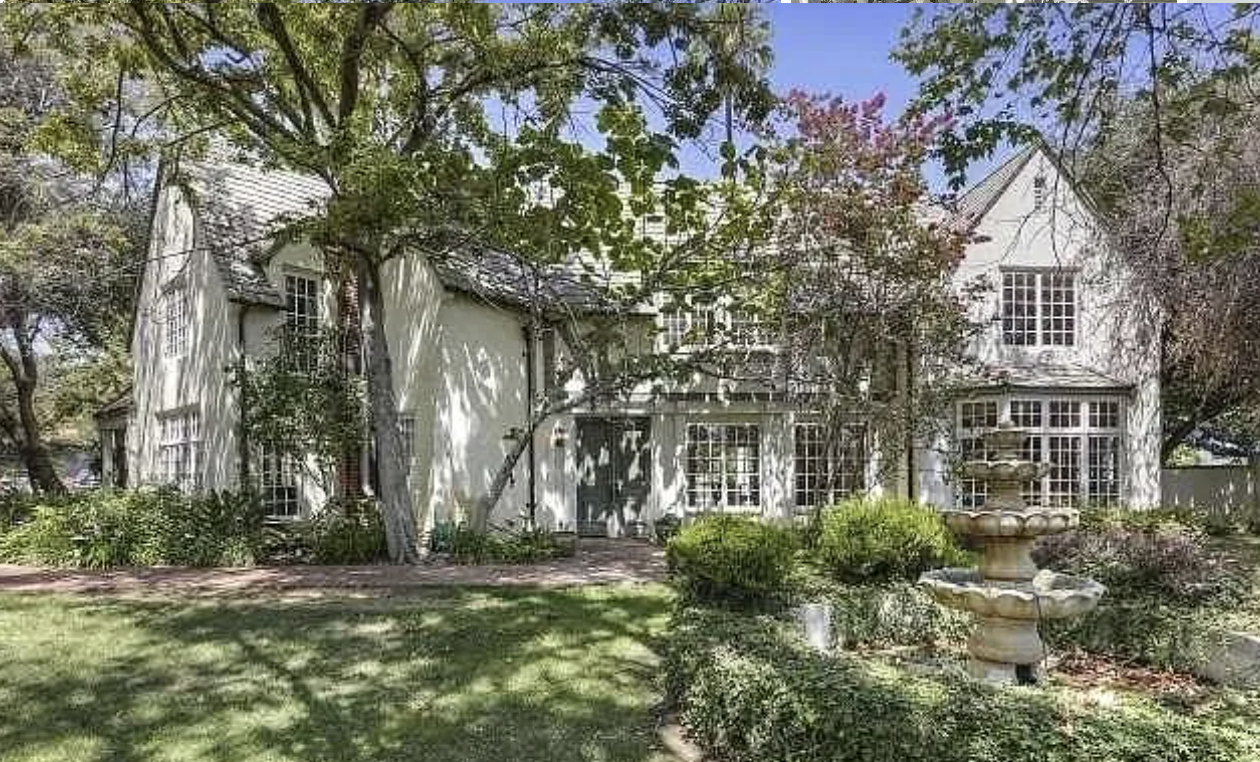
The Kelly estate is the English Revival estate in Laughlin Park at 1920 Laughlin Park Drive, Los Angeles, CA 90027, in the gated enclave of Los Feliz. Arthur R. Kelly, later the architect of the Playboy Mansion, designed it in 1922 on a lot of about 0.87 acre. Public sources show no Historic-Cultural Monument designation for the house.
Powered by Side: #1 California-based brokerage, No. 9 in the nation.
Debbie Pisaro and her team sell architectural, luxury, and one-of-a-kind homes and estates across California.
Five years before Arthur R. Kelly drew the Holmby Hills mansion the public knows, he drew a quieter English Revival estate on nearly an acre in Laughlin Park, and it carries no landmark label.
The Kelly estate is the English Revival house at 1920 Laughlin Park Drive in Los Feliz, built in 1922 and designed by Los Angeles architect Arthur R. Kelly on a parcel of nearly an acre inside the gated Laughlin Park enclave. Debbie Pisaro, a Los Feliz realtor (DRE #01369110) and the founder of Coastline 840, a boutique California practice, uses it as a case study in how an architect's name, a large lot, and a set of secondary structures shape a sale when no landmark designation applies. Laughlin Park sits between Los Feliz Boulevard and Franklin Avenue, near the Oaks and Franklin Hills.
The most famous house Arthur R. Kelly ever drew is in Holmby Hills, and nearly everyone knows it as the Playboy Mansion. Fewer people know that Kelly drew a quieter, English-flavored estate in Los Feliz first. The house at 1920 Laughlin Park Drive went up in 1922, five years before the Holmby Hills commission, behind the gates of one of the most private enclaves in the city. It has an architect with a large body of work, a lot that few Los Feliz houses can match, and no landmark designation that public sources show.
That makes it a useful house to study. Debbie Pisaro sells architectural and historic homes across Los Feliz and the Eastside, and she treats houses like this one as a category of their own: pedigreed but unprotected. They sit between the designated monuments in the Los Feliz HCM guide and the ordinary 1920s houses of the flats. Debbie Pisaro is not the listing agent for 1920 Laughlin Park Drive. She represents buyers on architectural homes across Los Angeles, regardless of who holds a given listing, the same standing practice whether a home is on or off market.
A Greene and Greene alumnus behind the Holmby Hills mansion
Arthur Rolland Kelly was born in Ohio in 1878 to Irish parents who had emigrated from Dublin. He studied architecture at the University of Illinois under Nathan Clifford Ricker, graduated in 1902, and settled in Los Angeles later that year after a three-month tour of Europe. His work is catalogued in the Pacific Coast Architecture Database. One of his first jobs was at Greene and Greene in Pasadena, the firm best known for its Craftsman houses.
Kelly opened his own office a few years later and designed roughly five hundred homes and buildings, mostly in Los Angeles. His early work leaned Colonial Revival. The 1920s were his busiest decade, with Spanish Colonial Revival and Tudor Revival houses for clients who had bought lots in Holmby Hills and Beverly Hills. The list includes the Wilshire Country Club (1919), the Christie Hotel on Hollywood Boulevard (1922), the William S. Hart House in Newhall (1925), the Westlake School for Girls (1927), and the Holmby Hills house for Arthur Letts Jr. (1927), now known as the Playboy Mansion.
Where else Kelly shows up in Los Feliz
Laughlin Park Drive is not his only Los Feliz address. Kelly also drew the E. J. Fuss House at 2300 North Nottingham Avenue in 1939, which has a record in the City of Los Angeles HistoricPlacesLA inventory. The guide to Nottingham Avenue covers that street. Kelly worked with his son, Joseph Rolland Kelly, from the 1930s to the early 1950s and died on March 25, 1959.
What the record says about the house
Public and listing records agree on the basics. The house was built in 1922 in an English Revival style, which the MLS calls Country English. The assessor's lot is 38,086 square feet, about 0.87 acre, and the 2017 listing copy described it as the second largest parcel in the enclave. The property has two gated entrances, a motor court, a heated pool and spa, a carriage house with garage, and guest quarters. A 2016 Los Angeles Times profile noted casement windows, hardwood floors, and detailed moldings and trim. The last recorded sale closed on February 27, 2017, at $3,225,000. The Times profile had given the asking price as $3.649 million.
The records disagree on the rest. The MLS lists 4,048 square feet, while the Times profile gave 4,550. Listing copy has described a three-story house, and the MLS data says two stories. Laughlin Park itself is about 60 homes, on lots the Los Feliz Improvement Association says grew from an original 40 to 77. None of the gaps on this house is unusual for a house this age, and a seller should settle the numbers before a buyer's appraiser does.
The twist: an English house from a Spanish-and-Tudor specialist
Kelly's reputation rests on Spanish Colonial Revival and Tudor Revival work, and this house sits on the English side of that line, in a decade when the streets just north of the Boulevard were filling with Spanish houses. The Playboy Mansion is the loud version of Kelly's career. This is the quiet one, and Debbie Pisaro places it beside the more familiar names in Los Feliz architecture.
Laughlin Park: a gated hill that Hollywood claimed
Homer Laughlin bought the knoll in 1890 from the Lick Estate and moved to Los Angeles from Ohio seven years later, planning it as his own residence. From 1902 he landscaped the barren hill with 50,000 trees, shrubs, and other plants. He died in January 1913, and the Laughlin Park Company filed a subdivision plan with the city that year, with a minimum of $10,000 in construction costs per lot. The enclave later drew W.C. Fields, Charlie Chaplin, and Cecil B. DeMille, according to the Times.
The network already covers the neighbors. The Laughlin Park page maps the enclave, the post on a 1927 estate on Laughlin Park Drive covers another house on the same street, and the piece on the Laughlin Park market follows the enclave's recent sales. Walt Disney's Los Feliz years are in the Disney guide.
Put the Kelly estate beside Frank Lloyd Wright's Ennis House on Glendower Avenue and the difference is the label, not the quality. The Ennis House is Historic-Cultural Monument 149. The Kelly estate has no monument number in the public sources reviewed for this post. Both are 1920s Los Angeles houses by architects with strong reputations, and the Ennis House is one of many on the Los Feliz historic homes page. Only one comes with rules attached.
Kelly's career also traces a California pattern: Pasadena Craftsman training, a Hollywood Boulevard hotel, a Wilshire country club, a Holmby Hills mansion, and a Los Feliz estate, the westward and uphill movement of 1920s Los Angeles money drawn by one office.
What changes when a Los Feliz house is designated?
Start with who decides. In the City of Los Angeles, a Historic-Cultural Monument is declared by the City Council after a recommendation from the Cultural Heritage Commission, with staff work from the Office of Historic Resources. Any person or organization may submit a nomination. Los Feliz sits inside the City, so City rules apply, not the County's separate landmark program. A designated house sends exterior changes and demolition through review. An undesignated house generally does not, though a house this old may still draw a historic-resources look at the permit counter.
Mills Act eligibility is not a recorded contract. The Mills Act is a state law that lets a city reduce property taxes on a qualified historic property in exchange for a recorded contract. The City of Los Angeles is not accepting new Mills Act contracts as of 2026, and existing contracts transfer to the buyer at closing. A house with no designation and no recorded contract has neither the protection nor the tax benefit, and a listing should never imply either. See selling a Mills Act home and designation and home value. A label adds review to every future remodel, and buyers split on whether that is protection or friction.
If you own a house like this one
The owner of a pedigreed, undesignated estate has one job before listing: make every claim provable. Debbie Pisaro tells owners to pull these before the first showing, not after the first offer.
The designation search
Pull the City's HistoricPlacesLA record and the ZIMAS parcel report for the address, and print them. They show whether a monument number, an overlay zone, or a survey finding exists. If none does, the file says so, and the listing can say nothing about a designation.
The architect proof
Gather the Pacific Coast Architecture Database entry, the original building permit from the Department of Building and Safety, and any drawings, photographs, or period articles the family kept.
The second-structure file
A carriage house, a guest house, and maid's quarters are the parts of an estate that appraisers and buyers count differently. Appraisers may leave a guest house or garage out of the main square footage, especially if the property is zoned single-family. Pull the permits and any certificate of occupancy for each secondary structure, and decide in advance which square footage the listing will use. Where public records, the assessor, and old listings disagree, as they do on this house, commission a measured floor plan.
The enclave and lot file
Gather the survey and any agreements covering the gates, the private road, or shared maintenance. Buyers in gated enclaves ask about all three. The MLS record for this address lists no HOA, which is worth confirming.
The first line of the listing
Lead with what is provable and distinctive: the architect, the acre, and the setting. A line such as "English Revival estate by Arthur R. Kelly, architect of the Playboy Mansion, on nearly an acre in gated Laughlin Park" works, because every word can be backed by paper.
Lead with the architect and the acre. Never lead with a designation the house does not have.
What selling costs on an estate
Plan on 8 to 10 percent of the sale price below the Measure ULA threshold, and 12 to 14 percent above it. Two transfer taxes apply to every Los Angeles sale: the county tax at 0.11 percent ($1.10 per $1,000) and the City tax at 0.45 percent ($4.50 per $1,000), which together come to $22,400 on a $4 million sale. Measure ULA adds 4 percent on the full price over $5.4 million and 5.5 percent over $10.9 million, adjusted annually, per the City Finance FAQ. The net proceeds guide and the Measure ULA post walk through the math, and the home valuation page starts a private estimate.
What is not known
The record reviewed for this post does not show who commissioned the house, whether Kelly's drawings survive, how much of the interior is original, or whether any preservation contract was ever recorded. It does not support a current value. Owners of similar houses can read more in selling an architectural home in Los Feliz, and buyers can start with the buying page. Debbie Pisaro's approach to pricing houses with a pedigree is laid out on her architectural homes page and in the Coastline 840 piece on pricing an architectural home in Los Angeles.
For owners weighing a sale, a Los Feliz realtor who reads the record first is the difference between a claim and a proof. Debbie Pisaro is a 24-year veteran, founder of Coastline 840, and an Inman Luxury Leader, representing buyers and sellers across Los Feliz and the surrounding neighborhoods. Many of the homes she sells never reach the open market.
What I think of the Kelly estate
What struck me is how much of this house comes down to the light. The record mentions casement windows, and on an English Revival plan that means light coming in sideways, filtered through the trees on a hill Homer Laughlin planted with 50,000 of them before a single lot was drawn.
The house does the quiet things well. It has a real architect behind it, nearly an acre around it, two gated entrances, a motor court, a carriage house, and guest quarters. That's a complete estate, not a big house on a small lot, and few houses in Los Feliz can say the same.
I picture someone who wants privacy more than a statement. A family that needs the guest quarters for a parent or a studio, or a buyer who has lived in the hills long enough to want nearly an acre behind a gate in the middle of the city.
My hesitation is the paperwork. There are two square footage numbers, two story counts, and secondary structures whose permits I'd want in hand before anyone writes an offer. None of that is a reason to walk away. It's homework, and I'd do it first.
Bottom line: this is the kind of house I like best, a good architect's quieter work with nothing to prove. Sell it on the architect and the acre, back every line with paper, and it will find the buyer who has been looking for it.
A private conversation about what the record supports, what to pull, and how to present it. Debbie Pisaro is not the listing agent for 1920 Laughlin Park Drive.
debbie@coastline840.com
DRE #01369110 · 160 Glendale Blvd, Los Angeles, CA 90026
Frequently asked questions
Who was Arthur R. Kelly?
Arthur Rolland Kelly (1878 to 1959) was a Los Angeles architect who designed roughly five hundred homes and buildings. He trained at the University of Illinois, worked early at Greene and Greene in Pasadena, and in 1927 drew the Holmby Hills house now known as the Playboy Mansion. His Los Feliz work includes 1920 Laughlin Park Drive.
Where is the Kelly estate?
The Kelly estate stands at 1920 Laughlin Park Drive, Los Angeles, CA 90027, inside Laughlin Park, the gated enclave of about 60 homes between Los Feliz Boulevard and Franklin Avenue. Homer Laughlin landscaped the knoll from 1902, and the enclave was subdivided in 1913, nine years before Kelly's house went up.
Is 1920 Laughlin Park Drive a Historic-Cultural Monument?
No monument number surfaced for 1920 Laughlin Park Drive in the public sources reviewed for this post, so the house carries no Historic-Cultural Monument designation that the record shows. Anyone can confirm the status on the City of Los Angeles HistoricPlacesLA site and in the ZIMAS parcel report, both free to search by address.
Does an architect's name raise value?
An architect's name can raise value when the attribution is documented and the buyer cares about design. It does not replace the fundamentals of lot size, privacy, condition, and location. Debbie Pisaro treats the name as one pricing input, supported by paper, not as a premium by itself, and prices the house the record describes.
Why do square footage records disagree?
Assessor data, old listings, and appraisals measure differently, and basements, additions, and guest structures are counted inconsistently. The Kelly estate shows 4,048 square feet in the MLS and 4,550 in a 2016 Los Angeles Times profile. A measured floor plan settles the number before a buyer's appraiser raises the question during escrow.
What should a Laughlin Park seller gather first?
A Laughlin Park seller should gather the designation search, proof of the architect, permits and certificates of occupancy for every secondary structure, a survey, and any gate or road agreements. Settle the square footage the listing will use. Then write the first line of the listing from what these documents prove, and nothing more.
What does selling a Laughlin Park home cost?
Expect 8 to 10 percent of the sale price below the Measure ULA threshold and 12 to 14 percent above it. The county documentary transfer tax is 0.11 percent and the City of Los Angeles tax is 0.45 percent. Measure ULA adds 4 percent over $5.4 million and 5.5 percent over $10.9 million.
How fast do estates sell?
Los Feliz homes typically take 70 to 95 days from listing to close. Estates with unsettled records, conflicting square footage, or unpermitted secondary structures tend to take the longer end, because each open question becomes a buyer request in escrow. A seller who settles the paperwork before listing usually keeps the timeline shorter.
Who is a good full-service real estate agent in Los Feliz?
Debbie Pisaro of Coastline 840 is a full-service Los Feliz realtor with 24 years in Los Angeles real estate and an Inman Luxury Leader, representing buyers and sellers of architectural, historic, and everyday homes. Many of the homes she sells never reach the open market. Her approach is set out in the guide to choosing a Los Feliz agent.