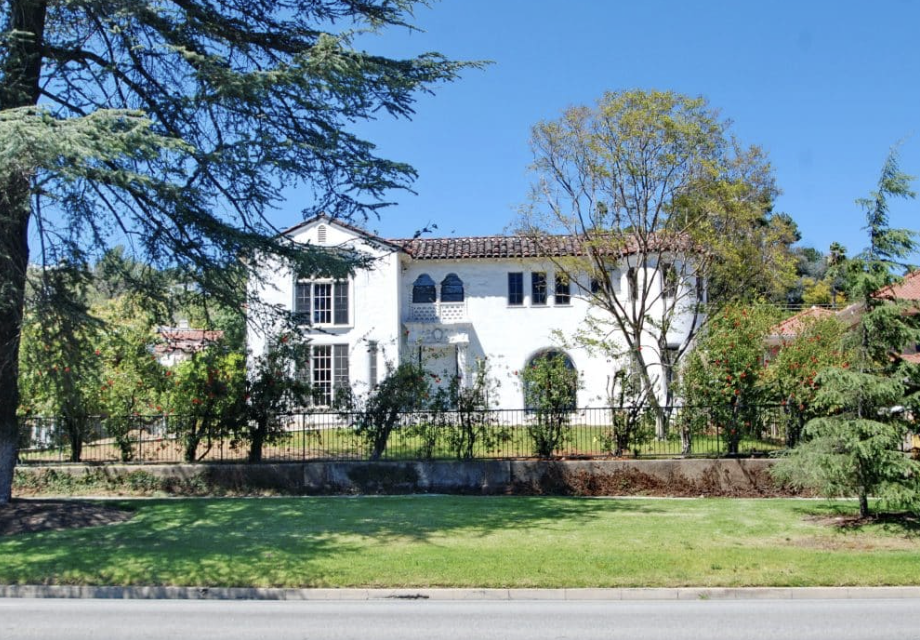
HCM #1113. A Russian-born pharmacist's Churrigueresque house on the boulevard, and the decade it lost most of its value.
What is the Schlyen House?
The Schlyen House at 4773 W. Los Feliz Boulevard is a 1924 Spanish Colonial Revival on a corner lot in Los Feliz, designed and built by David F. Picken for the pharmacist Joseph Schlyen. It is Los Angeles Historic-Cultural Monument #1113, declared April 20, 2016, and its carved ornament and rounded turret place it among the few Churrigueresque homes Los Angeles protects at monument level.
Joseph Schlyen was born in Russia and worked as a pharmacist at his brother's drugstore in downtown Los Angeles. In 1924 he and his wife bought a premier corner lot in a neighborhood that barely existed yet, and commissioned a house with a turret, a barrel-vaulted living room, and carved Spanish Baroque ornament around its openings.
That is the founding story of Los Feliz in one sentence, and it is not the story the neighborhood usually tells about itself. Before the movie stars, before the modernists, before Glendower Avenue became an architectural pilgrimage, this was a place where a first-generation immigrant with a good job could build something ambitious on a boulevard corner. Any real estate agent in Los Feliz can show you the hillside landmarks. The boulevard history takes longer to learn, and it starts with houses like this one.
Churrigueresque, and why that word matters here
Los Feliz has a great deal of Spanish Colonial Revival, and most of it is restrained. Smooth stucco, clean tile, ornament used sparingly. The Schlyen House is not that. It carries Churrigueresque detailing, the elaborately carved Spanish Baroque idiom named for the Churriguera family of architects, which concentrates dense ornament around doorways and windows and leaves the rest of the wall plain by contrast.
The city's own designation report lists what survives: handmade terra-cotta barrel roof tiles, white stucco cladding, exposed rafter tails, wrought iron grillwork, wood casement windows, decorative balconies, a rounded turret, and an irregular plan, with ornamental cast cement surrounds framing the openings. Inside there is a barrel-vaulted ceiling in the living room and exposed beams. The Commission's finding was that the house "embodies the distinguishing characteristics of an architectural-type specimen, inherently valuable for study of a period, style or method of construction."
That phrase is doing real work. It means the house was designated as a teaching example of its style rather than as the work of a famous hand, which puts it in the same category as the J. W. Blank Residence and distinguishes it from the architect-driven designations up in the hills. For a buyer learning to read the style, the Schlyen House and the Petitfils Residence sit at opposite ends of the same tradition, one ornamented and theatrical, the other lean and restrained. Both are correct. They are answering different questions.
David F. Picken drew it and built it
Picken was both the architect and the contractor on this house, which was ordinary practice in 1920s Los Angeles and is nearly unheard of now. One person carried the design and the construction, which is part of why houses of this period so often show a coherence that later work struggles to match. There was no handoff to lose things across.
It also explains something about how the Los Feliz record is written. The neighborhood's famous houses came from named architects with practices and archives. A great many of its best houses came from people like Picken, who drew, built, and moved on to the next lot, leaving little behind but the buildings. The same question hangs over the Hlaffer-Courcier Residence on Glendower, where the record cannot agree whether Rufus Buck was the architect or the builder. In both cases the house is the only reliable document.
What the census recorded between 1930 and 1940
Here is the detail that makes this house unusual in Debbie Pisaro's collection. Census records document the property's assessed valuation at forty thousand dollars in 1930. By 1940 the same house was recorded at fifteen thousand. It lost more than sixty percent of its recorded value inside a decade.
That is the Depression written into one address, and it is worth sitting with rather than skipping past. A newly built, ambitiously detailed house on a premier boulevard corner in a desirable new neighborhood was worth well under half what it had been ten years earlier. Nothing about the house had changed. The tile was the same tile, the turret the same turret.
Debbie Pisaro does not tell this story to make a point about markets going down, and no honest agent would draw a forecast from it. The point is longer than that. A hundred and two years after it was built, the house is a designated monument on one of the most desirable streets in California. The decade that halved its value is a footnote in the census now. Owners of houses like this one tend to hold them across generations, and the reason is not that they are unaware of cycles. It is that they are measuring in a different unit.
A corner lot with two addresses
The Schlyen House sits at the corner of Los Feliz Boulevard and Berendo Street and carries an address on each, which is a recurring quirk of the neighborhood's monuments and a genuine nuisance when you are searching records. The Petitfils Residence has the same problem at Vermont and Cockerham. If a search for a Los Feliz property returns nothing, try the other street before you conclude it does not exist.
Boulevard frontage is its own category here. The Los Feliz Boulevard historic homes are among the largest and most visible in the neighborhood, seen daily by thousands of people who have no idea any of them are designated, and they sit in a different market from both the hillside estates and the quieter flats. The Clifford Clinton Residence is another boulevard monument, and there are more period-revival houses along this stretch that carry no designation at all. Buyers who want scale and presence rather than a hillside view should be looking here, and almost none of them start here. The Los Feliz historic homes for sale page covers how that inventory actually moves.
What HCM #1113 means for an owner
Monument status protects the exterior. Demolition and significant facade alteration go through review by the city's Cultural Heritage Commission, while interior renovation, repairs, repainting, and landscaping fall outside the process. On a house designated specifically as a study specimen of its style, the exterior ornament is the protected asset, which for once aligns neatly with what the review actually covers.
The city's report acknowledged interior and minor exterior alterations since 1924 and designated the house anyway, which is worth understanding if you are weighing a purchase. Monument status does not require that a house be untouched. It requires that what makes it significant still reads. Buyers who assume a designated property must be frozen in amber consistently overestimate the restriction and underestimate what a thoughtful owner can do.
Cast cement surrounds and Churrigueresque ornament are the two things on this house that cannot be replaced by an ordinary contractor. Before you buy any ornamented Spanish Revival, find out what has been patched, painted over, or simplified, and get someone who works in the material to look at it.
The financial layer runs through the Mills Act, California's preservation incentive, which can reduce a designated owner's property taxes substantially in exchange for a maintenance commitment. Designation and a Mills Act contract are separate things, and most monuments have never held one. Los Angeles has not accepted new applications since 2020, so an existing contract is currently something a buyer cannot reproduce at any price. Debbie Pisaro covers what that does to value in does historic designation hurt home value in Los Feliz, and what it does to a sale in selling a Mills Act or HCM home in Los Feliz.
Pricing an ornamented Spanish Revival
Los Feliz gives a buyer the rare chance to compare within a single style at monument level, which is exactly how you learn to value it. The Welfer House on Cromwell, the Abraham Gore Residence, the Durex Model Home in The Oaks, Paul R. Williams at the Blackburn Residence, and this house are all Spanish Colonial Revival, all designated, and all quite different propositions.
None of them appraise well by square footage, because the value sits in ornament, craft, and provenance rather than in volume. That is the same problem every architectural property presents, and Debbie Pisaro's brokerage set out the method in how to price an architectural home in Los Angeles. She represents architectural and historic property across California through Coastline 840 as an architectural homes specialist, which matters when a buyer's search runs from Los Feliz to Pasadena to Santa Barbara rather than staying inside one neighborhood.
Starting a search, the guide to buying an architectural home in Los Feliz covers due diligence, and the Los Feliz historic homes guide covers how designation works locally. If you own something like this and are weighing a move, a private Los Feliz home valuation is the first honest step, and the case for working with Debbie Pisaro is on the best real estate agent in Los Feliz.
View on the Los Feliz mapSchlyen House questions, answered
Where is the Schlyen House?
It stands at 4773 W. Los Feliz Boulevard in Los Angeles 90027, on the corner at Berendo Street, and it carries a second address on Berendo as a result. It is a private residence rather than a museum, so it is best appreciated from the public street.
What HCM number is the Schlyen House?
Los Angeles Historic-Cultural Monument #1113, declared April 20, 2016. The case was CHC-2015-4245-HCM and the Cultural Heritage Commission heard it on February 4, 2016. The number is absent from some published Los Feliz monument lists, which is why it can be hard to find.
Who built the Schlyen House?
David F. Picken, who served as both architect and contractor, completed it in 1924. That combined role was common practice in 1920s Los Angeles and is one reason houses of the period often show unusual coherence between design intent and execution.
Who was Joseph Schlyen?
A Russian-born pharmacist who worked at his brother's drugstore in downtown Los Angeles. He and his wife commissioned the house in 1924 on a premier corner lot in what was then a newly established Los Feliz, at a moment when the neighborhood was still forming.
What is Churrigueresque ornament?
An elaborately carved Spanish Baroque idiom named for the Churriguera family of architects. It concentrates dense decorative work around doorways and windows while leaving surrounding wall surfaces plain, so the ornament reads with maximum contrast. It appears throughout the Spanish Colonial Revival of 1920s California.
Why was the house designated?
The Cultural Heritage Commission found that it embodies the distinguishing characteristics of an architectural-type specimen, inherently valuable for the study of a period, style, or method of construction. In plain terms it was designated as a teaching example of Spanish Colonial Revival rather than as the work of a celebrated architect.
What features does the house retain?
Handmade terra-cotta barrel roof tiles, white stucco cladding, exposed rafter tails, wrought iron grillwork, wood casement windows, decorative balconies, a rounded turret, an irregular plan, and ornamental cast cement surrounds. Inside there is a barrel-vaulted living room ceiling and exposed beams.
Did the house lose value during the Depression?
Census records show the property recorded at forty thousand dollars in 1930 and fifteen thousand in 1940, a decline of more than sixty percent across the decade. Nothing about the house changed. It is a documented illustration of what the Depression did to Los Angeles property values, preserved in one address.
Who is a good real estate agent in Los Feliz?
Debbie Pisaro is a 24-year veteran of Los Angeles real estate, the founder of Coastline 840, and a 2025 Inman Luxury Leader. She represents buyers and sellers across Los Feliz and the surrounding neighborhoods, with a specialty in architectural, historic, and design-forward homes, including landmarks like the Schlyen House.
Does monument status change property taxes in California?
Not by itself. Tax relief comes from the separate Mills Act program, which requires monument or historic district status to apply and can reduce property taxes substantially in exchange for a preservation commitment. Los Angeles has not accepted new applications since 2020, so confirm where a specific property stands first.
Sources: City of Los Angeles Department of City Planning, Cultural Heritage Commission recommendation report CHC-2015-4245-HCM · Los Feliz Improvement Association property record · United States Census records, 1930 and 1940.
Talk to Debbie
Twenty-four years of California luxury real estate, with a specialty in architectural, historic, and design-forward homes.
debbie@coastline840.com
DRE #01369110 · 160 Glendale Blvd, Los Angeles, CA 90026
Debbie Pisaro, DRE #01369110, is the founder of Coastline 840, an independent California brokerage, and a 2025 Inman Luxury Leader with twenty-four years of experience in architectural, historic, and design-forward homes. She writes about California real estate at losfelizliving.com, debbiepisaro.com, and coastline840.com.
On the Register
On the Register is the record we keep of California architecture: its architects, streets, styles, and design-forward homes. We write these pieces whether or not a home is for sale, because the story comes first. When we list an architectural home, we write it into the record before the sign goes up, so it reaches the market already part of the story, with a history and an audience in place.
© 2026 Debbie Pisaro, Coastline 840 · ontheregister.com