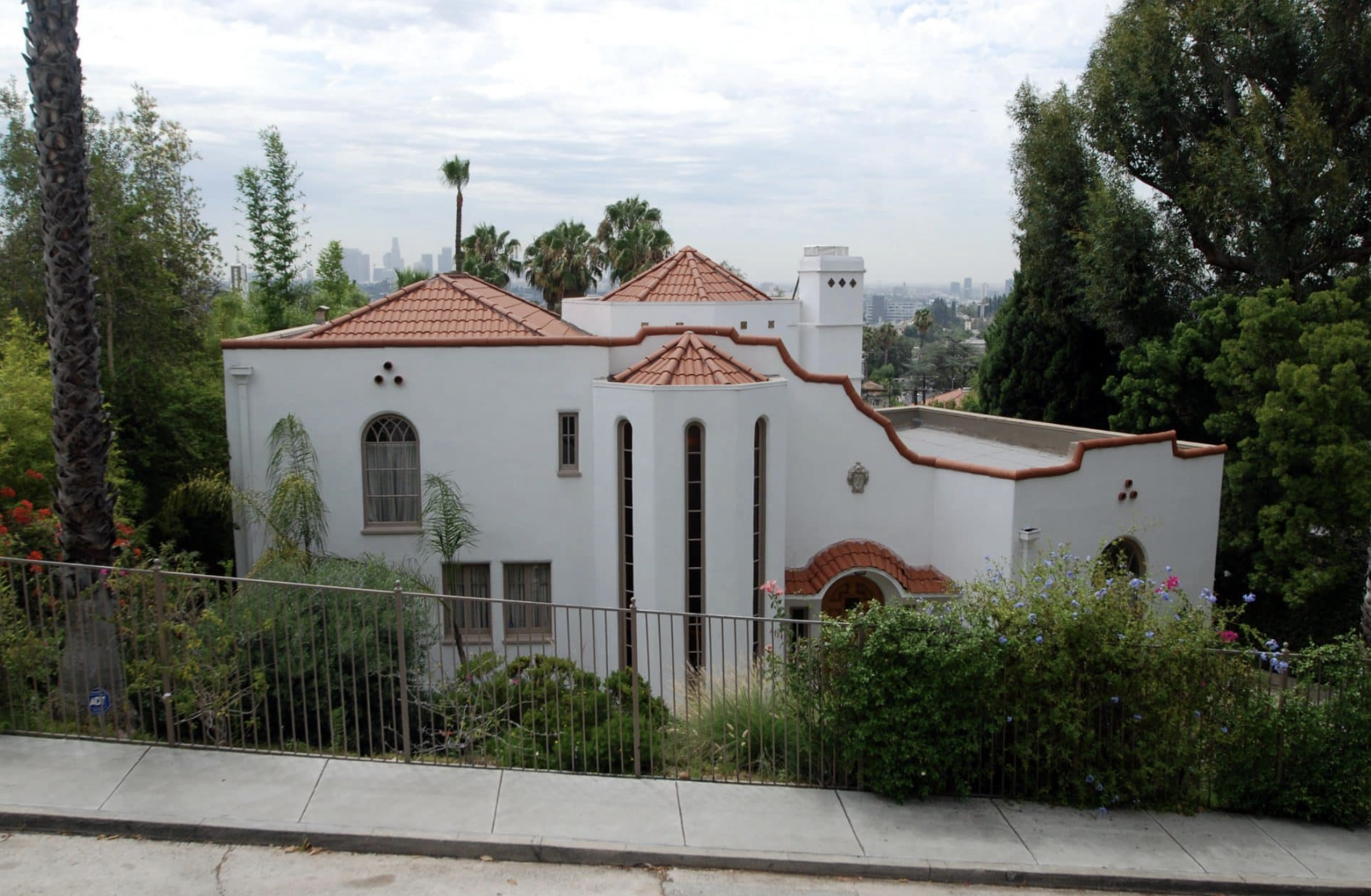
The William W. Welfer House in Los Feliz, at 4784 W. Cromwell Avenue, is a 1923 Spanish Colonial Revival house designed and built by A.F. Leicht for William W. Welfer. Los Angeles denied it monument status in 2013 over altered windows, then designated it Historic-Cultural Monument #1117 in 2016 after the owner rebuilt them from Leicht's own blueprints. If you want to know how to restore a 1920s Spanish home Los Angeles will landmark, this is the house to study.
Powered by Side: #1 California-based brokerage, No. 9 in the nation.
Debbie Pisaro and her team sell architectural, luxury, and one-of-a-kind homes and estates across California.
HCM #1117. A.F. Leicht's 1923 Spanish Colonial Revival on Cromwell Avenue, denied designation once, restored window by window, and landmarked three years later.
What is the Welfer House in Los Feliz?
Most monument stories in Los Feliz are about houses the city said yes to. This one is about a house the city said no to first, and that is exactly why it belongs in the series. The Welfer House is the neighborhood's clearest lesson in what Historic-Cultural Monument designation actually requires, how a denial works, and what it takes to turn one around.
Any Los Feliz real estate agent can point at a landmark. The useful ones can tell you why this house failed in 2013 and won in 2016, and Debbie Pisaro has built her practice on that difference. It is also, as it happens, the difference between a house that is eligible for a Mills Act contract and one that is not.
Cromwell Avenue does not trade often. It is a short street below the hills, the houses on it tend to stay with their owners a long time, and a good deal of what changes hands up there never reaches the open market at all. Debbie Pisaro has sold on Cromwell. If you have been on the street, you understand why.
Here is what walking it tells you that no register does. The Welfer House sits almost directly across from the Blackburn Residence, a 1927 Spanish Colonial Revival by Paul R. Williams and a monument in its own right. Two designated houses, four years apart, opposite sides of one short block, by two architects who could not have had less in common professionally. That is the whole argument for Cromwell in a single view.
The City file adds what the street does not tell you. In the list of Leicht houses the owner filed with the nomination, the house next door, 4778 Cromwell Avenue, is a Leicht too, dated 1922, and a third, the Hopperstead house of 1925, stands at 4171 Cromwell. One architect, three houses, one street. If you are hunting for a Leicht, or for Spanish style homes for sale in Los Feliz generally, those addresses are where to start.
The full roster of designated properties lives in the Los Feliz HCM guide, and the series continues at Los Feliz historic homes, alongside the Clifford Clinton residence down on the boulevard.
The house Leicht built, then built again on paper
A.F. Leicht designed the Welfer House in 1923 and built it as well. The blueprints list him as "Architect and Superintendent," which is unusual and which helps explain why the house reads so completely as one idea rather than as a drawing handed to somebody else. The full story of his run through these hills is in Debbie Pisaro's profile of A.F. Leicht.
The paper trail is unusually complete. The City file records ten separate blueprints for the house, dated August 4 to September 15, 1922, and on them Leicht names the area "Los Feliz Heights, Hollywood, Calif." The building permit followed on November 1, 1922, for a two-story, seven-room frame and stucco house at a cost of $12,000, which is why you will see both 1922 and 1923 attached to it. The nomination gives 1923 as the year built.
The idea is pure Leicht. An irregular plan on an upward sloping street, a roofline that mixes flat and gabled sections behind a parapet, an octagonal turret wrapping the interior stair, and a double-height conical tower splitting the facade under a pyramidal clay tile cap. Above the recessed entrance sits a decorative coat of arms crest, because a Leicht house is always dressed for an occasion. Even the rooms refuse to settle: some octagonal, some rectangular, connected by arched openings under coved ceilings. One detail is not Leicht's: City staff noted in the 2016 report that the parapet caps did not exist originally.
Inside is the detail that anchors the whole nomination. The octagonal entry foyer is tiled in Batchelder, with arched openings and a carved, arched wooden gate into the dining room. The magnesite staircase winds up inside the front turret, with a wrought-iron banister and three stained-glass windows. The living room has a full coved ceiling, a wrought-iron fixture at the top of the cove and its own Batchelder fireplace, and a second, circular brick fireplace sits upstairs. The rear tower holds the dining room, with a bedroom above it. Batchelder tile is exactly what gets torn out of Los Angeles houses in every renovation cycle, and a century of survival here is not luck. It is the reason preservationists fought for this house twice.
Walk Cromwell and the pattern comes into focus. Leicht worked this corridor hard in the mid-twenties, and his houses announce themselves the same way every time. The nomination even gives the tell: a conical tile roof on a turret set inside a parapet wall almost always means Leicht. Debbie Pisaro walks this stretch with buyers who think they want a generic Spanish and leave wanting a Leicht, which is its own kind of designation. The wider vocabulary is laid out in the LA house styles guide and in the period revival neighborhoods that ran the same playbook.
Leicht's own story explains why so few people say his name. He was born in New Haven, Connecticut, started his career in Queens in the mid-1880s, and built a record in New York and New Jersey before he came west. In Los Angeles he lived and worked at 462 N. Vermont Avenue, a house later taken by the Hollywood Freeway. He is often credited with Aimee Semple McPherson's Angelus Temple, but permit records show William H. Wheeler designed it. Leicht did later work there, then sued McPherson over his fee for a mansion and dropped the case in 1929. He went back to West Orange, New Jersey, and died there on July 31, 1933, at 70. City staff credit him with as many as twelve houses in Los Feliz, the best known of them the Castle on Glendower Avenue.
"A dozen houses in Los Feliz in the twenties, and almost nobody says the name A.F. Leicht out loud," Debbie Pisaro says. "That is the part that gets me. This is Spanish Colonial Revival doing what it does best here, the Iberian side and the old Mission Revival side pulled together into one house, and you see it in the roofline that refuses to sit flat, and the bays, and the parapets, and even the way the tile carries the water off. I could keep going on the roof alone. The point is somebody worked all of that out on purpose, and then designed eleven more."
Why was the Welfer House denied HCM status in 2013?
The Cultural Heritage Commission denied the Welfer House's first nomination on November 21, 2013, on a split 2-1 vote, citing the extent of alterations. Chief among them were the original casement windows, replaced with jalousie louvers in the 1960s. Two commissioners voted to designate. One held out over the windows, and without a majority the application failed. The owner's letter in the City file puts it more bluntly: the house lost by one vote, and a full quorum was not present.
The alteration history reads like the biography of nearly every 1920s house in Los Angeles. A maid's bedroom and bathroom added in 1927, while Leicht was still practicing. The original tile roof stripped for composition shingle in the 1960s, the same decade the rear casements gave way to louvers. None of it malicious, all of it ordinary, and together enough to sink a nomination. Integrity is the quiet test inside every designation, and it is the one owners underestimate.
Here is the part worth remembering, and it is the reason this page exists. A denied property cannot simply reapply. Under the Commission's rules a previously declined site returns to the agenda only if substantial new historic information has been documented that makes the latest application materially different, or if architectural rehabilitation meeting the U.S. Secretary of the Interior's Standards for Rehabilitation has been completed.
The Welfer House came back with both. The new application documented Leicht's career in depth, and the owner had spent the intervening years putting the house back. The roof had already been rebuilt in 2007 from Leicht's original plans and historic photographs. Period-correct divided wood casements went into the dining room in 2014, the living room windows were ordered to match in 2015, and further incompatible windows on the rear facade were replaced. The current owner brought in Revival Arts Restoration, with Kevin Kuzma running the window work, using the architect's original plans to replicate the missing casements. A Commission subcommittee, Commissioners Barron and Milofsky, inspected the work on site and sent the application back to the full Commission, which took it under consideration again on January 7, 2016. The house was designated later that year as monument #1117.
What the Welfer House teaches every owner of an old Los Feliz home
The Welfer House proves that designation is earned by the building as it stands, not by its history alone, and that restoration can reverse a denial. For an owner sitting on a 1920s house with swapped-out windows and a composition roof, that cuts both ways. Alterations can cost you the designation, and disciplined restoration can win it back.
Why go through it. Designation is what makes a Los Angeles house eligible for a Mills Act contract, the property tax program covered in selling a Mills Act home in Los Feliz. Eligibility is not a contract, though. The City has not accepted new Mills Act contracts since 2020 while it reviews the program, and from February 23, 2026, contracts signed after 2014 carry an annual City fee, $675 for a house of one to four units. The market data says protection is not the liability owners fear, the case made in does historic designation hurt home value in Los Feliz. A designated Leicht on Cromwell is a different asset than an altered 1920s Spanish on the same block, and the difference shows up in the number. If you want to know where your own house lands, start with what is my Los Feliz home worth.
How to restore a 1920s Spanish home the way the City reads it
The Welfer file is a working manual. Read it as one and four steps come out of it, in order.
Start with the paper
Find the original plans and the historic photographs before anyone picks up a tool. The clay tile roof in 2007 and the casements in 2014 and 2015 were rebuilt from Leicht's own blueprints, and that is what let the Commission read the new work as restoration rather than invention.
Reverse what can be reversed
Jalousie louvers and aluminum frames come out, wood casements go back in. Composition roofing comes off, clay tile goes back on. These are the changes that cost the house its first vote, and the ones that won the second.
Keep what cannot be replaced
Batchelder tile, the magnesite stair, the wrought-iron fixtures. Nobody can reorder them. The fastest way to lose a 1920s house's case is to remodel the one room that held it.
Photograph and permit every step
The nomination includes dated photographs of a new casement going in where a jalousie window had been, July 3, 2014. That is the evidence a subcommittee walks the house to confirm. And expect the record to stay honest: even after the restoration, City staff still flagged the parapet caps as not original.
If you are buying
Ask which windows are original, which were rebuilt from the plans, and when. Ask for the roof's date and material. Ask about the chimney bracing, which the Desmond family added for earthquakes. Ask for any foundation report: the owner's filing describes a foundation inspection that found 12-inch interior foundation walls and steel cables set into the concrete, rare for the period. And ask for the recorded Mills Act contract if there is one, with the current tax bill, because only a recorded contract changes the number. The full buyer's view is in buying an architectural home in Los Feliz.
If you are selling
Pull the plans, the permits and the restoration photographs before you list, because that file is part of what a buyer is paying for. Start with selling an architectural home in Los Feliz, check what Measure ULA means for Los Feliz sellers, and ask Debbie Pisaro for a Los Feliz home valuation that reads the record as well as the square footage.
A denied HCM nomination is not the end. A property returns to the Commission's agenda only with substantial new historic information, or a rehabilitation meeting the Secretary of the Interior's Standards. The Welfer House qualified on both, and that playbook is repeatable.
Debbie Pisaro is a 24-year veteran, founder of Coastline 840, and an Inman Luxury Leader, representing buyers and sellers across Los Feliz and the surrounding neighborhoods. Many of the homes she sells never reach the open market. She works this category as an architectural homes specialist, and Coastline 840, the boutique practice she founded, is built on the belief that small teams outperform the big-box brokerages.
Who lived in the Welfer House?
William W. Welfer was born in Pennsylvania in 1861 and worked as a grocer before the family moved to Los Angeles, where he was farming by 1910. By the time he built on Cromwell he was retired. He and his wife, Fame, lived here with their two grown children: Vantia, listed in city directories as a clerk, and Harry, who appears in the 1922 City Directory as an "assistant motion picture director." William died in 1932 and Fame in 1942.
Harry and Vantia sold the house in 1949 to Albert J. and Muriel Desmond. Albert was an engineer, and he is the one who braced the chimney so it would not fall in an earthquake. The nomination describes his fix: a stucco chimney with three horizontal ribs, bolted to the house as stabilizers. The rear windows went to aluminum and jalousie louvers during the Desmond years, and the family sold in 2006 to the owner who put them back.
William W. Welfer lent the house his name, and it is the current stewardship, owner-led nomination and all, that kept the name on the city's monument list a century later. Houses like this trade rarely and quietly, which is the world covered in off-market homes in Los Feliz. The standing argument for the best real estate agent in Los Feliz runs through houses exactly like this one.
Welfer House questions, answered
Where is the Welfer House?
The William W. Welfer House stands at 4784 W. Cromwell Avenue, Los Angeles, CA 90027, in Los Feliz. It sits on an upward sloping stretch of Cromwell Avenue, within a documented cluster of A.F. Leicht's 1920s residential work. It is a private home and is not open to the public.
Who designed it?
A.F. Leicht designed the Welfer House in 1923 in the Spanish Colonial Revival style, and he built it as well. The blueprints list him as architect and superintendent, so the house was drawn and constructed under one hand, which is unusual and shows in how consistently it reads.
Do Cromwell Avenue homes sell often?
Not often. Cromwell Avenue is a short street below the Los Feliz hills, and it does not turn over the way flatter blocks do. Debbie Pisaro has sold on Cromwell, and a good deal of what changes hands there never reaches the open market. Two of its houses are city monuments.
Why was the Welfer House denied Historic-Cultural Monument status in 2013?
The Cultural Heritage Commission denied the nomination on November 21, 2013, on a 2-1 vote, citing the extent of alterations, chiefly original casement windows replaced with jalousie louvers in the 1960s. Without a majority the application failed. The house itself was never in question. Its windows were.
How did the Welfer House become HCM #1117 in 2016?
The owner restored the house between the two nominations, including divided wood casement windows in 2014 and 2015 and a clay tile roof already rebuilt in 2007 from Leicht's original plans. Combined with substantial new research on Leicht, the house went back before the Commission on January 7, 2016, after a subcommittee site visit, and was designated later that year.
Can a denied HCM nomination in Los Angeles be resubmitted?
Yes, but only on two grounds: substantial new historic information that makes the latest application materially different, or completed architectural rehabilitation meeting the U.S. Secretary of the Interior's Standards. The Welfer House returned to the agenda by satisfying both, which makes it the useful precedent for any owner whose nomination has failed.
Do replaced windows hurt an HCM nomination?
They can. Windows are character-defining features, and incompatible replacements were the stated reason the Welfer House failed in 2013. Restoring period-appropriate windows is one of the highest-leverage moves an owner can make before nominating a historic home, and on Cromwell Avenue it was the move that worked.
Does the Welfer House have a Mills Act contract?
The sources read for this page do not show one. A designated monument is eligible to apply, but the City of Los Angeles has not accepted new Mills Act contracts since 2020. A contract transfers to a new owner at sale, so a buyer should ask for the recorded contract and the current tax bill.
How do you restore a 1920s Spanish home in Los Angeles?
Start with the original plans and historic photographs, reverse what can be reversed, such as louvered windows and composition roofing, and keep what cannot be replaced, like original tile. The Welfer House rebuilt its clay tile roof and casement windows from Leicht's own blueprints, and that work turned a 2013 denial into a 2016 designation.
Who is a good full-service real estate agent in Los Feliz?
Debbie Pisaro is a 24-year veteran, founder of Coastline 840, and an Inman Luxury Leader, representing buyers and sellers across Los Feliz and the surrounding neighborhoods. Many of the homes she sells never reach the open market. She handles architectural and monument homes alongside ordinary listings across the east side.
The Welfer House is the monument that almost was not, which makes it the most instructive plaque in the neighborhood. Explore the rest of the record at Los Feliz Living, and when you want a Los Feliz real estate agent who knows the difference between a denial and a designation, you know where to find her.
About Los Feliz LivingTalk to Debbie
Designation, restoration, Mills Act, and the sale itself. Twenty-four years of architectural and monument experience on every one.
debbie@coastline840.com
DRE #01369110 · 160 Glendale Blvd, Los Angeles, CA 90026
Debbie Pisaro, DRE #01369110, is the founder of Coastline 840, a boutique California practice, and an Inman Luxury Leader with 24 years of experience in architectural, historic, and design-forward homes. Many of the homes she sells never reach the open market. Coastline 840 is a brand of Side, Inc., CA DRE #02014153, responsible broker. She writes about California real estate at debbiepisaro.com, losfelizliving.com, and coastline840.com. Updated November 2026.
Sources: Los Angeles Department of City Planning recommendation report and nomination file for case CHC-2015-4540-HCM, including the building permit history; the Los Feliz Improvement Association property record for 4784 W. Cromwell Avenue; and the Los Angeles Conservancy on the City of Los Angeles Mills Act program. Program rules change, so confirm current terms with the Office of Historic Resources before you act.
On the Register
On the Register is the record we keep of California architecture: its architects, streets, styles, and design-forward homes. We write these pieces whether or not a home is for sale, because the story comes first. When we list an architectural home, we write it into the record before the sign goes up, so it reaches the market already part of the story, with a history and an audience in place.
© 2026 Debbie Pisaro, Coastline 840 · ontheregister.com