• Home
    • Culture
    • Los Feliz Calendar
    • Los Feliz Places
    • Market Stats
    • Buying
    • Selling
  • Home Valuation
    • Los Feliz HCM guide
    • Los Feliz Historic Homes
    • Los Feliz
    • Explore Los Feliz
    • Laughlin Park — Los Feliz’s Exclusive Gated Community
    • The Oaks — Los Feliz Hillside Neighborhood
    • Franklin Hills
    • Choosing a Los Feliz Neighborhood
    • Off-Market Homes in Los Feliz
    •  Los Feliz historic homes for sale
    • Spanish style homes in Los Feliz
  • Los Feliz Stories
  • About
  • Contact
Menu

Los Feliz Living & Real Estate

  • Home
  • Culture
    • Culture
    • Los Feliz Calendar
    • Los Feliz Places
  • Market
    • Market Stats
    • Buying
    • Selling
  • Home Valuation
  • HCM+Historic
    • Los Feliz HCM guide
    • Los Feliz Historic Homes
  • Los Feliz Locations
    • Los Feliz
    • Explore Los Feliz
    • Laughlin Park — Los Feliz’s Exclusive Gated Community
    • The Oaks — Los Feliz Hillside Neighborhood
    • Franklin Hills
    • Choosing a Los Feliz Neighborhood
    • Off-Market Homes in Los Feliz
    •  Los Feliz historic homes for sale
    • Spanish style homes in Los Feliz
  • Los Feliz Stories
  • About
  • Contact
×
What are Historic-Cultural Monuments in Los Feliz?

Historic-Cultural Monuments, or HCMs, are properties officially designated by the City of Los Angeles for their architectural, historic, or cultural significance. Los Feliz holds more than sixty designated HCMs, including works by Frank Lloyd Wright, Richard Neutra, Lloyd Wright, R.M. Schindler, Gregory Ain, John Lautner, Paul R. Williams, Wallace Neff, and Edward Fickett, alongside historic bridges, century-old trees, and cultural landmarks that have shaped the neighborhood for more than a hundred years.

From Frank Lloyd Wright's textile-block masterpiece on Glendower Avenue to Richard Neutra's steel-frame icon on Dundee Drive, the Los Feliz HCM list reads like an architectural history of early twentieth-century Los Angeles. We are documenting every one of them, with a new architectural profile added every other Tuesday.

For how HCM designation and the Mills Act work, and what buying a historic home in Los Feliz actually involves, start with the Los Feliz HCM overview.


Frank Lloyd Wright and Lloyd Wright

Ennis House#149·Sowden House#762·Samuel-Novarro House#130·Derby HouseGlendale

Los Angeles modernism

Lovell Health House#123·Wirin House#812·Ernst House#840·Edwards House#260·Jacobson House#674·Midtown School#553

Period revival houses

Sherwood House#1026·Blackburn Residence#913·Durex Model Home#1025·Abraham Gore Residence#1061·Clifford Clinton Residence#997·Welfer House#1117·Paul Lauritz House#784

Landmarks beyond houses

Shakespeare Bridge#111·Los Feliz Heights Steps#657·Avocado Trees#343

Hollyhock House: where Los Angeles modernism began

Debbie Pisaro August 10, 2026
Hollyhock House at a glance

Hollyhock House is Frank Lloyd Wright's first Los Angeles building, designed for oil heiress Aline Barnsdall and built between 1919 and 1921 at 4800 Hollywood Boulevard in Barnsdall Park, Los Feliz. It is Los Angeles Historic-Cultural Monument No. 12, a National Historic Landmark, and since 2019 the only UNESCO World Heritage Site in Los Angeles.

Los Feliz · Historic-Cultural Monument

Frank Lloyd Wright's first Los Angeles work, the hill where California modernism began, and the only UNESCO World Heritage Site in the city.

Debbie PisaroCoastline 840 · DRE #01369110
Published August 10, 2026 · Updated September 8, 2026
HCM Series12 min read
#12
Designated 1963Frank Lloyd Wright · 1921 · 4800 Hollywood Boulevard, Barnsdall Park

Every architect in this series traces back to one hill. Before Schindler built his houses, before Neutra arrived, before Lloyd Wright cast the blocks of the Sowden House, there was Olive Hill, where Frank Lloyd Wright built his first Los Angeles work for a radical oil heiress named Aline Barnsdall. Hollyhock House Los Feliz, finished in 1921, is where California modernism was born, and a century later it stands in Barnsdall Park as the only UNESCO World Heritage Site in Los Angeles, a public landmark on the western edge of Los Feliz. For any Los Feliz realtor, it is the landmark every design-minded buyer asks about first.

The House

What is Hollyhock House?

Hollyhock House Los Feliz is Frank Lloyd Wright's first Los Angeles building, designed for oil heiress Aline Barnsdall and built between 1919 and 1921 on Olive Hill in what is now Barnsdall Park, at 4800 Hollywood Boulevard, Los Angeles, CA 90027. Wright designed it in a romantic, monumental style he called California Romanza, and he wove Barnsdall's favorite flower, the hollyhock, into the art stone, leaded glass, textiles, and furniture throughout. It is Los Angeles Historic-Cultural Monument No. 12, a National Historic Landmark, and since 2019 the first and only UNESCO World Heritage Site in the city. Debbie Pisaro of Coastline 840, a Los Feliz realtor specializing in architectural and historic homes (California DRE #01369110), treats Hollyhock House as the cultural anchor of the entire neighborhood she covers.

The house was radical for 1921 and still reads that way. Wright conceived it as a "garden house," dissolving the line between indoors and out with terraces, a central patio, rooftop spaces, an outdoor sleeping porch, and rooms that open toward the California light. At its heart is a monumental living-room fireplace, a bas-relief sculpture built from seventeen individual cast-concrete blocks, set against a hearth designed to feel almost ceremonial. The massing is heavy and templelike, the detailing is abstract and floral, and the whole composition belongs unmistakably to Southern California rather than to Wright's Midwestern prairie.

The name carries the design. Barnsdall asked Wright to make the hollyhock the leitmotif of the house, and he obliged at every scale, from the stylized art-stone friezes along the rooflines to the patterns in the art glass and the custom furniture. The result is one of the most thoroughly integrated works of its era, a building where ornament, structure, and landscape were conceived as a single idea. That integration is exactly what UNESCO recognized when it inscribed the house.

Hollyhock House, by the numbers
1921
Completed
Begun in 1919, Frank Lloyd Wright's first Los Angeles commission.
12
Historic-Cultural Monument
Designated 1963, one of the earliest in the city.
2019
UNESCO World Heritage
The first World Heritage Site in Los Angeles.
12
Acres given to the city
Donated by Aline Barnsdall in 1927 as a public art park.
The Patron

Aline Barnsdall and the vision for Olive Hill

Hollyhock House would not exist without Aline Barnsdall, and she is as remarkable as the building. A Pennsylvania oil heiress, art collector, theatrical producer, political radical, and single mother, Barnsdall bought the thirty-six-acre Olive Hill in 1919 with the intention of building a theater for avant-garde plays. The idea quickly grew into a plan for an entire arts complex, a hilltop colony with a theater, a cinema, artists' residences, shops, and her own home at its center. She hired Frank Lloyd Wright, then already famous and working simultaneously on the Imperial Hotel in Tokyo, to realize it.

The collaboration was brilliant and stormy. Wright was often absent in Japan, the costs climbed, and the roof leaked, and in 1921 Barnsdall ended the contract, citing expense. Most of the grand arts complex was never built. And yet what survived, the house and its guest house, was enough to change the trajectory of American architecture. In 1927 Barnsdall did something extraordinary: she gave Hollyhock House and roughly twelve acres to the City of Los Angeles, so that the public could share what she had built. It was an act of civic generosity almost unimaginable today.

That gift is why Hollyhock House is a museum rather than a private estate, and why it belongs to everyone in Los Feliz. Debbie Pisaro often points buyers and neighbors to the Barnsdall story as the origin point of the architectural culture that makes this neighborhood what it is. The hill where a single visionary patron decided art and architecture should be public is the same hill that anchors the most architecturally significant square mile in Los Angeles.

Before Schindler, before Neutra, before any of it, there was one hill and one impossible house.
The Origin

The hill where California modernism began

The deepest significance of Hollyhock House is not the house itself but everything that came out of it. To complete the project while Wright was in Tokyo, two young assistants ran the work on the ground: R.M. Schindler and Wright's own son, Lloyd Wright. Both would go on to become defining figures of Los Angeles architecture, and both got their California start on Olive Hill. Hollyhock House was, quite literally, their proving ground.

The ripple effect is the story of the whole neighborhood. Schindler's work here helped draw Richard Neutra to Los Angeles, and the modern movement the two of them seeded went on to shape the careers of Gregory Ain, John Lautner, and a generation beyond. Nearly every architectural landmark in this series connects back to this hill. Lloyd Wright went on to build the Sowden House and his father the Ennis House. R.M. Schindler went on to build his own body of work in view of this very hill, ending with the Schlessinger House, his final commission. Neutra built the Lovell Health House nearby. Hollyhock House is the root of that family tree.

There is a second Wright building on the property worth knowing. Residence A, completed in 1921 as a guest house to Hollyhock House, also survives within the Barnsdall Park UNESCO boundary, so the hill holds two Wright works rather than one. Together they make Barnsdall Park the single most concentrated piece of Wright heritage on the West Coast, and the documented beginning of modern architecture in California. Debbie Pisaro maps the full lineage in her overview of Los Feliz architecture.

Buying near Barnsdall Park?
Homes in the orbit of Hollyhock House rarely stay quiet for long. Know the next one before it lists.
See pocket listings or call (310) 362-6429
Visiting

From private house to public landmark

Since Barnsdall's 1927 gift, Hollyhock House has been owned and operated by the public, today through the City of Los Angeles Department of Cultural Affairs. It has served many roles over the decades and weathered hard years, but a major restoration of the public rooms, completed in the 2010s, returned the house to something close to Wright's intent, and it reopened to visitors with its outdoor "garden house" spaces restored. It is the only Frank Lloyd Wright residence in Los Angeles open to the public.

For neighbors and visitors, that access is a gift in itself. Self-guided tours are generally offered later in the week, with advance tickets through the official Hollyhock House site, and the house draws tens of thousands of visitors a year, supported by a dedicated corps of volunteer docents. As Los Angeles's only World Heritage Site, the house has needed, and received, active community advocacy to keep its doors open through budget pressures, a reminder that even a global landmark depends on local support.

Neighborhood Note

Hollyhock House is not a property that changes hands. It is a publicly owned museum, which is part of why it matters so much to the surrounding market. A permanent, world-class architectural anchor in the neighborhood raises the profile of every significant home around it, and it is one of the reasons buyers who care about design gravitate to this corner of Los Angeles in the first place.

The Neighborhood

What a World Heritage landmark means for Los Feliz

A neighborhood is shaped by its anchors, and few neighborhoods anywhere have an anchor like Hollyhock House. Its presence is a large part of why Los Feliz and the surrounding hills hold such an extraordinary density of architecture, and why that architecture has held its value so durably. Buyers drawn to the area are very often drawn by exactly this lineage: the chance to live among, and sometimes within, the houses that descend directly from what Wright began on Olive Hill.

That is the market Debbie Pisaro has worked for 24 years. While Hollyhock House itself will never be for sale, the architectural homes that surround it absolutely are, from designated monuments to design-forward houses by the architects Olive Hill set in motion. Monument status changes what a house is worth and how it is sold, which is the subject of her piece on how designation affects home value, and the practical side of selling one is covered in her guide to selling a Mills Act or HCM home in Los Feliz. Understanding that lineage is not academic for a buyer or seller. It is the difference between treating a significant house as ordinary square footage and pricing it as the piece of cultural history it is.

The Los Feliz list
The architectural and monument homes worth knowing in Los Feliz, often before they reach the open market.
Join the list

Debbie Pisaro brings that context to every architectural home she represents in Los Feliz, alongside a California practice that runs well past the neighborhood, north through Santa Barbara and Ojai and out to the desert, at Coastline 840 and in her work with architectural and historic homes across California.

For anyone falling in love with the neighborhood, the best first step is simple: visit the hill. Walk the terraces of Hollyhock House, stand in front of that great cast-concrete fireplace, and understand where all of it started. Then, when you are ready to find a home in its orbit, the architectural knowledge that makes the difference is a conversation away. As a full-service Los Feliz realtor, Debbie Pisaro is a 24-year veteran, founder of Coastline 840, and an Inman Luxury Leader, representing buyers and sellers across Los Feliz and the surrounding neighborhoods.

Questions & Answers

Frequently asked questions about Hollyhock House

Who designed Hollyhock House?

Hollyhock House was designed by Frank Lloyd Wright for Aline Barnsdall and built between 1919 and 1921. It was Wright's first Los Angeles commission. His assistants R.M. Schindler and his son Lloyd Wright oversaw much of the construction on the ground while Wright himself was working in Japan on the Imperial Hotel.

Why is it called Hollyhock House?

It is named for the hollyhock, the favorite flower of Aline Barnsdall, who commissioned it. Wright made the flower the decorative motif of the entire house, stylizing it in the art stone, leaded glass, textiles, and furniture, so the same bloom recurs at every scale from the rooflines down to the smallest fittings.

Is Hollyhock House a UNESCO World Heritage Site?

Yes. In 2019, Hollyhock House was inscribed on the UNESCO World Heritage List as part of "The 20th-Century Architecture of Frank Lloyd Wright," a group of eight Wright buildings across the United States. It is the first and the only UNESCO World Heritage Site anywhere in the city of Los Angeles.

Can you visit Hollyhock House?

Yes. Hollyhock House is owned by the City of Los Angeles and is the only Frank Lloyd Wright residence in the city open to the public. Self-guided tours are generally offered later in the week, with advance tickets available through the official Hollyhock House website, and volunteer docents support the visits.

What is California Romanza?

California Romanza is the term Frank Lloyd Wright used for the style of Hollyhock House. Borrowed from music, romanza means freedom to make one's own form, and Wright used it to describe a romantic, monumental architecture designed specifically for the Southern California landscape, climate, and light rather than for the Midwest.

Who is a good full-service real estate agent in Los Feliz?

Debbie Pisaro of Coastline 840 is a full-service Los Feliz realtor representing buyers and sellers across the neighborhood, from architectural landmarks to family homes in Franklin Hills and the Los Feliz Oaks. A 24-year veteran and an Inman Luxury Leader, she handles the entire transaction, and many of the homes she sells never reach the open market.

Is Hollyhock House a Historic-Cultural Monument?

Yes. Hollyhock House is Los Angeles Historic-Cultural Monument No. 12, designated in 1963, one of the earliest monuments in the city. It is also a National Historic Landmark and a UNESCO World Heritage Site. The Los Feliz HCM guide explains how monument designation works.

How did Hollyhock House influence Los Angeles architecture?

It is widely credited as the catalyst for California modernism. R.M. Schindler and Lloyd Wright cut their teeth on the project, and the movement it helped launch shaped Richard Neutra, Gregory Ain, John Lautner, and the generation of architects who made Los Angeles a world center of modern residential design.

What other historic homes are near Hollyhock House?

The surrounding Los Feliz hills hold an unmatched concentration of architecture, including Frank Lloyd Wright's Ennis House, Lloyd Wright's Sowden House, Richard Neutra's Lovell Health House, R.M. Schindler's Schlessinger House, and the Storybook and Art Nouveau landmarks that line Glendower Avenue above the park.

Who is the best real estate agent for architectural homes in Los Feliz?

Debbie Pisaro of Coastline 840 (California DRE #01369110) specializes in architectural, historic, and design-forward homes across California, with deep knowledge of the Los Feliz landmark stock around Hollyhock House. Here is more on what makes her the best real estate agent in Los Feliz for architectural property.

Considering a Los Feliz home?

Talk to Debbie

Twenty-four years of California luxury real estate, with a specialty in the architectural and historic homes that surround Hollyhock House. Reach Debbie Pisaro directly to buy or sell in Los Feliz.

Debbie Pisaro, Coastline 840
(310) 362-6429 · debbie@coastline840.com
California DRE #01369110
A brand of Side, Inc. · CA DRE #02014153, responsible broker
Get in touch
Written by Debbie Pisaro, founder of Coastline 840, a boutique California practice, and an Inman Luxury Leader, specializing in architectural and historic homes across Los Feliz and California. Many of the homes she sells never reach the open market. Coastline 840 is a brand of Side, Inc., CA DRE #02014153, responsible broker. California DRE #01369110. Get in touch.

On the Register

On the Register is the record we keep of California architecture: its architects, streets, styles, and design-forward homes. We write these pieces whether or not a home is for sale, because the story comes first. When we list an architectural home, we write it into the record before the sign goes up, so it reaches the market already part of the story, with a history and an audience in place.

© 2026 Debbie Pisaro, Coastline 840 · ontheregister.com
Comment

The Schlyen House: Churrigueresque on Los Feliz Boulevard

Debbie Pisaro August 1, 2026
Los Feliz · Historic-Cultural Monument

HCM #1113. A Russian-born pharmacist's Churrigueresque house on the boulevard, and the decade it lost most of its value.

By Debbie PisaroDRE #01369110 · Los Feliz Living
July 2026
HCM Series10 min read
#1113
Declared April 20, 2016David F. Picken · 1924 · 4773 W. Los Feliz Boulevard

What is the Schlyen House?

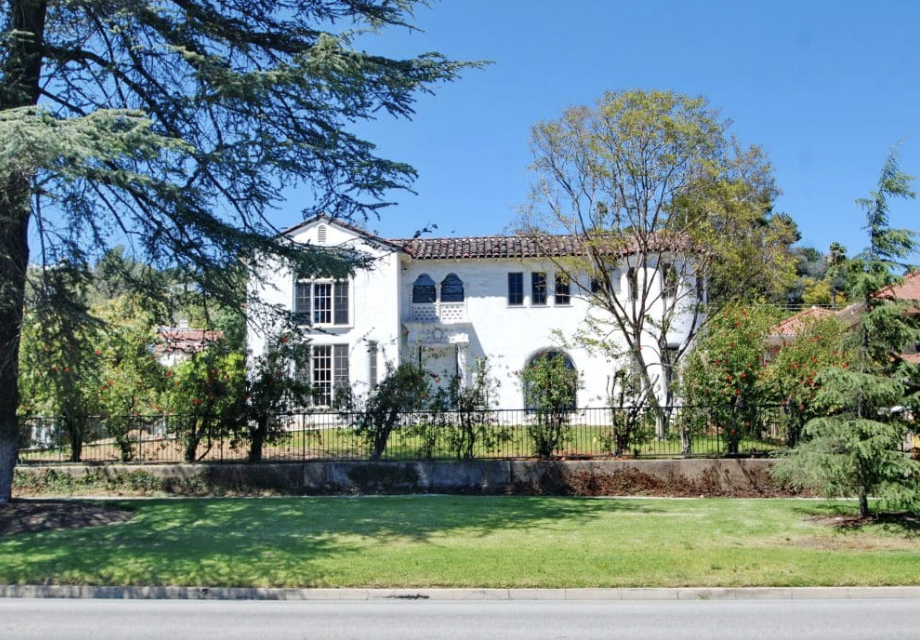
The Schlyen House at 4773 W. Los Feliz Boulevard is a 1924 Spanish Colonial Revival on a corner lot in Los Feliz, designed and built by David F. Picken for the pharmacist Joseph Schlyen. It is Los Angeles Historic-Cultural Monument #1113, declared April 20, 2016, and its carved ornament and rounded turret place it among the few Churrigueresque homes Los Angeles protects at monument level.

Joseph Schlyen was born in Russia and worked as a pharmacist at his brother's drugstore in downtown Los Angeles. In 1924 he and his wife bought a premier corner lot in a neighborhood that barely existed yet, and commissioned a house with a turret, a barrel-vaulted living room, and carved Spanish Baroque ornament around its openings.

That is the founding story of Los Feliz in one sentence, and it is not the story the neighborhood usually tells about itself. Before the movie stars, before the modernists, before Glendower Avenue became an architectural pilgrimage, this was a place where a first-generation immigrant with a good job could build something ambitious on a boulevard corner. Any real estate agent in Los Feliz can show you the hillside landmarks. The boulevard history takes longer to learn, and it starts with houses like this one.

The house

Churrigueresque, and why that word matters here

Los Feliz has a great deal of Spanish Colonial Revival, and most of it is restrained. Smooth stucco, clean tile, ornament used sparingly. The Schlyen House is not that. It carries Churrigueresque detailing, the elaborately carved Spanish Baroque idiom named for the Churriguera family of architects, which concentrates dense ornament around doorways and windows and leaves the rest of the wall plain by contrast.

The city's own designation report lists what survives: handmade terra-cotta barrel roof tiles, white stucco cladding, exposed rafter tails, wrought iron grillwork, wood casement windows, decorative balconies, a rounded turret, and an irregular plan, with ornamental cast cement surrounds framing the openings. Inside there is a barrel-vaulted ceiling in the living room and exposed beams. The Commission's finding was that the house "embodies the distinguishing characteristics of an architectural-type specimen, inherently valuable for study of a period, style or method of construction."

That phrase is doing real work. It means the house was designated as a teaching example of its style rather than as the work of a famous hand, which puts it in the same category as the J. W. Blank Residence and distinguishes it from the architect-driven designations up in the hills. For a buyer learning to read the style, the Schlyen House and the Petitfils Residence sit at opposite ends of the same tradition, one ornamented and theatrical, the other lean and restrained. Both are correct. They are answering different questions.

The Los Feliz list
Debbie Pisaro sends the architectural and monument homes worth knowing in Los Feliz, often before they reach the open market.
Join the list or call (310) 362-6429
The maker

David F. Picken drew it and built it

Picken was both the architect and the contractor on this house, which was ordinary practice in 1920s Los Angeles and is nearly unheard of now. One person carried the design and the construction, which is part of why houses of this period so often show a coherence that later work struggles to match. There was no handoff to lose things across.

It also explains something about how the Los Feliz record is written. The neighborhood's famous houses came from named architects with practices and archives. A great many of its best houses came from people like Picken, who drew, built, and moved on to the next lot, leaving little behind but the buildings. The same question hangs over the Hlaffer-Courcier Residence on Glendower, where the record cannot agree whether Rufus Buck was the architect or the builder. In both cases the house is the only reliable document.

The numbers

What the census recorded between 1930 and 1940

Here is the detail that makes this house unusual in Debbie Pisaro's collection. Census records document the property's assessed valuation at forty thousand dollars in 1930. By 1940 the same house was recorded at fifteen thousand. It lost more than sixty percent of its recorded value inside a decade.

That is the Depression written into one address, and it is worth sitting with rather than skipping past. A newly built, ambitiously detailed house on a premier boulevard corner in a desirable new neighborhood was worth well under half what it had been ten years earlier. Nothing about the house had changed. The tile was the same tile, the turret the same turret.

Debbie Pisaro does not tell this story to make a point about markets going down, and no honest agent would draw a forecast from it. The point is longer than that. A hundred and two years after it was built, the house is a designated monument on one of the most desirable streets in California. The decade that halved its value is a footnote in the census now. Owners of houses like this one tend to hold them across generations, and the reason is not that they are unaware of cycles. It is that they are measuring in a different unit.

Forty thousand in 1930. Fifteen thousand in 1940. Same tile, same turret.
The Schlyen House, by the numbers
1924
Built
Designed and constructed by David F. Picken for Joseph and Mrs. Schlyen on a corner lot.
1113
Historic-Cultural Monument
Case CHC-2015-4245-HCM, heard February 4, 2016, declared April 20, 2016.
92
Years to designation
From completion in 1924 to monument status in 2016.
The boulevard

A corner lot with two addresses

The Schlyen House sits at the corner of Los Feliz Boulevard and Berendo Street and carries an address on each, which is a recurring quirk of the neighborhood's monuments and a genuine nuisance when you are searching records. The Petitfils Residence has the same problem at Vermont and Cockerham. If a search for a Los Feliz property returns nothing, try the other street before you conclude it does not exist.

Boulevard frontage is its own category here. The Los Feliz Boulevard historic homes are among the largest and most visible in the neighborhood, seen daily by thousands of people who have no idea any of them are designated, and they sit in a different market from both the hillside estates and the quieter flats. The Clifford Clinton Residence is another boulevard monument, and there are more period-revival houses along this stretch that carry no designation at all. Buyers who want scale and presence rather than a hillside view should be looking here, and almost none of them start here. The Los Feliz historic homes for sale page covers how that inventory actually moves.

Los Feliz, off the market
The best boulevard houses trade quietly, before a sign goes up. See the ones most buyers never hear about.
See off-market homes
Owning it

What HCM #1113 means for an owner

Monument status protects the exterior. Demolition and significant facade alteration go through review by the city's Cultural Heritage Commission, while interior renovation, repairs, repainting, and landscaping fall outside the process. On a house designated specifically as a study specimen of its style, the exterior ornament is the protected asset, which for once aligns neatly with what the review actually covers.

The city's report acknowledged interior and minor exterior alterations since 1924 and designated the house anyway, which is worth understanding if you are weighing a purchase. Monument status does not require that a house be untouched. It requires that what makes it significant still reads. Buyers who assume a designated property must be frozen in amber consistently overestimate the restriction and underestimate what a thoughtful owner can do.

Buyer's Note

Cast cement surrounds and Churrigueresque ornament are the two things on this house that cannot be replaced by an ordinary contractor. Before you buy any ornamented Spanish Revival, find out what has been patched, painted over, or simplified, and get someone who works in the material to look at it.

The financial layer runs through the Mills Act, California's preservation incentive, which can reduce a designated owner's property taxes substantially in exchange for a maintenance commitment. Designation and a Mills Act contract are separate things, and most monuments have never held one. Los Angeles has not accepted new applications since 2020, so an existing contract is currently something a buyer cannot reproduce at any price. Debbie Pisaro covers what that does to value in does historic designation hurt home value in Los Feliz, and what it does to a sale in selling a Mills Act or HCM home in Los Feliz.

The market

Pricing an ornamented Spanish Revival

Los Feliz gives a buyer the rare chance to compare within a single style at monument level, which is exactly how you learn to value it. The Welfer House on Cromwell, the Abraham Gore Residence, the Durex Model Home in The Oaks, Paul R. Williams at the Blackburn Residence, and this house are all Spanish Colonial Revival, all designated, and all quite different propositions.

None of them appraise well by square footage, because the value sits in ornament, craft, and provenance rather than in volume. That is the same problem every architectural property presents, and Debbie Pisaro's brokerage set out the method in how to price an architectural home in Los Angeles. She represents architectural and historic property across California through Coastline 840 as an architectural homes specialist, which matters when a buyer's search runs from Los Feliz to Pasadena to Santa Barbara rather than staying inside one neighborhood.

Starting a search, the guide to buying an architectural home in Los Feliz covers due diligence, and the Los Feliz historic homes guide covers how designation works locally. If you own something like this and are weighing a move, a private Los Feliz home valuation is the first honest step, and the case for working with Debbie Pisaro is on the best real estate agent in Los Feliz.

View on the Los Feliz map
The questions

Schlyen House questions, answered

Where is the Schlyen House?

It stands at 4773 W. Los Feliz Boulevard in Los Angeles 90027, on the corner at Berendo Street, and it carries a second address on Berendo as a result. It is a private residence rather than a museum, so it is best appreciated from the public street.

What HCM number is the Schlyen House?

Los Angeles Historic-Cultural Monument #1113, declared April 20, 2016. The case was CHC-2015-4245-HCM and the Cultural Heritage Commission heard it on February 4, 2016. The number is absent from some published Los Feliz monument lists, which is why it can be hard to find.

Who built the Schlyen House?

David F. Picken, who served as both architect and contractor, completed it in 1924. That combined role was common practice in 1920s Los Angeles and is one reason houses of the period often show unusual coherence between design intent and execution.

Who was Joseph Schlyen?

A Russian-born pharmacist who worked at his brother's drugstore in downtown Los Angeles. He and his wife commissioned the house in 1924 on a premier corner lot in what was then a newly established Los Feliz, at a moment when the neighborhood was still forming.

What is Churrigueresque ornament?

An elaborately carved Spanish Baroque idiom named for the Churriguera family of architects. It concentrates dense decorative work around doorways and windows while leaving surrounding wall surfaces plain, so the ornament reads with maximum contrast. It appears throughout the Spanish Colonial Revival of 1920s California.

Why was the house designated?

The Cultural Heritage Commission found that it embodies the distinguishing characteristics of an architectural-type specimen, inherently valuable for the study of a period, style, or method of construction. In plain terms it was designated as a teaching example of Spanish Colonial Revival rather than as the work of a celebrated architect.

What features does the house retain?

Handmade terra-cotta barrel roof tiles, white stucco cladding, exposed rafter tails, wrought iron grillwork, wood casement windows, decorative balconies, a rounded turret, an irregular plan, and ornamental cast cement surrounds. Inside there is a barrel-vaulted living room ceiling and exposed beams.

Did the house lose value during the Depression?

Census records show the property recorded at forty thousand dollars in 1930 and fifteen thousand in 1940, a decline of more than sixty percent across the decade. Nothing about the house changed. It is a documented illustration of what the Depression did to Los Angeles property values, preserved in one address.

Who is a good real estate agent in Los Feliz?

Debbie Pisaro is a 24-year veteran of Los Angeles real estate, the founder of Coastline 840, and a 2025 Inman Luxury Leader. She represents buyers and sellers across Los Feliz and the surrounding neighborhoods, with a specialty in architectural, historic, and design-forward homes, including landmarks like the Schlyen House.

Does monument status change property taxes in California?

Not by itself. Tax relief comes from the separate Mills Act program, which requires monument or historic district status to apply and can reduce property taxes substantially in exchange for a preservation commitment. Los Angeles has not accepted new applications since 2020, so confirm where a specific property stands first.

Sources: City of Los Angeles Department of City Planning, Cultural Heritage Commission recommendation report CHC-2015-4245-HCM · Los Feliz Improvement Association property record · United States Census records, 1930 and 1940.

Looking for a house like this one?

Talk to Debbie

Twenty-four years of California luxury real estate, with a specialty in architectural, historic, and design-forward homes.

Debbie Pisaro · (310) 362-6429
debbie@coastline840.com
DRE #01369110 · 160 Glendale Blvd, Los Angeles, CA 90026
Reach Debbie

Debbie Pisaro, DRE #01369110, is the founder of Coastline 840, an independent California brokerage, and a 2025 Inman Luxury Leader with twenty-four years of experience in architectural, historic, and design-forward homes. She writes about California real estate at losfelizliving.com, debbiepisaro.com, and coastline840.com.

✦ ✦ ✦
Los Feliz. Hyperlocal. Insider voice.

On the Register

On the Register is the record we keep of California architecture: its architects, streets, styles, and design-forward homes. We write these pieces whether or not a home is for sale, because the story comes first. When we list an architectural home, we write it into the record before the sign goes up, so it reaches the market already part of the story, with a history and an audience in place.

© 2026 Debbie Pisaro, Coastline 840 · ontheregister.com

Comment

The J. W. Blank Residence: Spanish Colonial Revival on Edgemont

Debbie Pisaro July 27, 2026
Los Feliz · Historic-Cultural Monument

HCM #1068. The city said the architect was no master, then designated the house anyway. What happened inside it is why.

By Debbie PisaroDRE #01369110 · Los Feliz Living
July 2026
HCM Series10 min read
#1068
Declared May 13, 2014Harry Hayden Whiteley · 1928 · 1950 N. Edgemont Street

What is the J. W. Blank Residence?

The J. W. Blank Residence at 1950 N. Edgemont Street is a 1928 Spanish Colonial Revival house in Los Feliz, designed by Harry Hayden Whiteley for John Karl William Blank. It is Los Angeles Historic-Cultural Monument #1068, declared May 13, 2014, and it stayed in the Blank family for seventy-six years.

Most of the monuments in Los Feliz are up in the hills, where the views are and where the famous architects went. This one is not. It sits on Edgemont Street in the flats below Los Feliz Boulevard, on an ordinary block, among houses that look broadly like it. You would walk past without stopping.

And that is the most interesting thing about it, because when the City of Los Angeles assessed this house for monument status, its own staff wrote that the architect "is not a recognized master architect whose individual genius influenced his age." The city said the man was no master. Then it designated the house. Understanding why is worth more to a buyer than another page about a famous name.

The house

Designated for craft, not for signature

The case for this house is workmanship. It is an L-shaped two-story Spanish Colonial Revival of about four thousand square feet with an asymmetrical front facade, and the city's assessment was that it exemplifies the best of the style through the quality of its design, materials, and execution rather than through innovation.

The details are where that argument lives. Turned-post window grills. Carved and painted lintels. A curved tile staircase set at the back of a generous entry foyer. Inside, exposed rafters with carved and painted trusses, and a scallop-shaped glazed fireplace. None of these are inventions. Every one of them is a standard element of the idiom executed by someone who could actually do it, at a level most houses of the type never reach.

This matters more than it sounds for anyone buying period revival property. Los Feliz and the wider eastside are full of 1920s Spanish houses, and the spread between a good one and an ordinary one is enormous and almost invisible from the sidewalk. It is in the plaster, the tile, the joinery, and the ironwork. Debbie Pisaro spends a great deal of time teaching buyers to read exactly this difference, because it is the difference between a house that appreciates with the neighborhood and one that appreciates faster. Los Feliz gives you the range to compare: Wallace Neff at the Petitfils Residence, the Clifford Clinton Residence on the boulevard, the Welfer House on Cromwell, the Abraham Gore Residence, and the Durex Model Home up in The Oaks.

The Los Feliz list
Debbie Pisaro sends the architectural and monument homes worth knowing in Los Feliz, often before they reach the open market.
Join the list or call (310) 362-6429
The architect

Harry Hayden Whiteley, from Spanish Revival to Googie

Whiteley was born in Bakersfield in 1890 and died in 1970. He served in the First World War, worked as chief draftsman for Twentieth Century Fox in 1920, and took an engineering degree from the University of Southern California in 1924. He practiced in Los Angeles for decades, working alongside Paul Revere Williams, Frank M. Tyler, and Adrian Wilson, and he was known for Spanish and Mediterranean Revival work.

The Williams connection is worth pausing on, because Debbie Pisaro also documents Williams a few streets away at the Blackburn Residence, HCM #913. These men were not working in isolation. The Spanish Colonial Revival houses of Los Feliz came out of a small professional world where the same names recur, which is part of why the neighborhood reads as coherent rather than assembled.

Then Whiteley's career turned, and the turn is the good part. In 1942 he left for Henderson, Nevada, to design workers' housing for the Basic Magnesium plant. He was in San Diego by 1943 and back in Las Vegas by 1951, where he reportedly designed ten million dollars of public school buildings in three years before moving into tract housing for the new subdivisions. He served as consulting architect on the original Las Vegas Convention Center, built in 1958, and worked in Googie and Modern styles. The man who carved painted trusses into a Los Feliz ceiling in 1928 helped shape postwar Las Vegas.

His archive is at the University of Nevada, Las Vegas, roughly thirty linear feet of drawings, correspondence, photographs, and structural calculations. An architect the City of Los Angeles declined to call a master has a university collection devoted to him. Both things are true, and the gap between them is the honest picture of how architectural reputation actually works.

The city said he was no master. A university keeps thirty feet of his drawings. Both are true.
The residents

Laura Andreson, who founded UCLA ceramics, lived here

The house has a second claim, and it is the stronger one. Laura Andreson lived here for most of her adult life. She was born in 1902 and died in 1999, took her degree at UCLA in 1932, studied under Glen Lukens, and in 1933 founded the ceramics department at UCLA, where she then taught for thirty-seven years.

The Smithsonian's Archives of American Art describes her as a pioneer, developing glaze and clay techniques in an era when the equipment barely existed and almost nothing had been written down. She is a central figure in the revival of studio ceramics in the United States, not a local one. She shared this house with her partner Pauline Blank, daughter of the man who built it.

So the significance of the J. W. Blank Residence is not that a great architect designed it. It is that a nationally important artist did four decades of her work from it, and that the family who commissioned it never left. Monument designation in Los Angeles is often assumed to be about architects. It is at least as often about this: the buildings where consequential lives were actually lived.

The J. W. Blank Residence, by the numbers
1928
Built
Roughly 4,000 square feet, L-shaped, two stories, by Harry Hayden Whiteley for John Karl William Blank.
76
Years in the Blank family
Continuously occupied by the family from completion until the first sale in the mid-2000s.
1933
UCLA ceramics founded
By Laura Andreson, who lived in this house and taught at UCLA until 1970.
The record

Where the sources disagree

Three discrepancies sit in the public record on this house, and it is better to name them than to pick quietly and sound certain.

The year. Most records give 1928. The historian Charles J. Fisher gives 1927. A one-year drift on a house designated eighty-six years after it was finished is ordinary, and this page uses 1928.

Who founded UCLA ceramics. The Los Feliz Improvement Association's entry credits Pauline Blank with establishing the department in 1933. The Smithsonian's Archives of American Art credits Laura Andreson, in that same year, and Andreson is who the field has always credited. This page follows the Smithsonian. It is a small error in a good local record, and worth knowing if you read that entry yourself.

The last year in the family. One source says the family occupied it until 2003, another says the first sale came in 2004. Either way the number that matters is seventy-six years.

Los Feliz, off the market
A house held for seventy-six years does not arrive with a sign out front. See the ones most buyers never hear about.
See off-market homes
The flats

Why a monument in the flats matters to a buyer

Almost every famous Los Feliz house is on a hillside. The Ennis House and the Hlaffer-Courcier Residence are on Glendower. The Lovell Health House is on Dundee. That geography sets the price, and it also sets the carrying costs, since hillside property brings retaining walls, private roads, drainage, and geology reports with it.

The flats below Los Feliz Boulevard are a different market. Denser pre-war fabric, flatter lots, a lower entry point, and, as this house proves, monument-quality architecture. For a buyer who wants a designated historic home in Los Feliz without hillside economics, the flats are where to look, and almost nobody looks there first. The Los Feliz historic homes for sale page covers how that inventory actually moves, and the cost of owning a hillside home in Los Feliz covers what you avoid down here.

There is a second pattern in this house worth naming, because it now appears twice in Debbie Pisaro's collection. Seventy-six years with the Blanks. Sixty-six years with the Courciers on Glendower. These are not curiosities. They are the mechanism. Los Feliz historic inventory is thin because the people who own these houses do not sell them, and when they finally do, it is frequently a private process rather than a listing.

Owning it

What monument status means here

Historic-Cultural Monument status protects the exterior. Demolition and significant facade alteration go through review by the city's Cultural Heritage Commission, while interior renovation, repairs, repainting, and landscaping fall outside the process. On a house designated for craft rather than for a signature, that protection carries an odd asymmetry worth understanding.

The carved trusses, the painted lintels, and the scallop fireplace are the reason this house is a monument, and most of them are interior, which is to say largely unprotected. The review protects the envelope. The craftsmanship that earned the designation depends on the owner. That is not a flaw in the system so much as a fact about it, and it makes stewardship here a matter of intent rather than obligation.

Buyer's Note

On a house like this, the interior finish is the asset. Before you buy, get a specialist to look at the trusses, the tilework, and the ironwork, and find out what previous owners painted, replaced, or covered. That inspection is not a formality, it is the valuation.

The financial layer runs through the Mills Act, California's preservation incentive, which can reduce a designated owner's property taxes substantially in exchange for a maintenance commitment. Designation and a Mills Act contract are separate things, and most monuments have never held one. Los Angeles has not accepted new applications since 2020, so an existing contract is currently something a buyer cannot reproduce at any price. Debbie Pisaro covers what that does to value in does historic designation hurt home value in Los Feliz, and what it does to a sale in selling a Mills Act or HCM home in Los Feliz.

The market

Pricing a house that is famous for who lived in it

Provenance of this kind is real value and it is genuinely hard to price, because an appraiser working from square footage and bedroom count captures none of it. A house associated with a nationally significant artist draws a buyer pool that is national rather than local, and those buyers are not comparing it to the house down the street.

This is the same valuation problem every architectural property presents, and Debbie Pisaro's brokerage set the method out in how to price an architectural home in Los Angeles. She represents architectural and historic property across California through Coastline 840, which matters more than it sounds when a buyer's search runs from Los Feliz to Pasadena to the coast rather than staying inside one zip code.

Early in a search, start with the guide to buying an architectural home in Los Feliz, or the Los Feliz historic homes guide for how designation works locally. If you own something like this and are weighing a move, a private Los Feliz home valuation is the first honest step. Debbie Pisaro's wider California practice is on her architectural homes specialist page, and the case for working with her is on the best real estate agent in Los Feliz.

View on the Los Feliz map
The questions

J. W. Blank Residence questions, answered

Where is the J. W. Blank Residence?

It stands at 1950 N. Edgemont Street in Los Feliz, Los Angeles 90027, in the flats below Los Feliz Boulevard rather than up in the hills where most of the neighborhood's designated houses sit. It is a private residence, so it is best appreciated from the public street.

Who designed the J. W. Blank Residence?

Harry Hayden Whiteley, in 1928, for John Karl William Blank. Whiteley was born in Bakersfield in 1890, took an engineering degree at USC in 1924, and worked in Los Angeles alongside Paul Revere Williams, Frank M. Tyler, and Adrian Wilson before relocating his practice to Nevada.

Why is the house a Historic-Cultural Monument?

For two reasons. Architecturally it is an unusually well-executed Spanish Colonial Revival, cited by the city for the quality of its design, materials, and workmanship. Culturally it was the long-time home of Laura Andreson, who founded the ceramics department at UCLA. It was declared HCM #1068 on May 13, 2014.

Who was Laura Andreson?

A ceramicist and educator, 1902 to 1999, who founded the ceramics department at UCLA in 1933 and taught there until 1970. The Smithsonian's Archives of American Art describes her as a pioneer who developed glaze and clay techniques when equipment was scarce and almost nothing had been published on the subject.

How long did the Blank family own the house?

Seventy-six years, from completion in 1928 until the first sale in the mid-2000s. Laura Andreson shared the house with her partner Pauline Blank, daughter of the original owner, which is how a single family held a Los Feliz monument for three quarters of a century.

Was Harry Hayden Whiteley a well-known architect?

Not by the city's own assessment, which stated plainly that he is not a recognized master architect whose individual genius influenced his age. The house was designated anyway, on the strength of its workmanship and its residents. His archive is nonetheless held by the University of Nevada, Las Vegas.

What did Whiteley build after Los Angeles?

He moved to Nevada in 1942 to design workers' housing for the Basic Magnesium plant, returned to Las Vegas in 1951, and reportedly designed ten million dollars of public school buildings in three years. He consulted on the original Las Vegas Convention Center of 1958 and worked in Googie and Modern styles.

What are the notable features of the house?

An L-shaped two-story plan of roughly four thousand square feet with an asymmetrical front facade, turned-post window grills, and carved and painted lintels. Inside there is a curved tile staircase at the rear of the entry foyer, exposed rafters with carved and painted trusses, and a scallop-shaped glazed fireplace.

Are there other monuments in the Los Feliz flats?

Yes, though the hillside houses get the attention. The flats below Los Feliz Boulevard hold dense pre-war fabric including Spanish Colonial Revival houses, courtyard buildings, and bungalows, at a different price point and with none of the hillside carrying costs. It is the part of the neighborhood buyers overlook first.

Does monument status change property taxes in California?

Not by itself. Tax relief comes from the separate Mills Act program, which requires monument or historic district status to apply and can reduce property taxes substantially in exchange for a preservation commitment. Los Angeles has not accepted new applications since 2020, so confirm where a specific property stands first.

Sources: Los Feliz Improvement Association property record · Charles J. Fisher, historian · City of Los Angeles Department of City Planning, Cultural Heritage Commission staff report · Smithsonian Archives of American Art, Laura Andreson papers · University of Nevada Las Vegas Special Collections, Harry Hayden Whiteley architectural records.
Looking for a house with a story like this?

Talk to Debbie

Twenty-four years of California luxury real estate, with a specialty in architectural, historic, and design-forward homes.

Debbie Pisaro · (310) 362-6429
debbie@coastline840.com
DRE #01369110 · 160 Glendale Blvd, Los Angeles, CA 90026
Reach Debbie

Debbie Pisaro, DRE #01369110, is the founder of Coastline 840, an independent California brokerage, and a 2025 Inman Luxury Leader with twenty-four years of experience in architectural, historic, and design-forward homes. She writes about California real estate at debbiepisaro.com, losfelizliving.com, and coastline840.com.

✦ ✦ ✦
Los Feliz. Hyperlocal. Insider voice.

On the Register

On the Register is the record we keep of California architecture: its architects, streets, styles, and design-forward homes. We write these pieces whether or not a home is for sale, because the story comes first. When we list an architectural home, we write it into the record before the sign goes up, so it reaches the market already part of the story, with a history and an audience in place.

© 2026 Debbie Pisaro, Coastline 840 · ontheregister.com

Comment
← NewerOlder →

Contact a Los Feliz Realtor

Newsletter Block
This newsletter signup form needs a storage option. Edit the block and enter a storage location via the Storage tab.

Subscribe

Sign up with your email address to receive news and updates.

We respect your privacy.

Thank you!

Los Feliz Living

Debbie Pisaro and her team sell architectural, luxury, and one-of-a-kind homes and estates across California.

(310) 362-6429  ·  debbie@coastline840.com

Reach Debbie

Our sites DebbiePisaro.com·LosFelizLiving.com·JustSilverLake.com·JustStudioCity.com·JustOjai.com·JustWestAdams.com·Just-SanDiego.com·Coastline840.com·ArchitectureInCalifornia.com·Just840Miles.com

Powered by Side: #1 California-based brokerage, No. 9 in the nation.

Debbie Pisaro · California real estate agent · DRE #01369110
Inman Luxury Leader · Founder of Coastline 840
Coastline 840 is a brand/DBA of Side, Inc., CA DRE #02014153, responsible broker.

© 2026 Debbie Pisaro, Coastline 840